

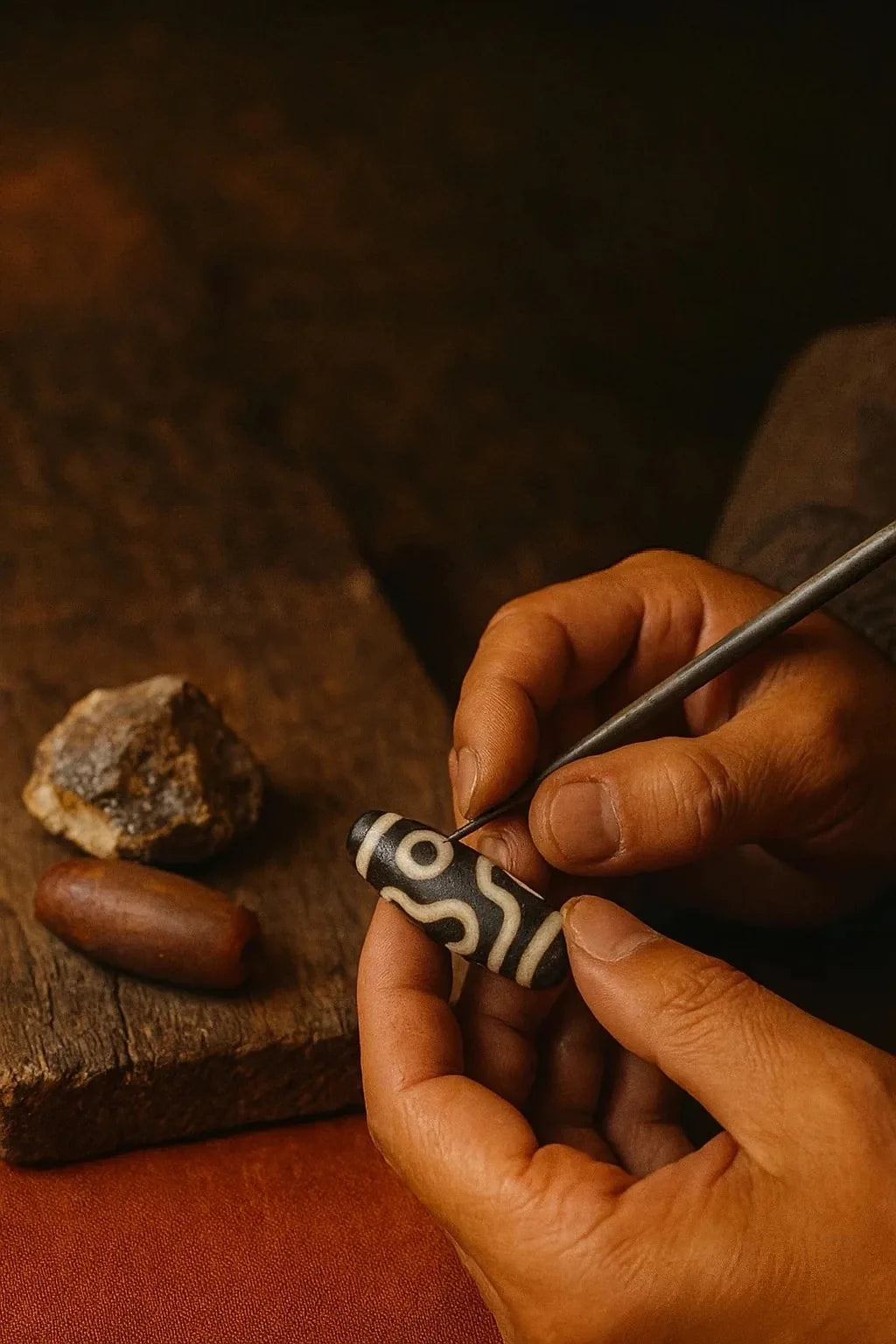










Agate sits at the intersection of mineral science, jewelry design, and symbolic culture. That makes it easy for several different ideas to become blurred together: agate and chalcedony, natural banding and dyed color, eye agate and Dzi eye motifs, mineral properties and modern crystal meanings.
This guide separates those layers. It explains what agate is gemologically, why its bands and patterns vary, what treatments can change its appearance, how agate relates carefully to Dzi beads, and how Kailora uses agate as a contemporary symbol of steadiness, clarity, and reflection.
Quick answer: Agate is a banded variety of chalcedony, a fibrous cryptocrystalline form of silica in the quartz family. Its patterns reflect complex variations in microstructure, porosity, inclusions, and mineral pigments. Agate can occur in natural colors, but chalcedony is also commonly dyed or otherwise treated, so vivid color alone does not prove either natural or treated origin. Dzi is not a mineral name: it is a culturally meaningful bead category. Many Dzi-related beads are made from agate or chalcedony, but not every agate is a Dzi, and a natural eye-like agate pattern should not automatically be described as a Dzi eye motif.
How Kailora classifies gemstone meaning
Kailora separates five kinds of statements so that mineral facts, cultural history, and modern symbolism are not presented as if they were the same thing:
- Gemological fact: mineral identity, structure, physical properties, natural features, treatments, synthetics, imitations, durability, and care.
- Historical record: information supported by museum objects, scholarly publications, archives, or other documentary evidence.
- Traditional belief: meanings that can be tied to a specific cultural or religious context.
- Contemporary interpretation: meanings used in modern crystal, spiritual, and intention-jewelry communities.
- Kailora intention: Kailora’s own contemporary framework for using jewelry as a reminder of a chosen inner quality or practice.
A banded microstructure is a mineral fact. A museum object is historical evidence. A modern claim that agate “grounds energy” is a contemporary belief. None of those categories should be used as proof for the others.
What is agate?
The Gemological Institute of America describes agate as a banded variety of chalcedony. Chalcedony itself is a fibrous cryptocrystalline form of silica composed mainly of very fine intergrowths of alpha-quartz and moganite. Unlike a large transparent quartz crystal, the individual crystallites in chalcedony are microscopic.
Agate is therefore part of the broader quartz family, but its visual identity comes from its fine-grained structure and characteristic banding rather than the large crystal faces associated with rock crystal or amethyst.
- Material family: Silica / quartz family
- Gemological category: Banded chalcedony
- Main composition: SiO₂ phases, principally alpha-quartz with moganite in the chalcedony structure
- Typical appearance: Translucent to opaque material with bands, zones, clouds, eyes, fortification-like patterns, or other layered structures
- Hardness context: Quartz is about 7 on the Mohs scale, giving agate useful scratch resistance for jewelry, though finished jewelry can still chip, crack, or suffer damage at drilled holes and fittings
Agate vs chalcedony vs quartz
These terms overlap but are not interchangeable at every level.
Quartz is the broader mineral family. Transparent rock crystal, smoky quartz, amethyst, and citrine are familiar macrocrystalline forms in which crystals can grow large enough to be recognized as individual crystals.
Chalcedony is a cryptocrystalline, fibrous form of silica made of extremely fine intergrowths. It can appear in many colors and varieties.
Agate is generally defined by banding within chalcedony. This means that an agate is chalcedony, but not every piece of chalcedony is necessarily agate.
This distinction matters in product descriptions. Calling every patterned chalcedony bead “agate” can erase useful material information, while treating “agate” as a completely separate mineral from quartz is also inaccurate.
How do agate bands and patterns form?
Agate commonly forms in cavities in volcanic rocks, although GIA literature also notes occurrences in hydrothermal veins and sedimentary environments. Silica-rich material enters or develops within available spaces, and repeated changes in conditions can produce zones with different microstructures, porosity, crystal sizes, inclusions, and pigmentation.
The familiar visual bands are therefore not simply painted stripes inside the stone. They are connected to real structural and compositional differences within the chalcedony. Iron hydroxides and oxides, manganese compounds, and other mineral phases can contribute natural color.
At the same time, the exact mechanisms that generate agate’s rhythmic banding remain an active research topic. GIA’s recent review describes agate formation as complex and still not completely resolved. For that reason, a responsible explanation should avoid presenting one simplified “silica water deposits one layer at a time” story as if every detail were settled science.
What is eye agate?
In jewelry language, eye agate is a descriptive term for agate whose natural bands or concentric zones create an eye-like visual pattern. The effect can appear as one or more rings, circular zones, or contrasting centers depending on how the material formed and how the bead or slice was cut.
The important point is that “eye” can describe a natural visual pattern. It does not, by itself, establish that the bead is a Dzi bead, that the eye carries a specific Tibetan meaning, or that the pattern was intentionally created.
Kailora therefore distinguishes products described as natural eye agate from products described as agate Dzi or Dzi-inspired. The first phrase describes material appearance; the second introduces a cultural and design category that requires separate context.
Natural color vs dyed or treated agate
Agate and other forms of chalcedony can display naturally occurring color, but they are also materials that can accept treatment. GIA documents dyeing as a long-established treatment for chalcedony and shows that colorless or lightly colored material may be dyed into a wide range of deeper colors. Bleaching and other appearance-altering processes can also be encountered in chalcedony.
This creates two common mistakes. The first is assuming that every intense color must be artificial. Natural chalcedony can contain strong colors caused by mineral pigments and trace elements. The second is assuming that a stone must be natural-color simply because the color looks plausible.
GIA laboratory reports on chalcedony show why the distinction can require microscopy, spectroscopy, chemical analysis, and other professional methods. A single visual clue is not a dependable universal test.
For buyers, the practical rule is simpler: look for clear disclosure. If color treatment is known, it should be described accurately. The U.S. Federal Trade Commission’s Jewelry Guides also emphasize truthful gemstone descriptions and disclosure when treatments are non-permanent, require special care, or significantly affect value.
Can you tell natural agate from dyed agate at home?
Sometimes obvious dye concentrations, unnaturally uniform color, or color collecting in fractures may raise a question, but none of those observations is a universal verdict. Natural material can be unusually vivid, and sophisticated treatment may not be obvious to an untrained eye.
Kailora does not recommend destructive “authenticity tests” such as scratching, heating, soaking in chemicals, or striking beads. Those methods can damage jewelry and still fail to provide a reliable identification.
If natural color or treatment status materially affects a high-value purchase, ask for supplier disclosure or independent gemological testing rather than relying on a social-media home test.
Is Dzi the same thing as agate?
No. Agate is a gem-material category. Dzi is a culturally meaningful bead category and name. Treating the two words as synonyms causes both gemological and cultural confusion.
The British Museum holds ancient banded agate bicone beads from Afghanistan, including examples dated to around the first and second centuries CE. The museum describes some of these beads as being “allied in shape, form and material to Tibetan dZi beads.” That comparison is useful evidence for broader historical relationships among agate bead forms across Asian material cultures.
But the museum does not identify those Afghan beads as Tibetan Dzi beads. They should not be used to claim that Tibetan Dzi history has been directly proven to begin with those particular objects.
Separately, the Rubin Museum of Himalayan Art holds 19th-century Tibetan prayer beads whose listed materials include dzi together with coral, turquoise, jade, clay, and silk. That object documents Dzi within Tibetan prayer-bead material culture. The museum listing, however, does not identify the Dzi component there as a specific mineral species.
Taken together, the evidence supports a careful conclusion: agate has strong relevance to the material study of Dzi-related beads, and Dzi is documented within Tibetan material culture, but “Dzi” should not be reduced to a mineral label meaning “agate.”
Natural eye agate vs a Dzi eye motif
This distinction is especially important for jewelry buyers.
A natural eye agate can develop concentric or eye-like zones through the stone’s natural banding and growth history. The visual “eye” may change dramatically depending on where the rough is cut and polished.
A Dzi eye motif, by contrast, belongs to a recognizable cultural and decorative vocabulary associated with Dzi beads. The number, arrangement, and form of eyes may be given symbolic interpretations in contemporary Dzi markets and communities.
Those two phenomena can visually resemble each other, but resemblance is not identity. A naturally banded eye agate should not automatically be assigned a Dzi eye number or a Tibetan symbolic meaning merely because a circle is visible on its surface.
For the cultural-symbolism side of the topic, read What Does a Dzi Bead Symbolize?. For bracelet-focused buying guidance, see What Are Dzi Bead Bracelets?.
What does agate mean today?
Modern crystal and metaphysical communities commonly associate agate with grounding, balance, stability, protection, confidence, or emotional steadiness. These meanings vary by seller, color variety, and contemporary spiritual system.
They are not measurable mineral properties. Agate’s silica structure does not establish that wearing it will treat anxiety, prevent harm, change luck, stabilize emotions, or produce spiritual results.
That does not make symbolic use meaningless. A patterned stone can become a physical reminder of a behavior or quality that the wearer has deliberately chosen to practice. The value of the ritual lies in the relationship between object, attention, and action—not in a guaranteed effect produced by the mineral.
Kailora’s interpretation: steadiness, clarity, and reflection
Kailora uses agate primarily as a contemporary symbol of steadiness, clarity, and reflection.
Its layered bands offer a natural visual language for returning to one’s center, noticing patterns, and approaching change with composure. Depending on the design, agate can appear within Kailora’s Protection & Grounding, Intuition & Awakening, or other contemporary intention journeys.
These journeys are Kailora’s own design framework. They are not presented as a traditional Tibetan classification of agate stones.
How Kailora uses agate in jewelry
The Natural Colorful Agate Necklace uses agate primarily as the visible gemstone language of the piece, allowing differences in color and pattern to remain part of the design.
The Natural Eye Agate Leather Cord Necklace focuses on an eye-like natural agate pattern. Kailora describes the visual structure carefully without treating every natural eye as a Dzi eye symbol.
The Natural Agate Dzi Cord Necklace sits in a different category: here the agate material is presented together with the Dzi bead context. This is why both the material description and cultural description matter.
You can browse the broader Agate collection and Tibetan Dzi Beads collection to compare how the two categories overlap without being identical.
How to choose agate jewelry
- Start with the material description. Look for clear terms such as natural agate, eye agate, chalcedony, dyed agate, or glass rather than vague “energy stone” language.
- Ask whether color is natural or treated when it matters. Do not assume vivid color proves treatment, and do not assume muted color proves natural origin.
- Look at pattern continuity. Natural banding can be irregular, layered, concentric, or locally interrupted. Pattern alone, however, is not a complete authenticity test.
- Separate Dzi claims from agate claims. “Natural agate” describes material. “Dzi” adds cultural and design context and should not be used as a mineral synonym.
- Be cautious with age and provenance claims. A bead described as “ancient,” “antique,” or from a specific historical period needs evidence beyond visual resemblance.
- Evaluate construction. Drilled holes, elastic, cord, leather, metal fittings, bead edges, and surface finish often determine everyday durability as much as the stone itself.
- Separate jewelry origin from stone origin. A piece handmade in Tibet does not automatically prove that the agate itself was mined in Tibet.
How to wear agate as an intention anchor
If you want agate to carry personal meaning, use it as a cue for a concrete practice rather than expecting the stone to produce a guaranteed outcome:
- Name one intention. For example: “stay steady before responding,” “notice the pattern before making a decision,” or “return to what is clear.”
- Choose one tactile cue. Touch one bead or pendant when you notice yourself becoming reactive or distracted.
- Connect the cue to an action. Take one slower breath, write down the next step, pause before replying, or remove one distraction.
- Review the result. At the end of the day, ask whether the object helped you remember the behavior you intended to practice.
This is Kailora’s approach to wearable ritual: the jewelry serves as the reminder; the wearer supplies the awareness and action.
Can agate be worn every day?
Agate belongs to the quartz family, whose hardness is about 7 on the Mohs scale. That provides useful resistance to everyday scratching, but hardness is not the same as toughness. Beads can still chip at edges or drilled holes, and finished jewelry may include cords, elastic, leather, metal, adhesives, or other materials that are more vulnerable than the stone.
Remove agate jewelry before high-impact exercise, swimming, showering, or work where a strand may snag or strike hard surfaces. Stretch bracelets should be rolled over the hand rather than pulled aggressively, and leather or textile cords should be kept dry when possible.
How to clean and care for agate jewelry
- Wipe beads with a soft dry or slightly damp cloth after wear.
- For simple untreated agate, lukewarm water with a small amount of mild soap is a conservative cleaning choice.
- Avoid prolonged soaking when a piece includes elastic, cotton, leather, adhesives, mixed stones, or plated metal.
- Avoid bleach, harsh household chemicals, perfume residue, and unnecessary heat.
- Be especially conservative with dyed, coated, or otherwise treated material because treatment may change care requirements.
- Store pieces separately so harder jewelry components do not repeatedly rub against polished bead surfaces.
For mixed-material pieces, follow the care requirements of the most vulnerable component. See How to Care for Mala Beads, Dzi Beads, and Natural Stone Jewelry for broader guidance.
Frequently asked questions
Is agate quartz?
Agate belongs to the quartz family. More precisely, it is a banded variety of chalcedony, a fibrous cryptocrystalline silica material composed mainly of very fine quartz and moganite intergrowths.
Is agate the same as chalcedony?
Agate is a type of chalcedony characterized by banding. Chalcedony is the broader material category, so not all chalcedony is necessarily agate.
Are all Dzi beads made of agate?
No universal statement should be made from the word “Dzi” alone. Dzi is a cultural bead category rather than a mineral species. Many modern Dzi-related beads are described as agate or chalcedony, but material should be identified and disclosed separately.
Is every eye agate a Dzi bead?
No. Natural eye agate can display concentric or eye-like banding without being a Dzi bead. A Dzi eye motif belongs to a separate cultural and design context.
Can agate be dyed?
Yes. GIA documents dyeing as a long-used treatment for chalcedony. Natural agate can also have strong colors, so color intensity alone is not a reliable treatment test.
How can I tell natural-color agate from dyed agate?
There is no single home test that works for every stone. Professional identification may use microscopy, spectroscopy, chemical analysis, and other gemological methods. For consequential purchases, rely on disclosure and qualified testing rather than destructive home experiments.
What does agate symbolize?
In modern crystal culture, agate is often associated with grounding, stability, protection, and balance. Kailora uses it more narrowly as a contemporary reminder of steadiness, clarity, and reflection. These are symbolic interpretations, not medically or scientifically guaranteed effects.
Is agate traditional in Tibetan culture?
Agate-related bead material has historical Asian parallels that museums compare with Tibetan Dzi forms, and Dzi itself is documented in Tibetan prayer-bead collections. That evidence should not be simplified into one universal “traditional Tibetan meaning of agate,” because the material, bead category, object context, and later symbolic interpretations are different layers.
Explore Agate at Kailora
Explore the Agate collection for natural agate, eye agate, and Dzi-related designs. For Dzi-focused pieces, visit the Tibetan Dzi Beads collection. You can also compare the Natural Eye Agate Leather Cord Necklace, Natural Agate Dzi Cord Necklace, and Three-Eye Dzi Agate Bracelet.
Editorial note: This guide separates gemological evidence, documented material culture, modern crystal symbolism, and Kailora’s contemporary intention language. Jewelry can support reflection and personal ritual, but it does not guarantee medical, psychological, protective, financial, or spiritual outcomes.