




Tibetan astrology is far more complex than choosing an animal sign from a birth year.
Within Tibetan intellectual traditions, what is often called “astrology” in English developed as part of a broader field of calendrical calculation, astronomy, elemental relationships, cyclical time and symbolic interpretation. For this reason, Tibetan institutions and scholars often use the term Tibetan Astro-Science when describing the traditional field.
Its history reflects centuries of exchange. Indian astronomical and calendrical traditions—especially material associated with the Kalachakra system—became intertwined with animal, element and calculation traditions historically connected with China and Central Asia. Tibetan scholars then developed distinctive lineages, calendars, methods and interpretive systems of their own.

Quick Answer: What Is Tibetan Astrology?
Tibetan astrology, or Tibetan Astro-Science, is a traditional field for calculating and interpreting cycles of time through combinations of astronomy, calendars, animal-element cycles, numerical systems, trigrams, lunar factors and other symbolic variables.
Some branches developed from Indian traditions connected with Kalachakra, while others incorporated element-based calculations historically related to Chinese systems. A traditional Tibetan horoscope can therefore consider far more than a person’s zodiac animal.
Why Is It Called Tibetan “Astro-Science”?
The English word “astrology” can make the subject sound as though it is mainly about personality descriptions or predicting the future. That does not fully describe the historical Tibetan field.
Traditional Tibetan Astro-Science includes mathematical and calendrical work: lunar dates, solar and lunar cycles, planetary calculations, year cycles, almanacs and methods used to evaluate particular moments in time.
The Kalachakra tradition became especially influential in Tibetan astronomical and calendrical calculation. This is one reason Tibetan astrology is better understood as a broad knowledge system rather than simply a question of “What is my sign?”
Where Did Tibetan Astrology Come From?
There is no single moment when Tibetan astrology appeared in its final form. Different bodies of knowledge entered Tibet over long periods and were gradually adapted, combined and systematized.
Animal-year designations and element-related calculations developed in Tibet through historical contact with Chinese and Central Asian traditions. Another major stream came through India, particularly with the transmission of Kalachakra texts into Tibet from the medieval period onward.
Tibetan scholars did not simply copy either neighboring system. They interpreted these traditions through Tibetan language, Buddhist philosophy, local calendrical practice and their own lineages of calculation.
Kar-Tsi and Jung-Tsi: Two Important Streams
A useful starting point is to recognize two broad streams often discussed in Tibetan Astro-Science.
Kar-Tsi
Kar-Tsi, often translated as “white calculations,” broadly refers to Indian-derived astronomical and astrological material. The Kalachakra tradition is one of its most important foundations. It includes subjects associated with astronomical calculation, calendars, planets and lunar cycles.
Jung-Tsi
Jung-Tsi, or element calculations, developed through traditions historically connected with Chinese astrological systems. This is where many modern readers encounter the twelve animals, five elements, Mewa numbers, Parkha trigrams and repeating cycles.
These streams should not be treated as completely isolated worlds. Traditional specialists could bring together information from several calculation systems depending on the question being considered.
Continue with Kar-Tsi and Jung-Tsi: Two Traditions in Tibetan Astro-Science.
Where Do the Twelve Animals Fit In?
The twelve animals are probably the most recognizable part of Tibetan astrology today: Rat, Bull or Ox, Tiger, Hare or Rabbit, Dragon, Snake, Horse, Sheep, Monkey, Bird or Rooster, Dog and Pig.
But the birth-year animal is only one layer. Traditional element calculations combine animal years with elemental relationships and repeating cycles. A Horse year is not treated as identical to every other Horse year: an Iron Horse, Fire Horse, Earth Horse, Water Horse and Wood Horse occupy different positions within the wider cycle.

For the full animal-element framework, read The Tibetan Zodiac: 12 Animals, Five Elements, and the 60-Year Calendar.
What Are Mewa and Parkha?
Two additional systems make clear why Tibetan Elemental Astrology cannot be reduced to a birth-year animal.
Mewa is a nine-number cycle used in traditional calculations, while Parkha is an eight-trigram system. Both can be calculated alongside animal-element relationships and may appear in historical Tibetan astrological diagrams.
- What Is Mewa in Tibetan Astrology? The Nine Numbers Explained
- What Is Parkha in Tibetan Astrology? Understanding the Eight Trigrams
What Are the Five Personal Elemental Forces?
Traditional Jung-Tsi also includes a set of elemental correspondences often translated as life-force, body, power or capacity, fortune and life-spirit. These are sometimes called the five pebble-elements in English-language descriptions.
They show that a person can have several relevant elemental values within one traditional calculation rather than one universal “personal element.”
Read The Five Personal Forces in Tibetan Astrology.
What Does the Tibetan Calendar Have to Do With Astrology?
The calendar is fundamental to Tibetan Astro-Science. Traditional specialists were concerned not only with individual symbolism but also with calculating and organizing time itself.
Lunar dates, months, year cycles, astronomical factors and calendrical lineages all matter. The Tibetan calendar is lunisolar, and Tibetan New Year does not simply begin on January 1 of the Gregorian calendar.
Losar is the prominent Tibetan New Year, but technical astrological cycles can use different starting conventions. This distinction becomes especially important for births near a year boundary.

For the technical calendar question, read Losar and the Tibetan Calendar: When Does the Tibetan Astrological Year Begin?. For the cultural festival itself, see What Is Losar? Tibetan New Year Traditions.
What Does a Traditional Tibetan Natal Horoscope Include?
A complete traditional natal horoscope can include much more than birth-year animal and element. Depending on method and lineage, calculations may consider exact birth timing, lunar weekday, lunar mansion, planetary factors, Mewa, Parkha, elemental relationships and annual progressions.
This is why a traditional horoscope prepared by a trained practitioner should not be equated with a lightweight online zodiac calculator.
See What Does a Traditional Tibetan Natal Horoscope Include?.
How Do You Read a Tibetan Astrological Chart?
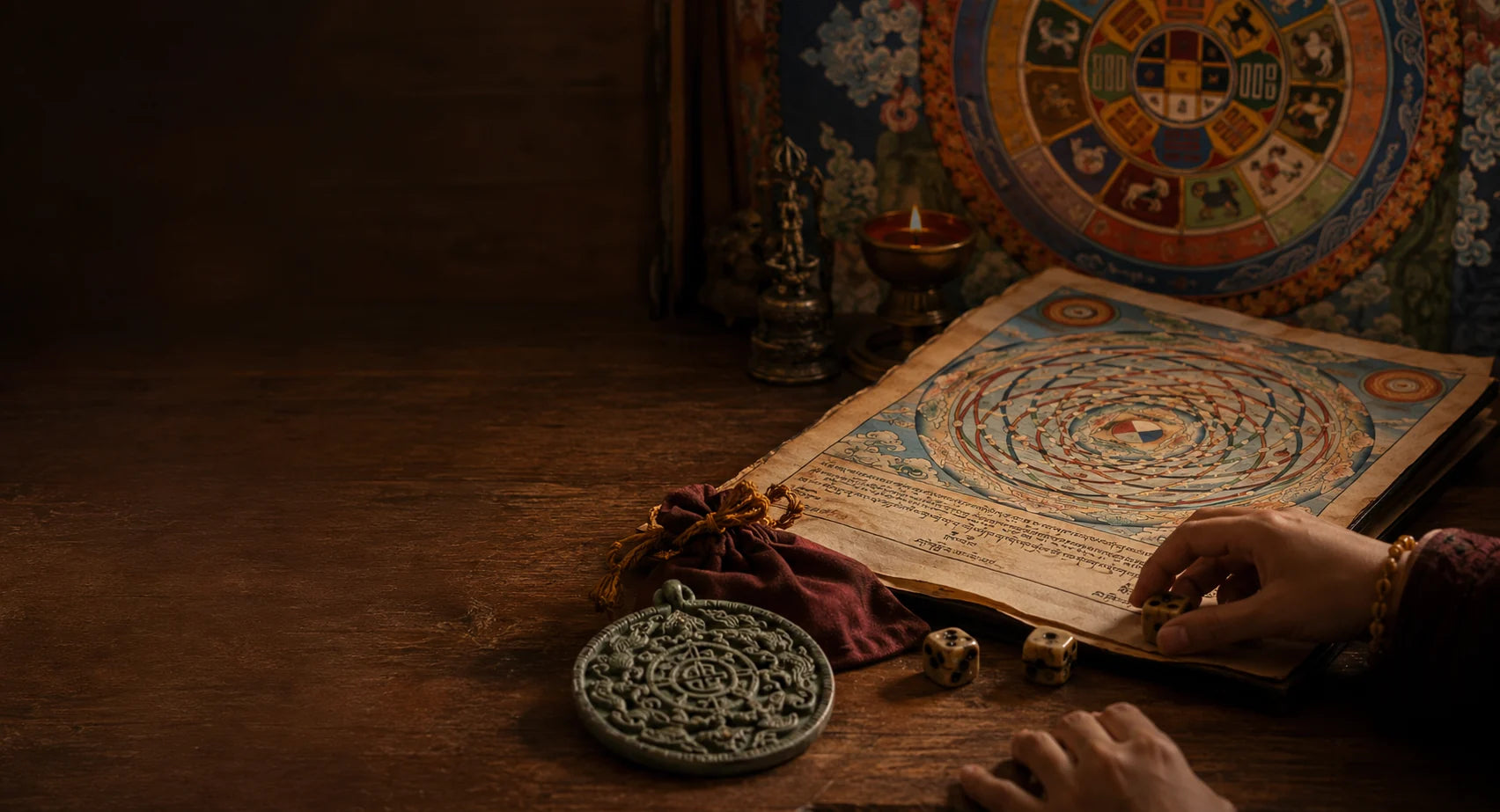
Historical diagrams can combine many systems visually. A useful reading order is to identify the chart type first, then the animal-element coordinate, followed by Mewa, Parkha, elemental relationships and relevant calendar factors.
Our focused guide How to Read Tibetan Astrological Charts: Mewa, Parkha, Elements & Calendar explains those layers without repeating this broader introduction.
What Is a Tibetan Almanac?
A Tibetan almanac is not the same thing as a personal horoscope. It organizes calendrical and astrological information for days and periods, potentially including lunar dates, weekdays, constellations, yoga, karana, animal-element cycles and traditional timing annotations.
See How to Read a Tibetan Almanac: Lunar Days, Constellations and Auspicious Timing.
Is Tibetan Astrology the Same as the Chinese Zodiac?
No. There is clear historical exchange, especially in animal and element cycles, but Tibetan astrology developed within a broader system that also absorbed Indian astronomical, calendrical and Buddhist Kalachakra traditions.
For a direct comparison, read Tibetan Astrology vs Chinese Zodiac: What’s Similar and What’s Different?.
Is Tibetan Astrology the Same as Western Astrology?
No. Popular Western astrology emphasizes zodiac signs, planets, houses, aspects and natal charts. Tibetan systems developed through a different historical framework in which animal-element cycles, lunar and calendrical calculations, Kalachakra astronomy, numerical methods and other traditional factors can all play a role.
For a detailed side-by-side explanation, read Tibetan Astrology vs Western Astrology: Two Different Ways of Reading Time.
Did Tibetan Astrology Predict the Future?
Historically, Tibetan Astro-Science did include prognostic practices. Specialists could prepare natal calculations, yearly analyses, compatibility assessments and timing evaluations.
That historical fact should not be turned into a modern promise that astrology can objectively predict what will happen. Traditional predictive claims are not scientifically established.
For cultural study, a more useful question is: How did Tibetan communities understand patterns of time, relationship, change and auspicious circumstance?
From Traditional Astro-Science to Kailora’s Modern Reflection
A professional traditional horoscope involves forms of knowledge and calculation that are much deeper than a simplified online reading.
Kailora therefore describes its Tibetan Energy Reading as a modern symbolic reflection inspired by selected concepts found in Tibetan astrological traditions. It is not presented as a traditional Tibetan natal horoscope and is not a prediction of the future.
It uses selected birth-year symbolism, elemental relationships and an annual energy framework to create a reflective experience around intention, rhythm and personal awareness.

Discover Your Tibetan Energy Reading →
Explore Tibetan Astrology: A Learning Path
Use this hub as the starting point, then move into the part of Tibetan Astro-Science you want to understand more deeply.
Foundations
- Kar-Tsi and Jung-Tsi: Two Traditions in Tibetan Astro-Science
- The Tibetan Zodiac: 12 Animals, Five Elements, and the 60-Year Calendar
Elemental Calculation Systems
- What Is Mewa in Tibetan Astrology?
- What Is Parkha in Tibetan Astrology?
- The Five Personal Forces in Tibetan Astrology
Charts, Horoscopes and Calendars
- How to Read Tibetan Astrological Charts
- What Does a Traditional Tibetan Natal Horoscope Include?
- Losar and the Tibetan Astrological Year
- How to Read a Tibetan Almanac
Compare Traditions
Frequently Asked Questions
What is Tibetan astrology?
Tibetan astrology, often called Tibetan Astro-Science, is a traditional field combining calendrical calculation, astronomy, animal-element cycles and several systems used to interpret time and individual circumstances.
What is the Tibetan zodiac?
The Tibetan zodiac uses a repeating group of twelve animals combined with elemental cycles. It forms one part of the broader Tibetan astrological tradition rather than the entire system.
What are the five elements in Tibetan astrology?
In Tibetan element calculations, the five commonly discussed elements are Wood, Fire, Earth, Iron and Water. “Iron” is frequently rendered as “Metal” in modern English explanations.
What is Kalachakra astrology?
Kalachakra Astro-Science is an Indian-derived component of Tibetan astrology associated with the Kalachakra tradition and includes astronomical and calendrical calculations.
Can Tibetan astrology predict my future?
Traditional astrology historically included prognostic practices, but cultural explanations and modern reflective experiences should not be interpreted as scientifically verified predictions of future events.
Cultural note: Tibetan astrological traditions vary by historical period, school, institution and lineage. This hub is an educational map rather than a traditional astrological consultation.