






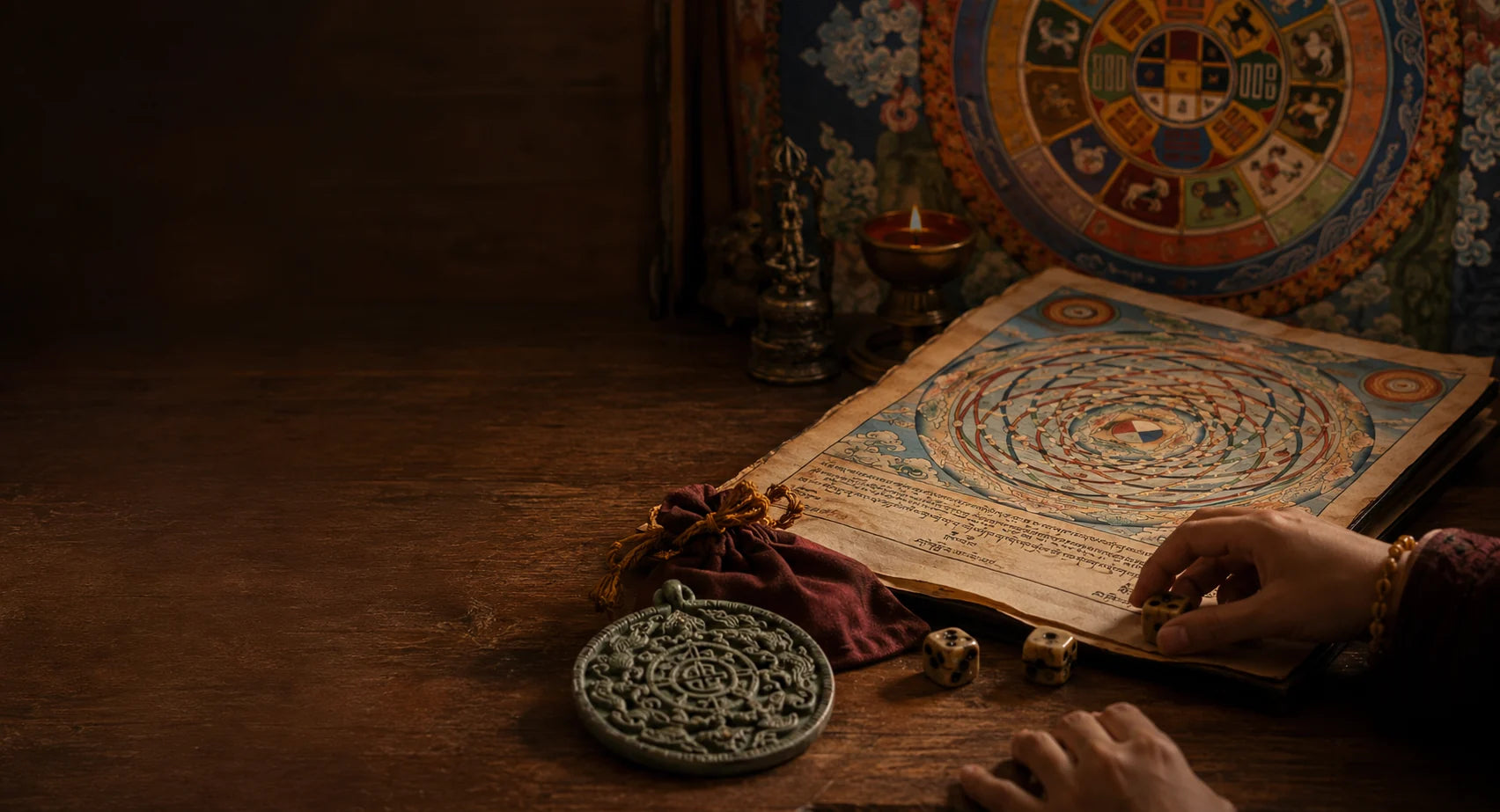

A traditional Tibetan astrological chart can look dense at first: animal signs, elements, numbers, trigrams, directions and calendrical values may appear together in a single diagram. The important point is that these are layers of calculation, not a collection of isolated fortune-telling symbols.
This guide focuses specifically on how to read the structure of Tibetan astrological charts. If you are looking for a broad introduction to the history and major branches of the tradition, begin with What Is Tibetan Astrology? A Beginner’s Guide to Tibetan Astro-Science.
What Is a Tibetan Astrological Chart?
“Tibetan astrological chart” can refer to more than one kind of diagram or calculation. Tibetan Astro-Science developed through several streams, including Indian-derived astronomical methods and Chinese-derived elemental calculations. Different charts therefore emphasize different variables.
A chart may organize a person’s birth information, a year, a date, or a wider calendrical cycle. Some diagrams combine animal signs, five-element relationships, Mewa numbers and Parkha trigrams. Others emphasize astronomical or lunar information.
The safest way to read one is to ask: Which calculation system is this chart using, and what question was it designed to answer?
1. Start With the Animal-Element Cycle
The most familiar layer is the twelve-animal cycle combined with five elements: Wood, Fire, Earth, Iron/Metal and Water. Together these produce a repeating sixty-year sequence.
An animal alone is not the complete coordinate. An Iron Horse and a Fire Horse occupy different positions within the cycle, even though both are Horse years.
For the full calendar structure, read The Tibetan Zodiac: 12 Animals, Five Elements, and the 60-Year Calendar.
2. Identify Mewa: The Nine-Number Layer
Mewa (sme ba) is a nine-number system used in Tibetan Elemental Astrology. Mewa numbers move through defined cycles and are traditionally associated with colors, elements and directional or calendrical relationships.
On a chart, the number is not simply a personality score. Its meaning depends on which Mewa is being calculated—natal, annual or another contextual value—and how it relates to other factors.
See What Is Mewa in Tibetan Astrology? The Nine Numbers Explained.
3. Identify Parkha: The Eight Trigrams
Parkha (spar kha) refers to the eight trigrams used within Tibetan Elemental Astrology. Their historical roots are connected with Chinese-derived cosmological systems, but they were incorporated into distinctive Tibetan methods of calculation.
Parkha can be connected with directions, elements and cyclical relationships. Like Mewa, a trigram should not be lifted from a chart and assigned a generic modern “energy meaning” without the surrounding calculation.
For the system in detail, continue with What Is Parkha in Tibetan Astrology? Understanding the Eight Trigrams.
4. Look for the Five Personal Elemental Forces
Another Jung-Tsi layer is the set often translated as the five pebble-elements: life-force, body, power or capacity, fortune, and life-spirit.
These categories can each receive an elemental value, meaning a traditional chart may contain several elemental relationships beyond a person’s birth-year element.
This is one reason a single statement such as “your element is Fire” cannot summarize a full traditional calculation.
Learn more in The Five Personal Forces in Tibetan Astrology.
5. Read the Calendar Before Reading the Interpretation
Tibetan astrology is inseparable from calendrical science. Lunar dates, weekdays, lunar mansions, animal-element cycles and different calendar lineages can all affect how a date is calculated.
For births close to New Year boundaries, using only the Gregorian year can be especially misleading. Losar is the major Tibetan New Year, but not every technical astrological cycle uses exactly the same boundary.
See Losar and the Tibetan Calendar: When Does the Tibetan Astrological Year Begin?.
6. Distinguish Jung-Tsi From Kar-Tsi
Animal signs, five elements, Mewa and Parkha belong mainly to the Chinese-derived stream commonly called Jung-Tsi or elemental calculation.
Tibetan Astro-Science also contains Kar-Tsi, an Indian-derived stream associated with astronomical and calendrical methods, including material connected with Kalachakra.
A chart based mainly on Jung-Tsi should therefore not be treated as though it automatically contains every planetary or astronomical calculation found in Kar-Tsi.
For this distinction, read Kar-Tsi and Jung-Tsi: Two Traditions in Tibetan Astro-Science.
7. A Natal Horoscope Adds Birth-Specific Layers
A traditional natal horoscope can go beyond the visually familiar animal-element chart. Depending on method and lineage, it may consider exact birth timing, lunar weekday, lunar mansion, planetary factors, Mewa, Parkha and changing yearly conditions.
This is why a traditional horoscope prepared by a trained practitioner is not equivalent to an online birth-year calculator.
See What Does a Traditional Tibetan Natal Horoscope Include?.
8. An Almanac Is Not the Same as a Natal Chart
A Tibetan almanac describes calendrical and astrological conditions for days and periods. It can include lunar dates, weekdays, constellations, animal-element cycles and traditional timing annotations.
A natal chart, by contrast, is calculated around an individual’s birth information. The two can interact, but they answer different questions.
To understand daily calendar layers, read How to Read a Tibetan Almanac.
How Should a Beginner Read a Tibetan Astrological Diagram?
- Identify the chart type. Is it natal, annual, calendrical or protective/iconographic?
- Find the animal-element coordinate. Do not stop at the animal alone.
- Locate Mewa and Parkha if they are present.
- Check which elemental relationships are being compared.
- Confirm the calendar system and date boundary.
- Separate historical symbolism from modern interpretation.
This order prevents the most common mistake: selecting one visually striking symbol and treating it as the entire meaning of the chart.
Are Protective Astrological Charts the Same as Horoscopes?
No. Some Tibetan and Himalayan diagrams combine astrological, calendrical and religious symbols into protective or auspicious compositions. Within traditional belief, such images may have ritual or protective significance.
That is different from a natal horoscope calculated for a person. A diagram can contain familiar Mewa, Parkha or zodiac imagery without functioning as a personal birth chart.
Does a Tibetan Astrological Chart Predict the Future?
Traditional Tibetan astrology historically included prognostic practices and assessments of favorable or unfavorable periods. Those practices belong to a traditional interpretive worldview.
They are not scientifically validated methods for guaranteeing future outcomes, diagnosing illness, or replacing medical, financial or legal advice.
Traditional Charts and Kailora’s Tibetan Energy Reading
Kailora’s Tibetan Energy Reading is not presented as a complete traditional Tibetan astrological chart. It is a modern symbolic reflection inspired by selected traditional references, centered on birth-year animal, elemental relationship and the current annual cycle.
The distinction matters: a traditional chart can involve many more layers than a lightweight online reflective experience.
Discover Your Tibetan Energy Reading →
Frequently Asked Questions
What symbols appear in Tibetan astrological charts?
Depending on the chart, you may see zodiac animals, five elements, Mewa numbers, Parkha trigrams, directions, lunar or calendrical values and religious or protective imagery.
Is Mewa the same as a zodiac animal?
No. Mewa is a separate nine-number cycle that can be calculated alongside animal-element information.
Is Parkha the same as Mewa?
No. Parkha is an eight-trigram system. Traditional calculations can use both Mewa and Parkha.
Do all Tibetan charts use the same method?
No. Tibetan Astro-Science includes multiple calculation streams and calendrical lineages, so the structure depends on the chart’s purpose and tradition.
Can I read a full Tibetan natal horoscope from my birth year alone?
No. A birth year gives only part of the information used in more complete traditional horoscope calculations.
Cultural note: Tibetan astrological terminology, chart design and calculation methods vary across historical periods, institutions and lineages. This guide explains broad structure for educational purposes rather than offering traditional astrological diagnosis or prediction.