






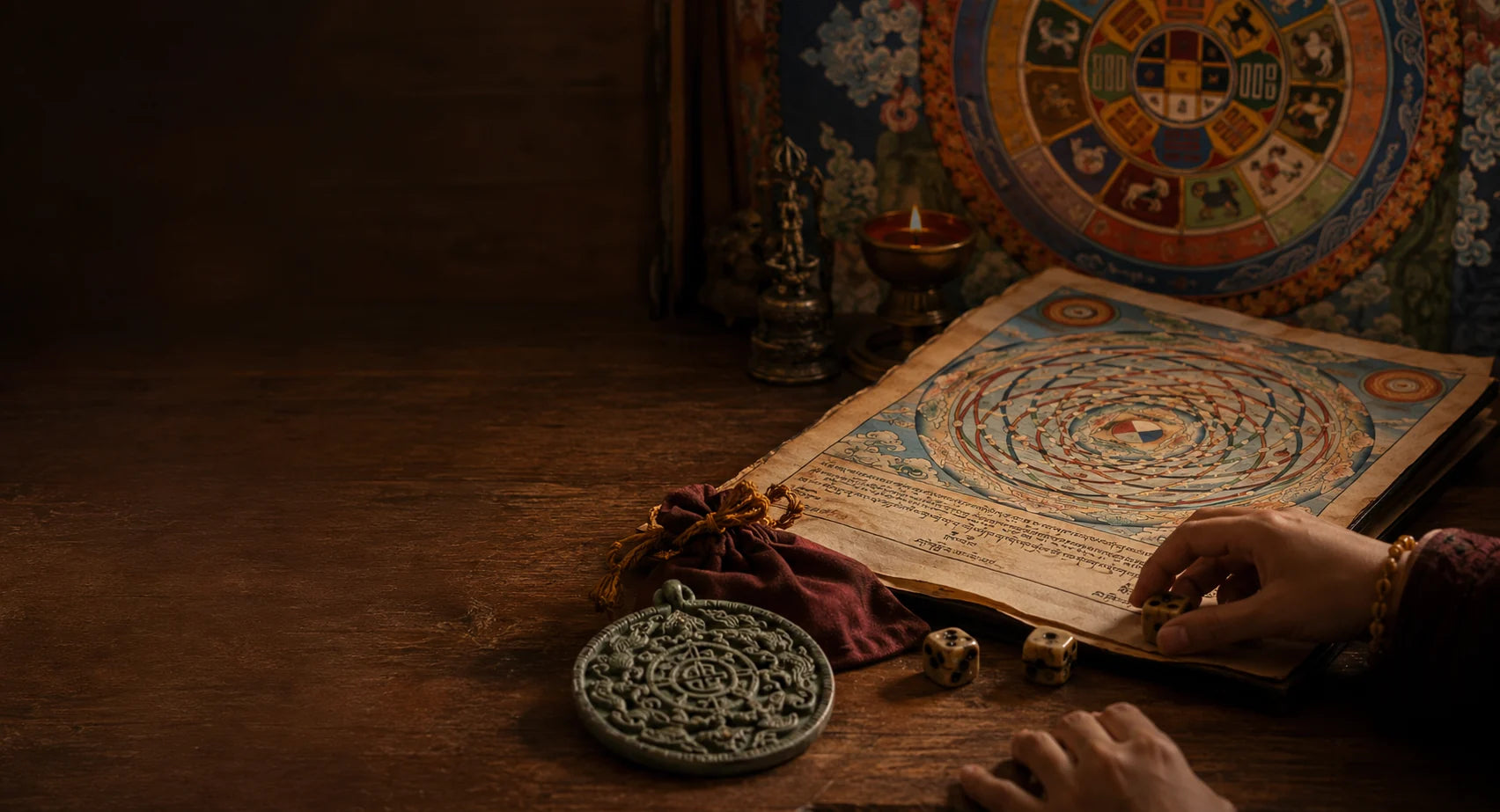

If you have already encountered the twelve animals of the Tibetan zodiac, you have seen only one visible layer of a much larger tradition.
Two terms help explain why Tibetan astrology is more complex than a birth-year sign: Kar-Tsi and Jung-Tsi. In more formal transliteration, these are often written dKar-rTsis and Byung-rTsis. They point to different historical streams of knowledge that became part of Tibetan Astro-Science.
Kar-Tsi is associated primarily with Indian-derived astronomical and calendrical traditions, especially the Kalachakra system. Jung-Tsi refers to elemental calculations historically connected with Chinese astro-science, including the five elements, twelve animals, trigrams, and numerical cycles.
They are not two competing horoscopes from which a person simply chooses one. Tibetan scholars and practitioners historically brought multiple systems together, adapting them within a distinct Tibetan framework.
If you are new to the wider subject, begin with our overview: What Is Tibetan Astrology? A Beginner’s Guide to Tibetan Astro-Science.
Quick Answer: What Are Kar-Tsi and Jung-Tsi?
Kar-Tsi (dKar-rTsis) is the Indian-derived stream of Tibetan Astro-Science. Its best-known foundation is Kalachakra Astro-Science, which contributed sophisticated methods for calendrical calculation, planetary motion, lunar cycles, eclipses, constellations, and the organization of time.
Jung-Tsi (Byung-rTsis) means, broadly, elemental calculation or Elemental Astrology. It developed in Tibet through traditions historically connected with Chinese astro-science. Its most recognizable features include the five elements, twelve animal signs, Eight Trigrams, Nine Numeric Squares, and cyclical relationships used in calendrical and interpretive work.
A useful way to think about the distinction is this: Kar-Tsi looks strongly toward astronomical and calendrical calculation shaped by Indian and Kalachakra traditions, while Jung-Tsi organizes many relationships through elements, animals, numbers, and directional patterns. In Tibetan practice, however, the boundaries are not absolute.
Why Do the Spellings Look So Different?
English-language writing about Tibetan astrology uses several systems of transliteration. This is why the same term may appear in a simplified form on one website and a scholarly form in another.
- Kar-Tsi may appear as dKar-rTsis.
- Jung-Tsi may appear as Byung-rTsis.
- rGya-rTsis is a broader term associated with Chinese-derived astro-science in Tibetan classifications.
The simplified spellings Kar-Tsi and Jung-Tsi are easier for English readers, while dKar-rTsis and Byung-rTsis more closely reflect formal Tibetan transliteration. In this guide we use both so readers can recognize the terms when they encounter them elsewhere.
Kar-Tsi (dKar-rTsis): The Indian Stream of Tibetan Astro-Science
Kar-Tsi is commonly described as the Indian branch of Tibetan Astro-Science. The term dKar-rTsis is traditionally associated with the Tibetan designation for India and the body of calculations transmitted from Indian intellectual traditions into Tibet.
The most influential foundation within this stream is the Kalachakra, or “Wheel of Time,” tradition. Kalachakra is much broader than astrology alone, but its astronomical and calendrical sections became deeply important for Tibetan systems of calculating time.
Kar-Tsi can involve the study and calculation of:
- lunar days and months;
- weekdays and calendrical relationships;
- constellations and celestial positions;
- planetary movements;
- solar and lunar eclipses;
- calendar construction and cyclical time;
- other astronomical variables used in traditional calculations.
This makes an important point about Tibetan astrology: part of the historical discipline was mathematical and calendrical. It was not limited to assigning personality traits to animal signs.

What Does Kalachakra Add to Tibetan Astrology?
Kalachakra literally centers on the idea of time and cycles. Within Tibetan intellectual history, its astronomical calculations helped shape ways of determining calendars, tracking celestial motion, and organizing recurring temporal relationships.
For beginners, the key point is not to memorize every technical calculation. It is to understand that the Kalachakra contribution makes Tibetan Astro-Science much more than a twelve-sign zodiac.
A traditional specialist working within this stream could be concerned with the structure of a month, the relationship between lunar and solar reckoning, celestial positions, or the timing of particular calendrical events. These calculations formed part of a larger knowledge system rather than a modern entertainment horoscope.
Because the Kalachakra tradition is religious and philosophical as well as astronomical, reducing it to “Tibetan fortune-telling” misses most of its historical meaning.
Jung-Tsi (Byung-rTsis): Elemental Astrology
Jung-Tsi, more formally Byung-rTsis, is commonly translated as Elemental Astrology or elemental calculation. It belongs to a body of Tibetan astrological knowledge historically connected with Chinese-derived rGya-rTsis traditions.
This is the stream that feels most familiar to people who already know the animal zodiac. But the twelve animals are only one component.
Jung-Tsi traditionally works with interconnected systems that can include:
- the five elements: Wood, Fire, Earth, Iron, and Water;
- the twelve animal signs;
- the Eight Trigrams;
- the Nine Numeric Squares;
- planetary and constellation-related correspondences;
- directional, temporal, and relational calculations.
In this framework, symbols gain meaning through relationship. An animal is considered together with an element; a year relates to other years; numbers and directions can interact with additional variables. The result is a web of correspondences rather than a single sign with a fixed personality description.

Is Jung-Tsi the Same as the Chinese Zodiac?
No. The connection is real, but the two should not be treated as interchangeable.
Tibetan Elemental Astrology developed through historical exchange with Chinese astrological traditions, which helps explain the shared language of twelve animals and five elements. But Tibetan scholars incorporated these ideas into their own calendrical, cultural, and intellectual system.
Modern Chinese-zodiac content often focuses on a birth-year animal and a short personality profile. Traditional Byung-rTsis can involve animals, elements, trigrams, numbers, directions, yearly relationships, and other factors. It also exists alongside Indian-derived Kar-Tsi within Tibetan Astro-Science.
For the animal-and-element cycle itself, see The Tibetan Zodiac: 12 Animals, Five Elements, and the 60-Year Calendar.
Kar-Tsi vs. Jung-Tsi at a Glance
| Aspect | Kar-Tsi | Jung-Tsi |
|---|---|---|
| Formal transliteration | dKar-rTsis | Byung-rTsis |
| Historical stream | Indian-derived | Chinese-connected elemental tradition |
| Best-known framework | Kalachakra Astro-Science | Elemental Astrology |
| Common features | calendar, lunar and planetary calculations, celestial cycles | five elements, twelve animals, trigrams, numeric squares |
| Role in Tibetan Astro-Science | one major stream within a larger synthesis | one major stream within a larger synthesis |
This table is deliberately simplified. Historical lineages and practical calculations can overlap, and Tibetan Astro-Science should not be reduced to a rigid two-column system.
How Did the Two Streams Work Together?
One of the most important ideas in studying Tibetan Astro-Science is synthesis.
Tibetan traditions developed through interaction among indigenous Tibetan knowledge and systems historically connected with China, Central Asia, and India. Over centuries, scholars translated, debated, adapted, and reorganized these materials.
That means Kar-Tsi and Jung-Tsi are useful categories, but they should not be imagined as sealed boxes. A trained practitioner could draw on different calculations depending on the question, lineage, calendar, or type of analysis being performed.
The Tibetan form of the tradition is therefore not simply “Indian astrology plus Chinese astrology.” It is the result of a long Tibetan process of selection, interpretation, and integration.

Which Stream Uses the Five Elements?
The five-element framework is most visibly associated with Jung-Tsi or Byung-rTsis.
The elements are commonly rendered in English as Wood, Fire, Earth, Iron, and Water. “Iron” is often translated as “Metal,” especially in modern English-language material.
These elements combine with the animal cycle, helping create animal-element year designations such as Wood Horse, Fire Horse, Earth Horse, Iron Horse, and Water Horse. Because the sequences repeat at different intervals, their combinations form a sixty-year cycle.
This is why two people born in different Horse years are not automatically assigned the same traditional year designation. Their element can differ, and a fuller calculation may consider many additional factors.
Which Stream Is Connected With the Twelve Animals?
The twelve animals are strongly associated with the Jung-Tsi / Byung-rTsis side of Tibetan Astro-Science, where they participate in elemental and cyclical calculations.
But seeing the animals inside Jung-Tsi also clarifies why the Tibetan zodiac should not be isolated from the rest of the tradition. Animal signs function inside a network of time, element, number, and relationship.
The animals are therefore best understood as coordinates within a cycle, not twelve independent personality archetypes.
What Do Kar-Tsi and Jung-Tsi Mean for a Birth Reading?
For a modern reader, the animal-and-element combination is often the easiest entry point because it can be connected to a birth year. Historically, however, a full Tibetan astrological calculation could go much further.
A specialist might consider calendrical boundaries, elemental relationships, additional natal factors, yearly conditions, and calculations drawn from more than one stream. This is why a traditional Tibetan horoscope should not be equated with a simple birth-year calculator.
Kailora’s Tibetan Energy Reading intentionally takes a different approach. It is a modern symbolic reflection inspired by selected birth-year, animal, element, and annual-cycle concepts. It is not presented as a traditional Tibetan natal horoscope and does not claim to predict the future.
Explore Your Tibetan Energy Reading →
Why This Distinction Matters
Understanding Kar-Tsi and Jung-Tsi changes the way we read Tibetan astrology.
Instead of seeing a collection of animal signs, we begin to see a historical knowledge system built from multiple approaches to time. One stream emphasizes astronomical and calendrical calculation shaped by Indian and Kalachakra traditions. Another organizes relationships through elements, animals, numbers, directions, and cycles with historical connections to Chinese astro-science.
Tibetan scholars brought these approaches into conversation with one another. The result is richer—and much less reducible to a horoscope meme—than the simplified zodiac content most people encounter online.
Frequently Asked Questions
What is Kar-Tsi in Tibetan astrology?
Kar-Tsi, or dKar-rTsis, refers broadly to the Indian-derived stream of Tibetan Astro-Science. Kalachakra astronomy and calendrical calculation are among its most influential foundations.
What is Jung-Tsi in Tibetan astrology?
Jung-Tsi, more formally Byung-rTsis, is Elemental Astrology. It is historically connected with Chinese-derived astro-science and includes systems involving five elements, twelve animals, trigrams, numbers, and cyclical relationships.
Is Kar-Tsi the same as Vedic astrology?
No. Kar-Tsi has Indian historical roots, but it developed within Tibetan scholarly and religious traditions and should not be treated as simply another name for modern Vedic astrology.
Is Jung-Tsi the same as the Chinese zodiac?
No. Jung-Tsi shares historical roots and symbolic language with Chinese traditions, including animals and elements, but Tibetan Elemental Astrology developed within its own broader Tibetan system.
Which tradition uses the five elements?
The five-element framework—Wood, Fire, Earth, Iron, and Water—is most visibly associated with Jung-Tsi or Byung-rTsis.
Which tradition is linked with Kalachakra?
Kar-Tsi or dKar-rTsis is the stream most closely associated with Kalachakra Astro-Science and its astronomical and calendrical calculations.
Did Tibetan astrologers use Kar-Tsi and Jung-Tsi together?
Tibetan Astro-Science developed as a synthesis of several traditions, and practitioners could use different types of calculation depending on lineage and purpose. The two categories are therefore useful for study but should not be understood as completely isolated systems.
Continue Exploring Tibetan Astro-Science
- What Is Tibetan Astrology? A Beginner’s Guide to Tibetan Astro-Science
- The Tibetan Zodiac: 12 Animals, Five Elements, and the 60-Year Calendar
- What Is Losar? Tibetan New Year Traditions
- Discover Your Tibetan Energy Reading
Cultural note: Terminology, transliteration, and methods vary across historical periods, institutions, and lineages. This article uses the readable forms Kar-Tsi and Jung-Tsi while also noting dKar-rTsis and Byung-rTsis. It is a cultural introduction and does not replace study with a trained Tibetan Astro-Science practitioner.