






The Tibetan zodiac is often introduced through the same twelve animals familiar across much of East Asia: Rat, Ox, Tiger, Rabbit, Dragon, Snake, Horse, Sheep, Monkey, Bird, Dog, and Pig. But the animals are only one part of a much larger calendrical and astrological system. In Tibetan traditions, they interact with five elements and repeating cycles of time, creating a framework used historically for calendars, almanacs, life calculations, and the interpretation of auspicious and inauspicious periods.
Understanding the Tibetan zodiac therefore requires more than asking, “What animal am I?” It means looking at the way animal signs, elements, years, months, days, and other systems of calculation were woven together within Tibetan intellectual and everyday life.
For the broader system behind the zodiac, begin with What Is Tibetan Astrology? A Beginner’s Guide to Tibetan Astro-Science.
What Are the 12 Animals of the Tibetan Zodiac?
The twelve-animal cycle follows a repeating sequence: Rat, Ox, Tiger, Rabbit, Dragon, Snake, Horse, Sheep, Monkey, Bird, Dog, and Pig. English translations vary slightly. The Tibetan sign commonly rendered as “Bird” is often called “Rooster” in popular East Asian zodiac guides, while “Sheep” may also appear as “Goat.” These translation choices do not change the cyclical structure.
Each year is associated with one animal, and after twelve years the sequence begins again. This makes the animal cycle useful for identifying recurring birth-year relationships, but Tibetan calendrical systems do not stop at a twelve-year rotation.
The Five Elements: Wood, Fire, Earth, Iron, and Water
The animal signs are combined with five elements: Wood, Fire, Earth, Iron, and Water. “Iron” is sometimes translated as “Metal” in English-language explanations. Each element extends across two consecutive years, traditionally distinguished through additional gendered or polarity classifications in calendrical calculation.
When the twelve animals and five elements are combined in sequence, they produce a sixty-year cycle. A Wood Horse year, for example, is not simply another Horse year: its place in the larger cycle differs from that of a Fire Horse, Earth Horse, Iron Horse, or Water Horse year.
Why Does the Cycle Last 60 Years?
The mathematics are straightforward but culturally important. The twelve-animal sequence and elemental sequence repeat together in a pattern that returns to its starting combination after sixty years. This sixty-year cycle became a fundamental way of naming and organizing years in Tibetan calendrical traditions.
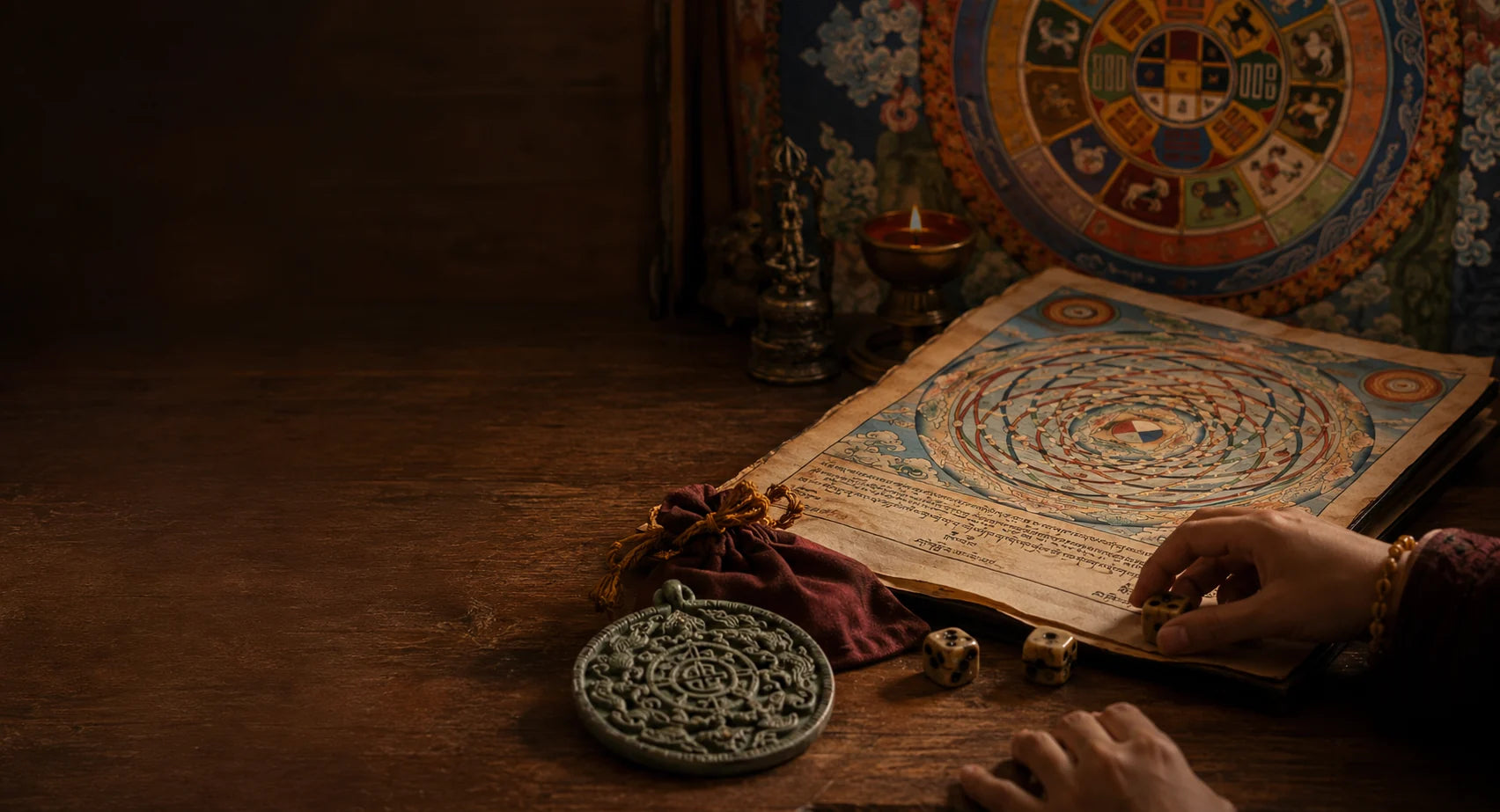
Historical Tibetan astrological diagrams visually demonstrate how several systems can coexist. Twelve zodiac animals may be arranged together with numerical and cosmological schemes, showing that the animal signs function within a broader tradition of calculation rather than as isolated personality symbols.
Is the Tibetan Zodiac the Same as the Chinese Zodiac?
They are closely related, but treating them as identical erases important context. Tibetan calendrical and astrological knowledge developed through centuries of exchange with neighboring intellectual traditions, including Chinese and Indian systems, while also taking distinctive Tibetan forms. The shared twelve animals are the most immediately recognizable connection.
Modern “Chinese zodiac” guides usually focus on birth-year animals and personality descriptions. Tibetan astrology can involve far more: elemental relationships, calendrical calculations, natal factors, Mewa, Parkha, astronomical methods, ritual calendars and systems used by trained specialists.
For a direct side-by-side explanation, read Tibetan Astrology vs Chinese Zodiac: What’s Similar and What’s Different?.
The Zodiac and the Tibetan Calendar
The Tibetan calendar is lunisolar: months follow lunar phases while additional calculations keep the calendar aligned with the solar year. The dating of festivals, ritual observances and yearly transitions depends on calendrical computation rather than on the Western Gregorian calendar alone.
This is especially visible at Losar, the Tibetan New Year. But a technical astrological calculation should not automatically assume that every cycle resets at exactly the same moment as the social New Year.
For the year-boundary question, see Losar and the Tibetan Calendar: When Does the Tibetan Astrological Year Begin?.
What Did Zodiac Animals Mean in Everyday Life?
Animal signs could help people identify years, remember age relationships and discuss calendrical compatibility. In specialist astrology, the year animal was considered alongside additional factors rather than used as a complete description of a person.
This distinction matters because modern lifestyle content often turns zodiac signs into fixed personality types: “Tigers are always brave,” “Rabbits are always gentle,” or “Dragons are destined for success.” Such statements are contemporary simplifications. Historical Tibetan astrology is more structured and contextual than a single character profile attached to an animal.

From Traditional Calendar to Contemporary Zodiac Jewelry
Today, zodiac animals also appear in jewelry, gifts, illustration, fashion and personal identity. These contemporary uses can create a meaningful connection with a birth year without claiming to reproduce the work of a Tibetan astrologer or a traditional ritual object.
Kailora approaches zodiac jewelry in this contemporary sense: the animal sign can act as a personal marker of birth year, memory, identity or intention. Our Chinese Zodiac Crystal Bracelets are modern jewelry designs rather than astrological instruments, and the symbolic language used around them should be understood as contemporary interpretation.
Go Beyond the Birth-Year Animal
A fuller Tibetan Elemental Astrology calculation can add several layers beyond an animal-element year. Mewa introduces a nine-number cycle, Parkha adds eight trigrams, and traditional pebble-element calculations compare categories such as life-force, body, power, fortune and life-spirit.
- What Is Mewa in Tibetan Astrology?
- What Is Parkha in Tibetan Astrology?
- The Five Personal Forces in Tibetan Astrology
How to Read Your Zodiac More Carefully
If you want to explore beyond your animal sign, begin with three questions: What animal was associated with your birth year? What element belonged to that year? Where does that combination sit within the sixty-year cycle? From there, traditional Tibetan astrology becomes substantially more complex and is best studied through historical calendrical sources or qualified practitioners.
The most useful takeaway is simple: the Tibetan zodiac is not a collection of twelve standalone mascots. It is one visible layer of a sophisticated tradition for organizing time, relating cycles and interpreting the calendar.
Cultural note: Tibetan calendrical and astrological traditions vary by historical period, school, region and specialist lineage. This article provides a cultural introduction and does not present zodiac jewelry or modern personality descriptions as substitutes for traditional astrological practice.