





A Tibetan birth-year animal and element are only the beginning of Elemental Astrology. Behind a label such as “Iron Horse” or “Water Tiger” is another traditional layer: a set of five elemental correspondences used in what English-language sources call pebble-element calculations.
These five categories are commonly translated as life-force, body, power or capacity, fortune, and life-spirit. Traditional astrologers compare their elemental relationships across natal and annual cycles rather than treating a single birth-year animal as a complete reading.
This is one of the clearest examples of why Tibetan astrology is more complex than an online zodiac personality list.
For the broader framework first, see What Is Tibetan Astrology? A Beginner’s Guide to Tibetan Astro-Science.
What Are Pebble-Elements in Tibetan Astrology?
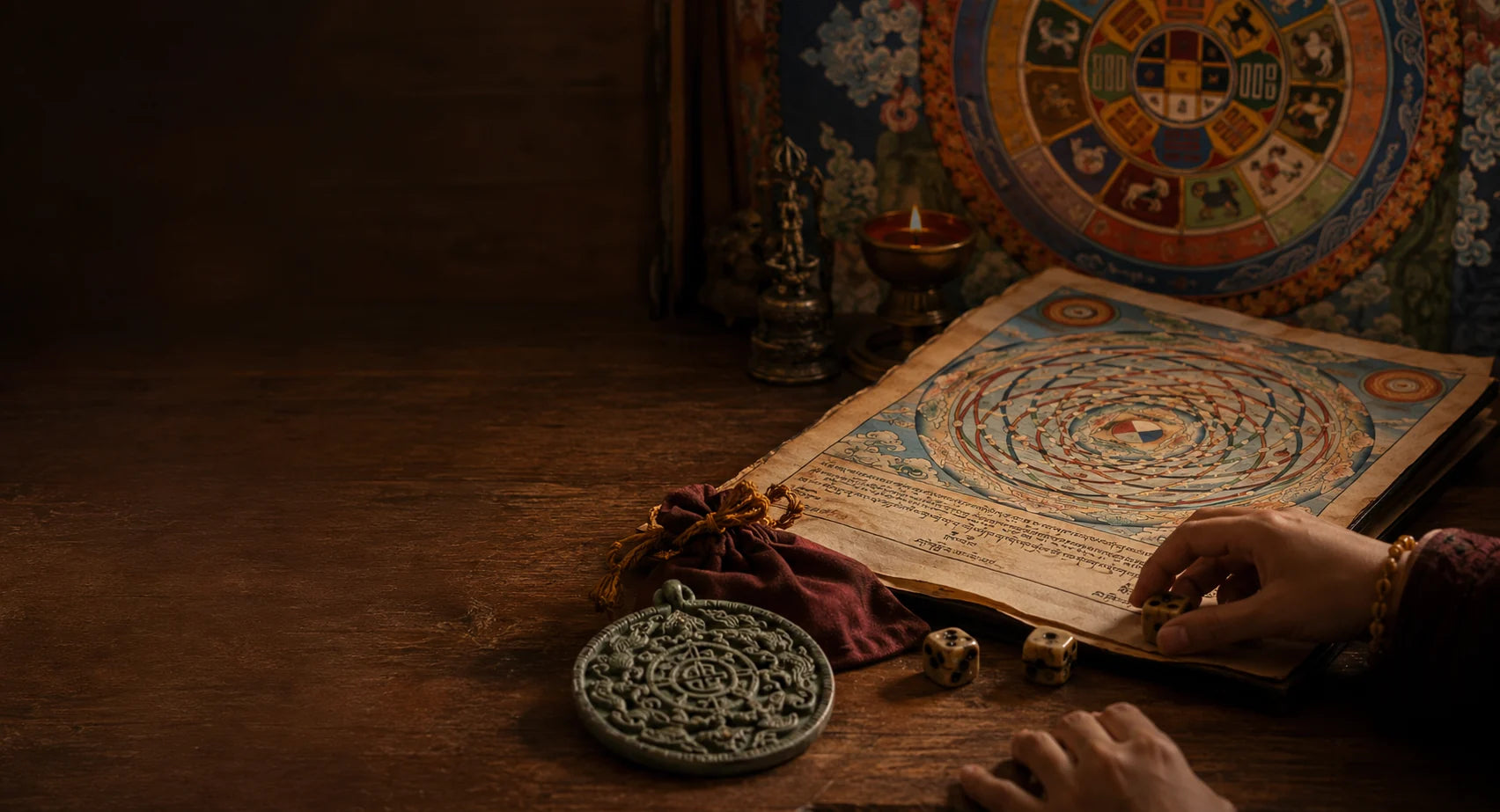
In Tibetan Elemental Astrology, or Jung-Tsi, each animal-element combination in the sixty-year cycle is associated with a set of elemental values. These are used in traditional calculations called rdel, often translated as pebble calculations or pebble-elements.
The term reflects the older computational practice of arranging or counting with physical markers. It does not mean the categories are literal stones or minerals.
The five categories commonly listed are:
- Life-force — srog
- Body — lus
- Power or capacity — dbang
- Fortune / valley-of-fortune — klung
- Life-spirit — bla
The first four have historical parallels in Chinese-derived astrology. Traditional Tibetan sources describe bla, life-spirit, as a more specifically Tibetan or Bön-related category.
The Five Categories at a Glance
| Traditional category | Tibetan term | Broad traditional association |
|---|---|---|
| Life-force | srog | Vital continuity and the life-force category within elemental calculations. |
| Body | lus | The bodily or embodied dimension in the traditional symbolic model. |
| Power / capacity | dbang | Agency, capability, influence or the capacity to carry things through. |
| Fortune | klung | Traditional ideas of fortune, momentum and favorable circumstances; often discussed in relation to wind-horse. |
| Life-spirit | bla | A Tibetan concept associated with the organizing or stabilizing principle of life in traditional thought. |
These descriptions are cultural explanations of a traditional symbolic system. They should not be read as medical measurements, diagnostic categories or scientifically validated predictors.
1. Life-Force: Srog
Srog is commonly translated as life-force. In traditional astrological language, it is one of the elemental correspondences examined when considering the relationship between a person’s natal pattern and a particular year or period.
The word can sound more literal in English than it should. A traditional “life-force element” is not a medical vital sign and should not be used to estimate lifespan or diagnose health.
For modern readers, the most responsible way to understand it is as a category inside an inherited symbolic and calendrical framework.
2. Body: Lus
Lus means body. Within pebble-element calculation, the body category receives an elemental correspondence that can be compared with other elements in the chart or year.
Traditional astrological texts may attach physical implications to such relationships, but those claims belong to the historical system rather than evidence-based medicine.
In an educational context, lus shows how Tibetan Astro-Science organized human experience into several linked dimensions rather than reducing a person to one zodiac animal.
3. Power or Capacity: Dbang
Dbang is translated in different sources as power, capacity, authority or capability. In related Chinese-derived systems, a comparable category is sometimes discussed in terms of wealth.
The Tibetan translation is broader than money. It can be understood as the traditional category concerned with one’s ability to act, influence circumstances or bring an undertaking to completion.
Again, this is not a numerical score of “how powerful” a person is. It is an elemental relationship used inside a larger interpretive calculation.
4. Fortune, Klung and the Wind Horse
The fourth category, klung, is often translated as valley-of-fortune or simply fortune. In Tibetan astrological discussion it is closely connected with rlung-rta or lungta—the Wind Horse.
Wind Horse is a much broader cultural symbol than a single horoscope category. Across Tibetan traditions it is associated with uplifted fortune, vitality, momentum and the image of aspirations being carried by the wind.
If you want that symbol’s cultural history rather than another astrological definition, read What Is the Tibetan Wind Horse? Lungta, Prayer Flags & Auspicious Energy.
Within astrology, however, the fortune element is one calculated factor among several. It should not be turned into a promise that a particular object, ritual or reading can guarantee luck.
5. Life-Spirit: Bla
Bla is usually translated as life-spirit or life-principle. This category is especially important for understanding what became distinctly Tibetan about a system with Chinese-derived roots.
Historical explanations note that the first four pebble categories have parallels in classical Chinese astrology, while the life-spirit category is more characteristic of Tibetan and Bön traditions.
That makes bla a useful example of cultural adaptation: Tibetan scholars did not merely import an external calculation system unchanged. They integrated it with local concepts and practices.
How Do the Five Forces Relate to the Five Elements?
Each category is assigned an element—Wood, Fire, Earth, Iron/Metal or Water—according to traditional tables tied to the animal-element cycle.
The result is not simply five copies of your birth element. A person’s life-force element, body element, power element, fortune element and life-spirit element can differ from one another.
Traditional astrologers then examine how these elements relate to the elements associated with another year, person or situation.
Mother, Child, Friend, Enemy and Same-Element Relationships
Jung-Tsi interprets elemental relationships through a network often described with terms such as mother, child, friend, enemy and same. These relationships express whether one element traditionally supports, generates, controls or matches another.
They are part of the computational grammar behind annual and compatibility readings.
This is another reason “What is my element?” is only a first question. Tibetan Elemental Astrology is concerned not only with which element is present, but also with how elements relate.
Are the Five Pebble-Elements the Same as Mewa?
No. Mewa is the nine-number cycle used in Tibetan Elemental Astrology. Pebble-elements are a separate set of five elemental correspondences associated with life-force, body, power, fortune and life-spirit.
A traditional calculation can use both.
For the nine-number system, see What Is Mewa in Tibetan Astrology? The Nine Numbers Explained.
Are They the Same as Parkha?
No. Parkha refers to the eight trigrams used in Tibetan Elemental Astrology. Like Mewa, Parkha is historically connected to Chinese-derived cosmological material but developed within Tibetan calculation traditions.
Read What Is Parkha in Tibetan Astrology? Understanding the Eight Trigrams.
How Are the Five Forces Used in a Traditional Horoscope?
A traditional practitioner may calculate natal pebble-elements and compare them with changing yearly elements. The same family of calculations can appear in discussions of annual cycles, compatibility and other traditional readings.
The meaning comes from the relationship among several factors rather than from one isolated category.
A complete natal horoscope can also incorporate planetary and calendrical factors beyond Jung-Tsi. See What Does a Traditional Tibetan Natal Horoscope Include?.
Why This Layer Matters
Online zodiac content often compresses an entire tradition into one animal and one personality paragraph. The pebble-elements show why that approach misses much of Tibetan Astro-Science.
A birth-year animal is a coordinate. The five elemental categories add relationships. Mewa and Parkha add other cycles. Kar-Tsi adds astronomical layers. Traditional interpretation emerges from how those systems are combined.
The Five Forces and Kailora’s Tibetan Energy Reading
Kailora’s Tibetan Energy Reading does not claim to calculate the full traditional five pebble-elements. It is a modern reflective experience inspired by selected traditional references, centered on birth-year animal, five-element relationship and the current annual cycle.
The distinction is intentional: traditional Tibetan astrology is deeper and more technically layered than a lightweight online symbolic reading.
Discover Your Tibetan Energy Reading →
Frequently Asked Questions
What are the five pebble-elements in Tibetan astrology?
They are five traditional elemental categories usually translated as life-force, body, power/capacity, fortune and life-spirit.
Why are they called pebble-elements?
The English term refers to traditional calculation practices using counters or markers. It does not mean the categories are gemstones or physical stones.
Is fortune the same as Lungta?
The fortune category klung is closely associated in Tibetan astrological terminology with wind-horse, or lungta, but Wind Horse also has a much wider cultural and ritual meaning outside astrology.
Is life-force a medical measurement?
No. In this context it is a category inside a traditional astrological system, not a medical vital sign or diagnostic measure.
Is life-spirit found in Chinese astrology too?
Traditional explanations identify stronger Chinese parallels for the first four categories, while bla, life-spirit, is described as a more specifically Tibetan or Bön-related contribution.
Are Mewa and Parkha part of the five forces?
No. Mewa and Parkha are separate calculation systems that can be combined with pebble-element analysis in Tibetan Elemental Astrology.
Continue Exploring Tibetan Elemental Astrology
- Kar-Tsi and Jung-Tsi: Two Traditions in Tibetan Astro-Science
- What Is Mewa in Tibetan Astrology?
- What Is Parkha in Tibetan Astrology?
- What Is the Tibetan Wind Horse?
Cultural note: Terms and translations vary among Tibetan astrological lineages and English-language sources. The associations described here explain a traditional interpretive system; they are not scientific measurements, medical guidance or guarantees about future outcomes.