




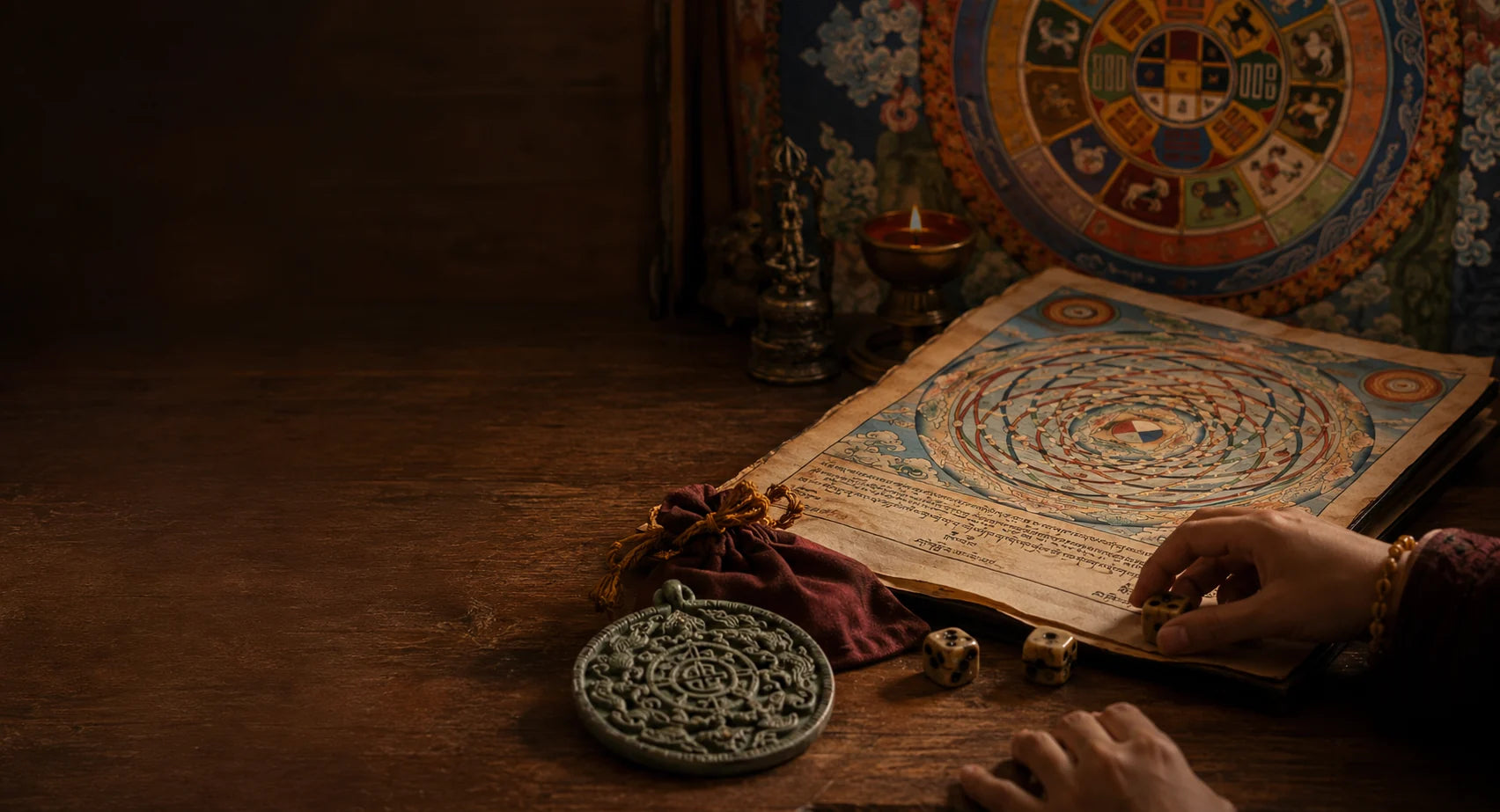

In Tibetan astrological diagrams, numbers can appear beside animals, elements, directions, trigrams, and other symbols. To a modern viewer, they may look like decoration. In traditional Tibetan Astro-Science, however, those numbers belong to a structured system known as Mewa, often written sme ba.
Mewa uses a cycle of nine numerical signs. The nine numbers are connected with colors, elemental associations, time cycles, and other relationships inside Jung-Tsi, or Tibetan Elemental Astrology. They are one reason Tibetan astrology cannot be reduced to a birth-year animal alone.
This guide explains what Mewa is, how the nine-number system works, why a 3×3 magic square matters, how Mewa relates to Parkha trigrams, and why a traditional Mewa calculation is more nuanced than entering a Gregorian birth year into a simple online numerology formula.
If you are new to the wider field, begin with What Is Tibetan Astrology? A Beginner’s Guide to Tibetan Astro-Science.
Quick Answer: What Is Mewa in Tibetan Astrology?
Mewa (sme ba) is a nine-number system used within Tibetan Elemental Astrology. Each Mewa number belongs to a repeating numerical cycle and is traditionally associated with a color and an element. Mewa can be used alongside animal-element years, calendrical factors, Parkha trigrams, directions, and other variables in traditional astrological calculation.
The numbers are commonly represented through a 3×3 magic-square structure. In a magic square, the numbers 1 through 9 are arranged so that the rows, columns, and diagonals share the same total. This mathematical pattern became part of a broader symbolic and calendrical language rather than functioning as a standalone personality quiz.
A natal Mewa may be associated with a person’s birth circumstances, while other Mewa calculations can be connected with years, dates, or changing periods of life. The exact method depends on the calendrical system, lineage, and type of calculation being performed.
What Does “Mewa” or “sme ba” Refer To?
English-language explanations often retain the Tibetan term Mewa rather than replacing it with a single English equivalent. In scholarly transliteration it can appear as sme ba.
The important point for beginners is functional: Mewa refers to a structured set of nine numerical signs used in Tibetan astrological calculation.
These nine numbers do not exist in isolation. Within Tibetan Elemental Astrology they can interact with:
- the five elements;
- the twelve animal signs;
- Parkha, the eight trigrams;
- directions and spatial relationships;
- year and date cycles;
- other natal and calendrical factors.
For this reason, reading “Mewa 7” as though it were equivalent to a modern life-path number removes the traditional context that gives the system its meaning.
The 3×3 Magic Square Behind the Nine Numbers
The visual logic of Mewa is closely associated with a nine-position square. A simple mathematical example of the classic 3×3 magic-square principle is:
In this arrangement, every row, column, and diagonal totals 15. The example illustrates the mathematical idea of the nine-number square. Traditional Tibetan diagrams may orient or present the numbers according to their own conventions, so the grid above should be read as an explanatory model rather than a claim that every Tibetan chart uses one fixed visual orientation.
The deeper idea is relational. A number has a place within a patterned whole. Its position is understood through relationship to the other numbers rather than as an isolated digit.

The Nine Mewa Numbers: Colors and Elements
Traditional explanations connect the nine Mewa numbers with colors and elemental qualities. One commonly documented Tibetan presentation gives the following associations:
| Mewa | Color | Element |
|---|---|---|
| 1 | White | Iron |
| 2 | Black | Water |
| 3 | Blue | Water |
| 4 | Green | Wood |
| 5 | Yellow | Earth |
| 6 | White | Iron |
| 7 | Red | Fire |
| 8 | White | Iron |
| 9 | Maroon / Red | Fire |
Terminology and presentation can vary across texts and lineages. “Iron” is also frequently rendered as “Metal” in modern English explanations.
The table is useful for orientation, but it should not be turned into nine fixed personality types. Traditional interpretation depends on how the Mewa relates to other factors in a calculation.
Why Are Mewa Numbers Connected to Colors and Elements?
In Tibetan Elemental Astrology, numbers, colors, elements, animals, and directions form overlapping systems of correspondence. The purpose is not merely to label a number with a decorative color. These relationships allow the number to be considered within a wider pattern of compatibility, change, and cyclical time.
This relational approach is one of the recurring features of Tibetan Astro-Science. A Horse year is not just “Horse.” It also belongs to an element and a larger calendrical cycle. In the same way, a Mewa number is not interpreted as an isolated digit.
For the animal-element framework, continue with The Tibetan Zodiac: 12 Animals, Five Elements, and the 60-Year Calendar.
How Mewa Fits Into Jung-Tsi
Mewa belongs most visibly to Jung-Tsi, or Byung-rTsis, the elemental-calculation stream of Tibetan Astro-Science.
Jung-Tsi includes the familiar twelve animal signs and five elements, but it also works with Mewa numbers, Parkha trigrams, directions, and other structured relationships. This is why reducing Jung-Tsi to “the Tibetan zodiac” leaves out much of the system.
By contrast, Kar-Tsi is the stream more closely associated with Indian-derived astronomical and calendrical traditions, especially Kalachakra Astro-Science.
For a focused comparison, read Kar-Tsi and Jung-Tsi: Two Traditions in Tibetan Astro-Science.
Mewa and the 60-Year and 180-Year Cycles
The nine Mewa numbers repeat on their own cycle, while animal-element years form a sixty-year cycle. When these repeating systems are considered together, the same combination of a Mewa number with a particular animal-element year returns only after a longer period.
A commonly described combined cycle is 180 years: three sixty-year animal-element cycles allow the nine-number pattern and the sixty-year pattern to return to the same correspondence.
This illustrates an important feature of traditional astrology: several cycles can operate at the same time. A year can be identified through its animal and element while also occupying a position in a Mewa sequence.
That layered structure is very different from treating a birth year as a single sign with one fixed description.
Is Mewa the Same as Modern Numerology?
No. Both systems use numbers symbolically, but that does not make them the same tradition.
Popular Western numerology often derives numbers from a person’s Gregorian birth date or name and then assigns personality or life-path meanings. Mewa developed inside a different historical framework connected with Tibetan Elemental Astrology, calendrical cycles, elemental correspondences, animals, directions, and trigrams.
Calling Mewa simply “Tibetan numerology” can be a useful search phrase for beginners, but it should not imply that Tibetan Mewa calculations follow modern Western numerology rules.
Is Mewa the Same as Chinese Nine-Star Systems?
No, although the historical relationship matters.
Jung-Tsi developed through long contact with Chinese-derived astro-scientific traditions, and the nine-number square has parallels elsewhere in East Asian cosmology. But Tibetan scholars incorporated these concepts into their own terminology, calendars, interpretive systems, and combinations with other Tibetan astrological methods.
For that reason, a chart from Feng Shui or Nine Star Ki should not automatically be substituted for a Tibetan Mewa calculation. Shared historical structures do not make every later tradition interchangeable.
What Is the Difference Between Mewa and Parkha?
Mewa and Parkha are related components of Tibetan Elemental Astrology, but they are not the same thing.
- Mewa refers to the cycle of nine numerical signs.
- Parkha refers to eight trigrams used in structured astrological and directional calculations.
Both can appear in the same astrological or protective diagram alongside animals, elements, directions, and other symbols.
This is why a traditional diagram can look visually dense: it may be combining several systems of correspondence at once rather than displaying one “zodiac wheel.”

Can I Find My Mewa Number From My Birth Year?
Traditional astrology does include a natal Mewa, so birth timing is relevant. But a responsible answer is more complicated than “take your Western birth year and apply a modulo-nine formula.”
The Tibetan calendar does not begin on January 1. A person born near the Tibetan New Year boundary may belong to a different Tibetan year than a simple Gregorian-year lookup suggests. Calculation methods can also depend on the specific system, lineage, and purpose of the horoscope.
Traditional methods may additionally derive changing or progressed Mewa for particular ages or years, and some calculations use different sequences for males and females.
For these reasons, a simplified web calculator can be useful as an educational approximation, but it should not be presented as equivalent to a complete traditional Tibetan astrological calculation.
What Did Mewa Mean in a Traditional Horoscope?
Historically, Mewa could contribute to a broader astrological assessment. A trained practitioner might consider a person’s animal-element year, Mewa, Parkha, calendar relationships, and other variables together.
Traditional astrological practice could include interpretations of favorable and unfavorable relationships, timing, compatibility, directions, health-related symbolism, or changing life periods according to inherited methods.
Those historical uses belong to a traditional worldview. They should not be converted into modern claims that a Mewa number can scientifically predict future events, diagnose illness, or guarantee an outcome.
For a wider explanation of how these components appear in traditional charts, see How Does Tibetan Astrology Work? Understanding Traditional Astrological Charts.
Mewa and Kailora’s Modern Tibetan Energy Reading
Kailora’s Tibetan Energy Reading is intentionally different from a traditional Tibetan horoscope.
It is a modern symbolic reflection inspired by selected concepts found in Tibetan astrological traditions. It uses accessible birth-year, animal, element, and annual-cycle symbolism to create a reflective experience around intention and personal rhythm.
It does not claim to reproduce the full traditional Mewa, Parkha, calendrical, or Kalachakra calculation system, and it is not presented as fortune-telling or a prediction of the future.
Discover Your Tibetan Energy Reading →
Why Mewa Matters for Understanding Tibetan Astrology
Mewa reveals something important about Tibetan Astro-Science: the tradition thinks in layers of relationship.
An animal belongs to an element. A year belongs to several overlapping cycles. A number occupies a place in a nine-part pattern. Trigrams, directions, calendars, and other variables add further relationships.
Once Mewa enters the picture, the familiar question “What is my Tibetan zodiac animal?” begins to look like only the first page of a much larger system.
The nine numbers are therefore valuable not because they offer nine easy personality labels, but because they show how Tibetan Elemental Astrology organizes time through interlocking patterns.
Frequently Asked Questions
What is Mewa in Tibetan astrology?
Mewa, or sme ba, is a cycle of nine numerical signs used in Tibetan Elemental Astrology. The numbers are traditionally linked with colors, elements, calendrical cycles, and other astrological relationships.
How many Mewa numbers are there?
There are nine Mewa numbers, numbered 1 through 9.
What is a Mewa magic square?
Mewa is associated with a nine-position square. The 3×3 magic-square principle arranges the numbers 1 through 9 so that rows, columns, and diagonals share the same total. Tibetan astrological usage places this numerical structure within a wider symbolic and calendrical system.
What is the difference between Mewa and Parkha?
Mewa uses nine numerical signs, while Parkha uses eight trigrams. Both belong to the wider framework of Tibetan Elemental Astrology and can appear together in astrological diagrams and calculations.
Can I calculate my Mewa from my Gregorian birth year?
A simplified approximation is possible, but a traditional calculation should respect Tibetan calendrical boundaries and the method being used. People born near Tibetan New Year are a clear example of why January 1 cannot simply be treated as the traditional year boundary.
Is Mewa the same as numerology?
No. Mewa uses numbers symbolically, but it developed within Tibetan Elemental Astrology and should not be equated with modern Western numerology.
Is Mewa the same as Nine Star Ki or Feng Shui?
No. There are historical connections among East Asian nine-number systems, but Tibetan Mewa developed within its own astrological and calendrical context. Their rules and interpretations should not be merged casually.
Does a Mewa number predict the future?
Traditional Tibetan astrology historically included prognostic interpretation, but a Mewa number should not be presented as scientifically verified prediction. It is best understood within its historical and cultural system.
Continue Exploring Tibetan Astro-Science
- What Is Tibetan Astrology? A Beginner’s Guide to Tibetan Astro-Science
- Kar-Tsi and Jung-Tsi: Two Traditions in Tibetan Astro-Science
- The Tibetan Zodiac: 12 Animals, Five Elements, and the 60-Year Calendar
- How Does Tibetan Astrology Work? Understanding Traditional Astrological Charts
- Discover Your Tibetan Energy Reading
Cultural note: Tibetan astrological terminology, color conventions, diagrams, and calculation methods can vary across texts, institutions, and lineages. This guide is an educational introduction to Mewa and does not replace a calculation prepared by a trained Tibetan Astro-Science practitioner.