






Search “traditional Tibetan jewelry” and you will find an enormous range of images—some historical, some tourist-market, some contemporary, and some incorrectly labeled. Museum collections offer a more reliable starting point because they preserve objects with dates, materials, and cultural attribution.
Quick answer: traditional Tibetan jewelry was highly varied. Surviving nineteenth- and early twentieth-century necklaces combine turquoise, coral, silver and other metals, amber, glass, stone, cotton, jade, and other materials. There was no single universal “Tibetan necklace” design.
Start with objects, not stereotypes
The strongest way to understand historical jewelry is to look at documented objects and ask concrete questions: When was it made? What materials were used? Is it identified as Tibetan or from a specific region? Was it part of dress, ritual life, or personal adornment?
That method avoids turning Tibetan culture into a collage of anything that looks Himalayan.
Historical Tibetan necklaces were materially complex
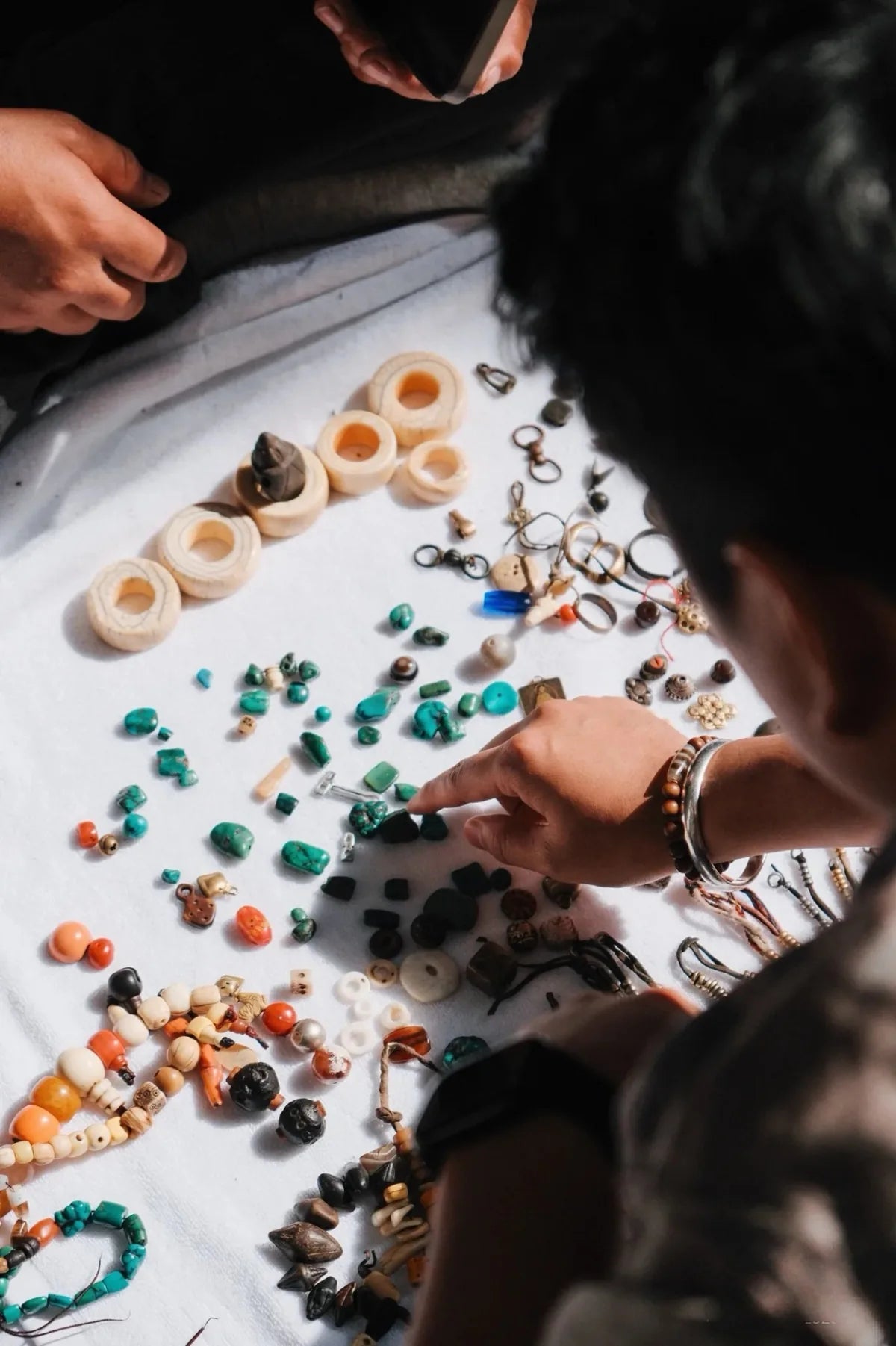
The Metropolitan Museum of Art preserves Tibetan necklaces made from combinations including turquoise, coral, metal, glass, stone, cotton, amber, jade, and silver. Some pieces emphasize large colored beads; others use pendant structures or textile elements.
Read Why Do Tibetan Necklaces Mix Turquoise, Coral, Amber, Silver and Other Materials? for a closer look at why this material diversity matters.

Turquoise and coral create one of the most recognizable palettes
Blue-green turquoise and red coral form a visually powerful combination and appear across multiple Tibetan adornment objects. Their cultural histories are not identical: turquoise has deep importance in Tibetan material life, while coral also tells a story of long-distance trade into the plateau.
These materials became part of recognizable Tibetan aesthetics, but neither should be reduced to a single modern “energy” keyword.
Amber and silver expand the visual vocabulary
Warm amber can appear in substantial beads or necklace components, while silver and other metals provide settings, pendants, structural parts, and ornament. A historical necklace might therefore combine color, weight, texture, and reflective surfaces in one composition.
The result can be bold and materially dense compared with minimalist contemporary jewelry.
Jewelry belonged to dress, not just the jewelry box
Adornment is best understood together with clothing, hairstyles, head ornaments, belts, textile structures, and regional dress. Jewelry could participate in identity, status, family display, ceremonial appearance, and everyday presentation.
This is why a museum necklace displayed alone should not be imagined as an isolated object with one mystical message. It belonged to a dressed body and a social world.

Regional variation matters
Tibet is geographically vast, and communities across the plateau and wider Himalayan world developed different dress and adornment traditions. Period, locality, social position, trade access, and family resources all affect what jewelry looked like.
Claims such as “all Tibetan women wore X” or “this one necklace is the traditional Tibetan style” should therefore be treated cautiously.
Historical Tibetan jewelry vs. Tibetan-inspired jewelry
Contemporary design does not need to imitate an antique to be respectful. It can study historical proportions, color relationships, material combinations, cord techniques, and portable forms, then interpret them in a clearly modern piece.
Kailora uses the term “Tibetan-inspired” for that reason. A modern product should not be marketed as an antique, a museum reproduction, or a sacred object unless there is documentation for that specific claim.
The Multicolor Tassel Earrings are a contemporary design that draws on a layered Himalayan palette rather than claiming to be a historical Tibetan artifact.
How to evaluate a “traditional Tibetan jewelry” listing
- Check whether the seller provides a real date or provenance rather than vague “ancient” language.
- Look for precise material descriptions.
- Distinguish antique, vintage, contemporary Tibetan-made, and Tibetan-inspired objects.
- Be skeptical of guaranteed spiritual powers attached to every material.
- Compare claims with museum-documented objects when possible.
Frequently asked questions
What stones were used in traditional Tibetan jewelry?
Turquoise and coral are especially visible in museum collections, alongside amber, jade, other stones, glass, silver, and additional materials.
Was traditional Tibetan jewelry minimalist?
Many surviving pieces are visually rich and materially layered, although styles vary greatly by region and function.
Is Tibetan-inspired jewelry traditional Tibetan jewelry?
No. Tibetan-inspired jewelry is contemporary design informed by Tibetan or Himalayan material culture. Clear labeling protects the difference.
Continue through the Kailora Tibetan Culture Guide.