




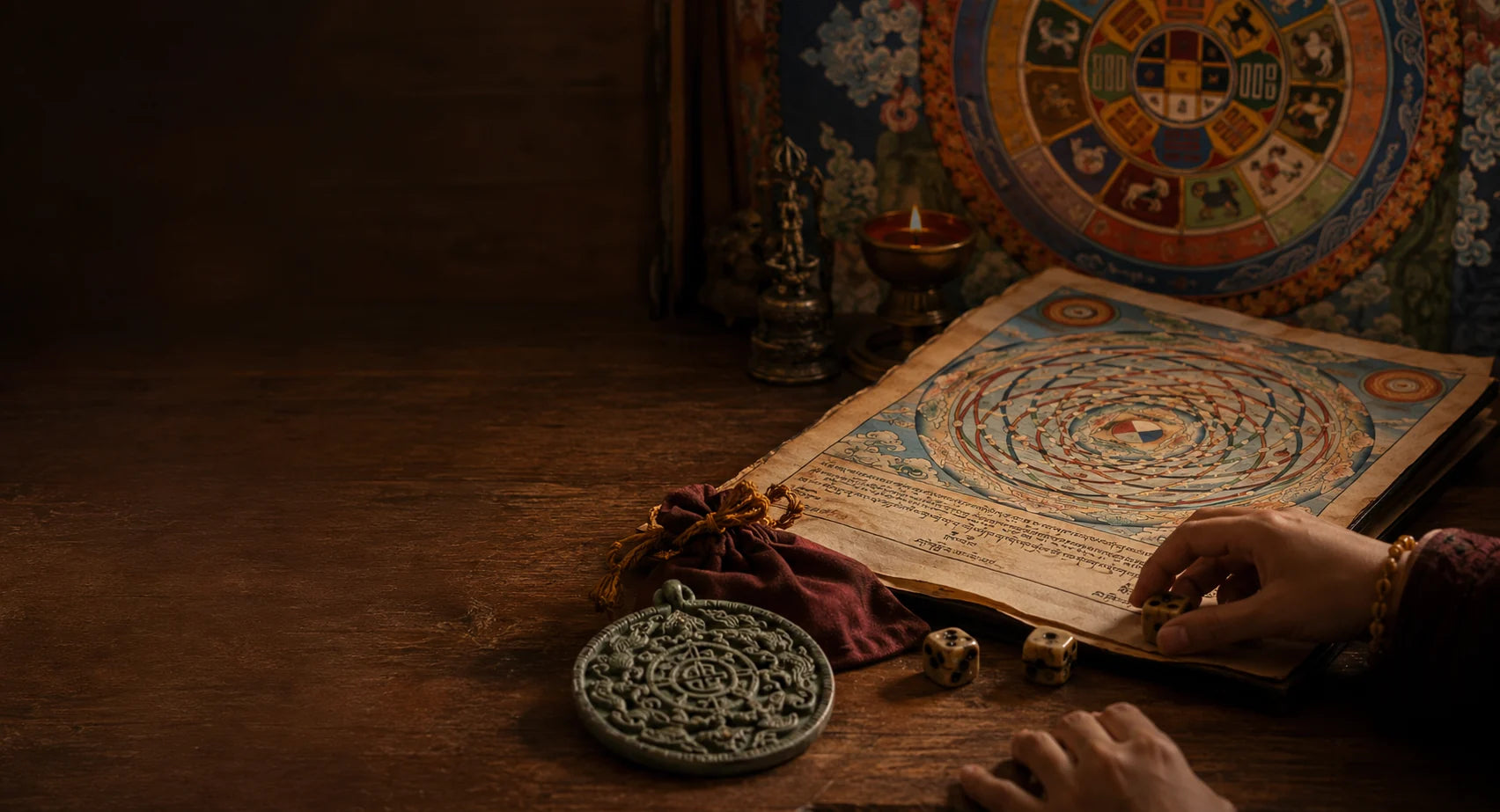

Look closely at a traditional Tibetan astrological chart and you may notice a ring of symbols made from three broken or unbroken lines. These are not decorative marks. They belong to a system known in Tibetan astrology as Parkha, or spar kha: the eight trigrams used within Tibetan Elemental Astrology.
Parkha is one of the clearest examples of why Tibetan astrology is much more than a twelve-animal zodiac. Alongside animal-element years and the nine Mewa numbers, the eight trigrams create another layer of relationship involving direction, element, time, and changing conditions.
This guide explains what Parkha means, how the eight trigrams are structured, where they fit within Jung-Tsi, how they relate to Mewa, and why Tibetan Parkha should not simply be treated as another name for modern Feng Shui or a generic Bagua chart.
If you are new to the wider system, start with What Is Tibetan Astrology? A Beginner’s Guide to Tibetan Astro-Science.
Quick Answer: What Is Parkha in Tibetan Astrology?
Parkha (spar kha) refers to eight trigrams used in Tibetan Elemental Astrology, especially within the tradition known as Jung-Tsi or Byung-rTsis.
Each trigram is formed from three lines. A line can be continuous or broken, creating eight possible three-line combinations. In Tibetan astrological calculation, these eight signs are associated with directions and elemental or natural qualities such as fire, earth, iron, sky, water, mountain, wood, and wind.
The trigrams are historically related to the eight trigrams of the Chinese Yijing or Book of Changes, but Tibetan specialists integrated them into a distinct system alongside Mewa numbers, animal-element cycles, Tibetan calendrical calculations, and other forms of interpretation.
What Does “Parkha” or “spar kha” Mean?
English-language sources use several spellings, including Parkha, Par-kha, and the transliterated Tibetan form spar kha. The expression spar kha brgyad means the eight trigrams.
For a beginner, the most important distinction is simple:
- Mewa is a nine-number system.
- Parkha is an eight-trigram system.
They are separate systems, but traditional Tibetan Elemental Astrology often considers them together.
Why Are There Eight Parkha Trigrams?
A trigram contains three horizontal lines. Each line can take one of two forms: continuous or broken. Three positions with two possibilities each create eight combinations.
The eight signs can be written with Unicode trigram symbols:
Transliterations vary. You may encounter forms such as Kon/Khön, Dva/Da, Ken/Khen, Gin/Khin, Zin/Tsin, and Zon/Zön. These spelling differences do not necessarily indicate different trigrams.
The Eight Parkhas: Directions and Symbolic Qualities
A commonly documented Tibetan arrangement associates the eight Parkhas with the following directions and qualities:
| Parkha | Symbol | Direction | Associated Quality |
|---|---|---|---|
| Li | ☲ | South | Fire |
| Khön / Kon | ☷ | Southwest | Earth |
| Da / Dva | ☱ | West | Iron / Metal |
| Khen / Ken | ☰ | Northwest | Sky / Heaven |
| Kham / Kam | ☵ | North | Water |
| Gin / Khin | ☶ | Northeast | Mountain |
| Zin / Tsin | ☳ | East | Wood |
| Zon / Zön | ☴ | Southeast | Wind |
English spellings and the way broader five-element categories are assigned can vary by source and lineage. The table therefore preserves the traditional natural-image terms—sky, mountain and wind—rather than forcing every trigram into one simplified five-element label.
How Parkha Fits Into Tibetan Elemental Astrology
Parkha belongs primarily to Jung-Tsi, the elemental-calculation stream of Tibetan Astro-Science. Jung-Tsi also includes the twelve animals, five elements, Mewa numbers, and a range of calendrical and directional relationships.
This matters because Parkha is rarely meaningful as a completely isolated symbol. Traditional interpretation asks how a trigram relates to other factors: a person’s Mewa, elemental relationships, age, direction, or the purpose of a specific calculation.
For the broader distinction between the elemental and Indian-derived streams of Tibetan astrology, see Kar-Tsi and Jung-Tsi: Two Traditions in Tibetan Astro-Science.

Parkha and Mewa: What Is the Difference?
Because both systems often appear together, Mewa and Parkha are easy to confuse.
| Feature | Mewa | Parkha |
|---|---|---|
| Basic structure | Nine numbers | Eight trigrams |
| Visual form | Nine-position square | Three-line signs |
| Common associations | Numbers, colors, elements, cycles | Directions, elemental or natural qualities, relationships |
| Traditional context | Jung-Tsi / Elemental Astrology | Jung-Tsi / Elemental Astrology |
The systems intersect because the eight trigrams can be arranged around the same nine-position framework used for Mewa. The center position does not correspond to a ninth permanent trigram, which is one reason the relationship between the “nine numbers” and “eight trigrams” is more interesting than simply matching one list to another.
For the full nine-number system, read What Is Mewa in Tibetan Astrology? The Nine Numbers Explained.
Where Do the Eight Trigrams Appear in Tibetan Astrological Art?
One of the best-known visual examples is the Srid pa ho, a Tibetan protective astrological chart.
In surviving historical examples, the center may show a tortoise carrying several concentric systems at once: the nine magic-square numbers, the eight Parkha trigrams, and the twelve animals of the sixty-year cycle. Planetary symbols, protective inscriptions, and other astrological motifs may appear around them.
The important point is not that every Tibetan horoscope looks like this. Rather, the image demonstrates how Tibetan astrological thought can place numbers, trigrams, animals, elements, directions, planets, and protective symbolism in one relational diagram.
That visual density is a reminder that Parkha was never merely an eight-item personality list.
Is Parkha the Same as the Chinese Bagua?
They are historically related, but they should not be treated as completely interchangeable.
The eight Parkha signs derive from the Chinese eight-trigram tradition associated with the Yijing. Tibetan astrological texts preserve Tibetanized forms of the trigram names and use the same basic family of three-line signs.
However, Tibetan astrology incorporated the trigrams into Tibetan Elemental Astrology, where they interact with Mewa numbers, Tibetan calendrical conventions, animal-element cycles, age calculations, and other methods.
Another important distinction is that Tibetan elemental calculations use the eight trigrams without simply importing the full sixty-four-hexagram divination system as a standard component of Tibetan astrology.
So “Tibetan Bagua” can help a newcomer recognize the visual connection, but it is not a complete description of Parkha’s role in Tibetan Astro-Science.
Is Parkha the Same as Feng Shui?
No.
Parkha and Feng Shui share historical concepts related to trigrams, directions, elemental correspondences, and East Asian cosmological systems. But a modern Feng Shui Bagua map and a traditional Tibetan Parkha calculation are not automatically the same tool.
Tibetan Parkha belongs to a wider astrological framework and may be considered alongside Mewa, age, natal factors, marriage calculations, directional relationships, and other traditional variables.
Using a generic modern Feng Shui chart as though it were a complete Tibetan Parkha reading would blur important historical and methodological differences.
Does Everyone Have a Birth Parkha?
Traditional Tibetan astrology does work with natal and changing trigrams, but this is another area where online simplification can create confusion.
A Parkha is not always obtained by taking a Gregorian birth year and assigning one of eight symbols in a simple repeating sequence.
Traditional explanations can derive a natal trigram through family and age-based calculations, while progressed trigrams change with age and may be counted differently for males and females. Different astrological purposes can also require different forms of Parkha calculation.
That means a webpage claiming “your Parkha is simply birth year modulo eight” should not be assumed to reproduce a complete traditional Tibetan method.
Why Are Directions Important in Parkha?
Each Parkha occupies a directional relationship: north, northeast, east, southeast, south, southwest, west, or northwest.
Traditional elemental divination could evaluate how directions relate to a person, a period of time, or a particular activity. Some Parkha systems distinguish relationships considered supportive from those considered difficult according to inherited astrological rules.
Historically, this directional dimension contributed to decisions involving timing, movement, ritual action, marriage calculations, and other practical concerns.
These uses belong to a traditional cultural framework. They should not be presented as scientifically established guarantees that a direction will cause good or bad events.
Why Do Parkha Spellings Differ So Much?
If you research Tibetan astrology in English, you will quickly encounter multiple spellings for the same trigram.
For example:
- Kham may appear as Kam.
- Khön may appear as Kon or Khon.
- Da may appear as Dva or Dwa.
- Khen may appear as Ken.
- Gin may appear as Khin or Kin.
- Zin may appear as Tsin.
- Zon may appear as Zön.
This happens because authors use different Tibetan transliteration conventions and different ways of representing names that themselves entered Tibetan through historical contact with Chinese terminology.
For SEO and readability, Kailora uses a common English form first and includes major variants where they help readers recognize the same concept across different sources.
What Was Parkha Used For Traditionally?
Within traditional Tibetan astrological practice, trigrams could contribute to several kinds of calculation rather than one universal “Parkha reading.”
Depending on the method, practitioners might consider natal trigrams, changing trigrams, directional relationships, compatibility, marriage calculations, timing, or relationships between trigrams and Mewa numbers.
Traditional astrology also developed remedial or protective practices for circumstances interpreted as difficult or inauspicious.
These practices are historically significant because they show how astrology functioned as part of lived cultural decision-making. They should be described as traditional astrological beliefs and methods—not as scientifically verified prediction.
Parkha and the Larger Tibetan Astrological Chart
The most useful way to understand Parkha is to see it as one layer inside a larger system.
A traditional Tibetan astrological assessment can include far more than:
“What animal year were you born in?”
Depending on the type of calculation, a practitioner may consider animal and element relationships, Mewa numbers, Parkha trigrams, calendar factors, lunar information, planets, and other variables.
For an overview of how these layers appear together, continue with How Does Tibetan Astrology Work? Understanding Traditional Astrological Charts.
Parkha and Kailora’s Tibetan Energy Reading
Kailora’s Tibetan Energy Reading does not claim to calculate a complete traditional Parkha horoscope.
It is a modern symbolic reflection inspired by selected concepts found in Tibetan astrological traditions. The experience uses accessible birth-year animal, five-element relationship, and annual-cycle references to create a reflective interpretation around intention and personal rhythm.
Traditional Parkha, Mewa, calendrical, and other professional astrological calculations remain distinct from that modern experience.
Discover Your Tibetan Energy Reading →
Why Parkha Matters for Understanding Tibetan Astrology
Parkha changes the way we see Tibetan astrology.
Once the eight trigrams enter the picture, astrology is no longer just a line of twelve animals repeating through the years. It becomes a layered system in which direction, number, element, age, calendar, and symbol can interact.
The eight trigrams also reveal the historical openness of Tibetan intellectual culture. Concepts with Chinese roots were not merely copied; they were translated, renamed, organized, and interpreted inside Tibetan astrological traditions alongside other bodies of knowledge.
Understanding Parkha therefore helps us move from the simplified idea of a “Tibetan zodiac” toward the much richer field of Tibetan Astro-Science.
Frequently Asked Questions
What is Parkha in Tibetan astrology?
Parkha, or spar kha, is the Tibetan astrological system of eight trigrams used primarily within Jung-Tsi, or Tibetan Elemental Astrology.
How many Parkha trigrams are there?
There are eight. Each is formed from a unique combination of three continuous or broken lines.
What does spar kha brgyad mean?
It means the eight trigrams. The term appears in Tibetan astrological and elemental-divination contexts.
Are Parkha and Mewa the same?
No. Mewa uses nine numerical signs, while Parkha uses eight trigrams. They are different but interconnected components of Tibetan Elemental Astrology.
Is Parkha the same as Bagua?
Parkha is historically derived from the same eight-trigram tradition associated with the Chinese Bagua and Yijing, but Tibetan astrology integrates those trigrams into its own elemental and calendrical system.
Is Parkha Feng Shui?
No. The traditions share historical directional and trigram concepts, but a modern Feng Shui Bagua map is not automatically equivalent to a traditional Tibetan Parkha calculation.
Can I calculate my Parkha from my birth year?
Traditional methods are more complicated than a simple eight-year sequence. Natal and changing Parkhas can involve age, gender, family-related calculation, calendrical conventions, and the purpose of the horoscope.
Does Parkha predict the future?
Traditional Tibetan astrology historically used Parkha in prognostic and directional interpretation, but this should be understood as a traditional cultural practice rather than scientifically verified future prediction.
Continue Exploring Tibetan Astro-Science
- What Is Tibetan Astrology? A Beginner’s Guide to Tibetan Astro-Science
- Kar-Tsi and Jung-Tsi: Two Traditions in Tibetan Astro-Science
- What Is Mewa in Tibetan Astrology? The Nine Numbers Explained
- How Does Tibetan Astrology Work? Understanding Traditional Astrological Charts
- Discover Your Tibetan Energy Reading
Cultural note: Tibetan astrological terminology, transliterations, correspondence systems, and calculation methods can vary across texts and lineages. This article is an educational introduction and does not replace a horoscope prepared by a trained Tibetan Astro-Science practitioner.