





A traditional Tibetan natal horoscope is not simply a zodiac animal assigned to a birth year. It is a layered astrological calculation that can bring together calendrical timing, animal-and-element relationships, Mewa numbers, Parkha trigrams, planets, constellations and other factors drawn from different streams of Tibetan Astro-Science.
This matters because many modern introductions reduce Tibetan astrology to a question such as “What Tibetan zodiac sign am I?” That can be a useful entry point, but a traditional birth horoscope goes much further. Its purpose is to examine relationships among several cycles and indicators associated with the moment of birth.
This guide explains what a traditional Tibetan natal horoscope can include, why exact birth timing matters, how Jung-Tsi and Kar-Tsi contribute different layers of calculation, and how a traditional horoscope differs from a simplified online reading.
If you are new to the subject, begin with What Is Tibetan Astrology? A Beginner’s Guide to Tibetan Astro-Science.
Quick Answer: What Is a Tibetan Natal Horoscope?
A Tibetan natal horoscope is an astrological assessment calculated from a person’s birth information according to Tibetan Astro-Science. Depending on the practitioner, lineage and type of reading, it can include the Tibetan calendar date, birth-year animal and element, elemental relationships, Mewa, Parkha, planetary and constellation positions, and interpretations of changing periods across the lifespan.
Traditional institutions distinguish a natal horoscope from other astrological services such as marriage compatibility, yearly or obstacle-year readings, health-related astrology and calculations connected with death or funeral rites. In other words, “Tibetan astrology” is not one single chart used for every question.
A natal horoscope should also not be confused with Kailora’s modern Tibetan Energy Reading, which is a symbolic reflective experience rather than a traditional horoscope calculation.
Why Exact Birth Time Matters
Traditional Tibetan natal astrology can require more than a birth year. Detailed horoscope services may ask for the exact time of birth because astronomical calculations can consider the positions and arrangements of planets and constellations at the time of birth.
The Tibetan calendrical date matters as well. The Tibetan year does not begin on January 1, which means someone born near the Tibetan New Year boundary cannot always be classified correctly by looking only at the Gregorian year number.
Depending on the system and practitioner, additional contextual information may also be recorded. The key point is that a detailed traditional horoscope starts with precise calendrical data, not just a twelve-animal lookup table.
A Tibetan Birth Horoscope Draws From More Than One Astrological Tradition
Tibetan Astro-Science developed through several intellectual streams. Two particularly important ones are Jung-Tsi and Kar-Tsi.
Jung-Tsi, or Elemental Astrology, works with relationships among animals, elements, Mewa numbers, Parkha trigrams, directions and calendrical cycles. Its historical development reflects long interaction with Chinese-derived elemental and cosmological systems.
Kar-Tsi is associated more strongly with Indian-derived astronomical and calendrical traditions. Kalachakra Astro-Science contributes sophisticated calculations involving planets, constellations and other astronomical factors.
A traditional Tibetan horoscope may therefore look less like a single self-contained “system” and more like a synthesis of several methods used together.
For a focused introduction to these two streams, read Kar-Tsi and Jung-Tsi: Two Traditions in Tibetan Astro-Science.
What Can a Traditional Tibetan Natal Horoscope Include?
The exact structure varies, but the following layers are among the most important concepts a beginner may encounter.
| Layer | What it describes in the traditional system | Why it is not standalone |
|---|---|---|
| Birth date and time | Places the birth within Tibetan calendrical and astronomical cycles. | Other indicators are calculated from this timing. |
| Animal and element | Identifies the birth year within animal-element cycles. | A Horse, Dragon or other animal is only one component of the chart. |
| Mewa | Places the person within a nine-number cycle associated with colors and elements. | It interacts with other natal and changing factors. |
| Parkha | Uses eight trigrams connected with directions and elemental or natural qualities. | Traditional calculation can include natal and changing trigrams. |
| Elemental relationships | Examines relationships among elemental factors associated with the individual and a period of time. | Interpretation depends on combinations rather than one fixed element meaning. |
| Planets and constellations | Adds astronomical timing and Indian-derived astro-scientific calculations. | Methods depend on the type and depth of horoscope. |
| Life-cycle periods | Traditional interpretation may examine changing periods, ages or years across a lifespan. | These are interpreted through multiple natal and annual relationships. |
1. The Birth-Year Animal Is Only the Beginning
The most familiar part of Tibetan astrology is the twelve-animal cycle: Mouse, Ox, Tiger, Hare, Dragon, Snake, Horse, Sheep, Monkey, Bird, Dog and Pig.
But a traditional natal horoscope does not stop after assigning an animal. Each year also belongs to an elemental relationship, creating the broader sixty-year animal-element cycle.
Even this combination is still only one layer. Two people born in years associated with the same animal can have different Mewa, Parkha, calendar relationships and other factors depending on their birth data and the method used.
For the animal-element calendar itself, see The Tibetan Zodiac: 12 Animals, Five Elements, and the 60-Year Calendar.
2. Mewa Adds a Nine-Number Cycle
Mewa, or sme ba, is the nine-number system used within Tibetan Elemental Astrology. The nine signs are associated with colors, elemental qualities and repeating cycles.
A natal Mewa can form one part of a person’s traditional astrological profile. Other Mewa calculations may change according to age or year, depending on the method.
This is one reason a traditional horoscope cannot be reduced to modern numerology. Mewa belongs to a wider system that includes animals, elements, trigrams, directions and calendrical relationships.
For a full explanation, read What Is Mewa in Tibetan Astrology? The Nine Numbers Explained.
3. Parkha Adds the Eight Trigrams
Parkha, or spar kha, refers to the eight trigrams used in Tibetan Elemental Astrology. Each is formed from three broken or unbroken lines and is associated with directional and natural or elemental qualities.
Traditional calculation can distinguish natal and changing trigrams rather than assigning one permanent trigram through a simple eight-year loop.
Parkha can therefore contribute another relational layer to the horoscope, especially when considered alongside Mewa and elemental calculations.
Continue with What Is Parkha in Tibetan Astrology? Understanding the Eight Trigrams.
4. Elemental Relationships Are Interpreted Together
The five elements—wood, fire, earth, iron or metal, and water—are central to Tibetan Elemental Astrology. But “your element” is not necessarily one fixed label that explains everything about you.
Traditional calculations can examine several elemental relationships connected with the birth year, changing years and other astrological indicators. Their significance depends on how those elements support, generate, weaken or conflict with one another according to the interpretive system being used.
This relational approach is very different from a modern quiz that assigns one elemental personality type.
5. Planets and Constellations Can Enter Detailed Calculations
The astronomical side of Tibetan Astro-Science brings in another level of precision. Traditional detailed horoscopes can consider planetary and constellation positions calculated for the time of birth.
Indian-derived Kar-Tsi and Kalachakra traditions contributed mathematical astronomy, planetary cycles, lunar mansions and calendrical techniques to Tibetan astrology.
These calculations help explain why exact birth time can be important in a detailed traditional horoscope.

6. A Natal Horoscope Can Be Read Across Different Phases of Life
Traditional natal-horoscope interpretation may extend beyond describing birth characteristics. Practitioners have historically used natal factors to discuss changing periods across a person’s lifespan.
Traditional readings may address topics such as family relationships, partnership, children, education, work, prosperity, favorable or difficult periods, and cautionary years. Some systems also identify traditional favorable days, colors or ritual remedies.
These interpretations belong to an inherited astrological worldview. They should not be treated as scientifically established predictions or guarantees about a person’s future.
What Does a Traditional Tibetan Horoscope Actually Look Like?
People familiar with Western astrology may expect a circular birth chart divided into twelve houses. A Tibetan natal horoscope does not have to follow that visual format.
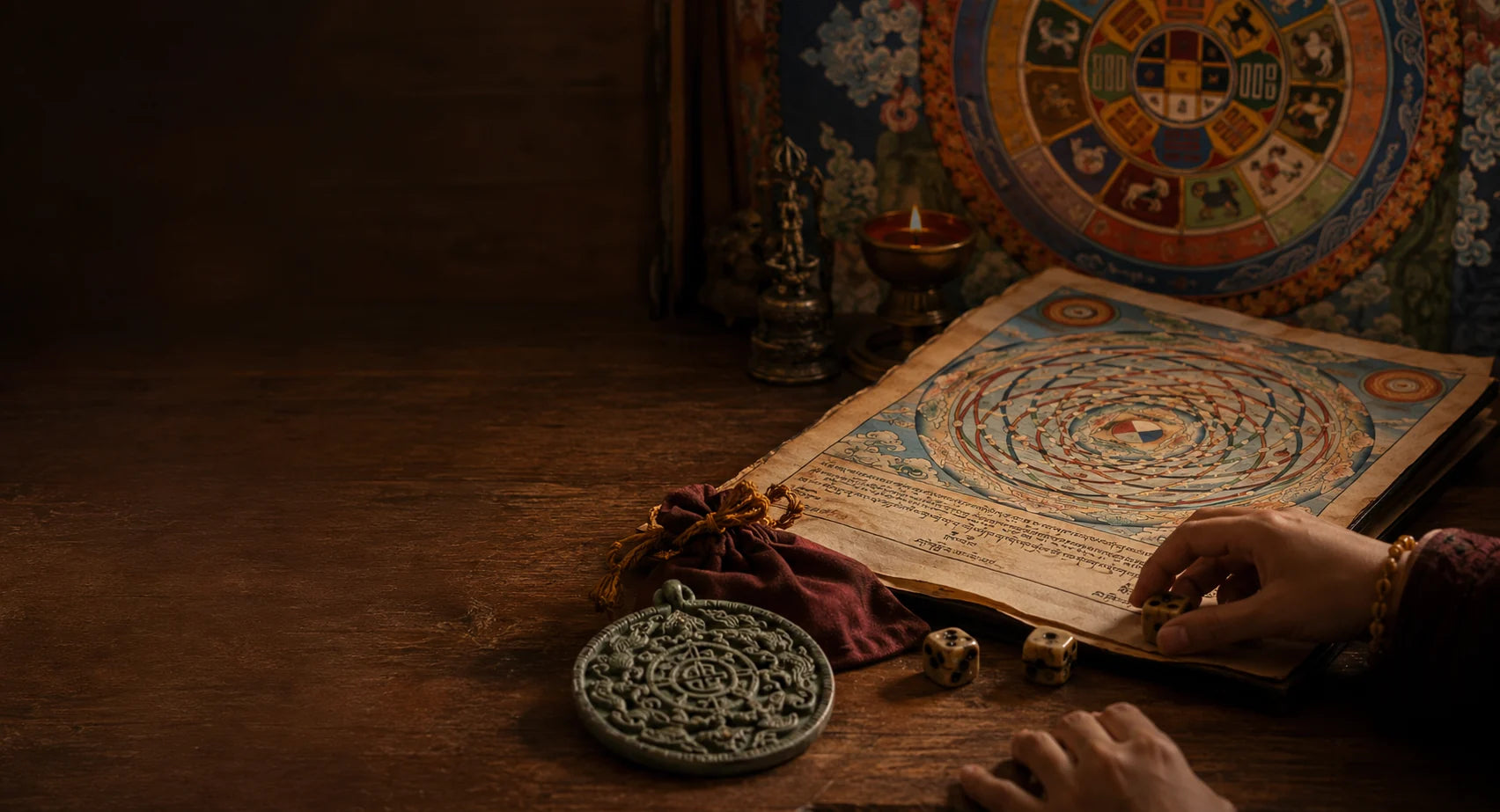
Historical Tibetan astro-scientific materials include numerical tables, calendrical calculations, diagrams, written interpretations, animal-element cycles, magic squares, trigram structures and astronomical imagery.
The calculation is more important than one standardized graphic template. A detailed horoscope prepared by a practitioner may therefore contain text and numerical work that does not resemble the popular Western natal wheel.
For a broader look at traditional Tibetan astrological charts, read How Does Tibetan Astrology Work? Understanding Traditional Astrological Charts.
Detailed vs. Brief Natal Horoscope Readings
Traditional institutions can offer different levels of natal-horoscope detail.
A brief reading may summarize major natal factors and important periods. A detailed reading can involve more extensive calculation and interpretation of birth timing, planets, constellations, elemental relationships and life-cycle factors.
This distinction is useful when comparing traditional services with online calculators. A calculator that returns one animal, one element and a paragraph of interpretation is not reproducing the full scope of a detailed traditional natal horoscope.
Natal Horoscope vs. Other Tibetan Astrological Readings
A natal horoscope is only one category of traditional Tibetan astrological practice.
| Traditional reading type | Traditional purpose |
|---|---|
| Natal horoscope | Examines birth-related astrological factors and changing life periods. |
| Marriage compatibility | Traditionally compares astrological relationships between two people. |
| Year / obstacle-year reading | Traditionally assesses a particular year or age-related period. |
| Health-related astrology | Historically interprets health symbolism within the traditional system; it is not medical diagnosis. |
| Death / funeral calculation | Historically used for ritual and calendrical questions after death. |
These categories show how astrology functioned within traditional social and ritual life. They are historical and cultural practices, not scientifically validated methods for diagnosing illness or guaranteeing future events.
How Is a Tibetan Natal Horoscope Different From a Western Birth Chart?
Both traditions can use the moment of birth as a foundation for astrological interpretation, but their technical languages and historical frameworks are different.
Western natal astrology is commonly organized around zodiac signs, planets, houses and aspects plotted on a circular chart. Tibetan natal astrology can combine animal-element cycles, Mewa, Parkha, Tibetan calendrical relationships, planetary and constellation calculations, and other methods inherited through Tibetan, Chinese-derived and Indian-derived traditions.
Similar questions about birth and time do not mean the systems are interchangeable.
Is a Tibetan Natal Horoscope the Same as the Chinese Zodiac?
No.
Tibetan Elemental Astrology shares historical structures with Chinese-derived systems, including the twelve animals, five elements, trigrams and nine-number patterns. But Tibetan scholars integrated these elements into Tibetan calendrical and astrological traditions and combined them with Indian-derived astronomical systems.
Knowing that someone was born in a Horse or Dragon year therefore does not provide the complete Tibetan natal horoscope.
Can an Online Calculator Reproduce a Traditional Tibetan Natal Horoscope?
Not completely.
A responsible online tool can calculate or illustrate selected factors, but a full traditional horoscope may require Tibetan calendar conversion, exact birth timing, lineage-specific rules, Mewa and Parkha methods, planetary or constellation calculations, and interpretation by a trained practitioner.
Births near Tibetan New Year are a simple example of why an online tool can go wrong: using the Gregorian year without converting the Tibetan calendar can assign the wrong animal-element year.
The more a calculator claims to reproduce a complete traditional horoscope from only a Gregorian birth year, the more cautious a reader should be.
Does a Tibetan Natal Horoscope Predict the Future?
Traditional Tibetan astrology historically included prognostic interpretation. Practitioners could discuss favorable and difficult periods, relationships, timing and ritual responses according to inherited methods.
That historical fact should be distinguished from modern scientific evidence. Traditional astrological interpretations are not scientifically verified predictions, and they should not be used as substitutes for medical, legal, financial or other professional advice.
For cultural education, the value of the natal horoscope lies partly in understanding how Tibetan traditions organized relationships among time, nature, astronomy, ritual and human life.
Traditional Natal Astrology and Kailora’s Tibetan Energy Reading
Kailora’s Tibetan Energy Reading is intentionally much simpler than the traditional system described in this article.
It is a modern symbolic reflection shaped by a birth-year animal, a five-element relationship and the current annual cycle. It is designed for reflection around symbolism, intention and personal rhythm.
It does not calculate a complete traditional Tibetan natal horoscope. It does not reproduce full Mewa or Parkha calculations, planetary and constellation positions, Kalachakra astronomical mathematics or practitioner-based prognostic interpretation.
It is also not presented as fortune-telling or as a prediction of future events.
Discover Your Tibetan Energy Reading →
Why the Full Natal Horoscope Matters
Understanding the structure of a traditional Tibetan natal horoscope changes the way we think about “Tibetan zodiac signs.”
The animal sign is not the final answer. It is one coordinate inside a larger network of time.
Animal and element, Mewa and Parkha, calendrical boundaries, planets and constellations, annual changes and life-cycle calculations can all contribute additional layers. Different schools and practitioners may emphasize those layers differently, but the underlying principle remains relational rather than one-dimensional.
That complexity is what makes Tibetan Astro-Science a field of study rather than a twelve-sign personality system.
Frequently Asked Questions
What is a Tibetan natal horoscope?
It is a traditional astrological assessment based on birth information and Tibetan astro-scientific methods. Depending on the system, it can include animal-element cycles, Mewa, Parkha, calendrical relationships, planets, constellations and changing life periods.
Is exact birth time required for Tibetan astrology?
Detailed natal-horoscope calculations can require exact birth time, particularly when astronomical factors such as planets and constellations are considered. Simpler calculations may use less information.
Is a Tibetan natal horoscope just my Tibetan zodiac animal?
No. The animal is only one layer. A fuller traditional horoscope can include elements, Mewa, Parkha, calendar factors and astronomical calculations.
Does every Tibetan natal horoscope include Mewa and Parkha?
They are important components of Tibetan Elemental Astrology, but the exact combination of calculations depends on the school, practitioner and purpose of the horoscope.
Is a Tibetan natal horoscope the same as a Western birth chart?
No. Both can begin with birth information, but their historical traditions, symbols and calculation systems are different.
Can I calculate a complete Tibetan natal horoscope online?
An online tool can show selected components, but a complete traditional horoscope can involve Tibetan calendar conversion, exact-time calculations and lineage-specific methods that go beyond a simple calculator.
Does Tibetan natal astrology diagnose health problems?
No modern medical diagnosis should be based on astrology. Traditional Tibetan astrology historically included health-related interpretations, but these belong to a cultural and historical framework and do not replace professional medical care.
Does a Tibetan natal horoscope predict my future?
Traditional astrology historically included prognostic readings, but those interpretations are not scientifically verified predictions. They are best understood within their cultural and historical context.
Continue Exploring Tibetan Astro-Science
- What Is Tibetan Astrology? A Beginner’s Guide to Tibetan Astro-Science
- Kar-Tsi and Jung-Tsi: Two Traditions in Tibetan Astro-Science
- What Is Mewa in Tibetan Astrology? The Nine Numbers Explained
- What Is Parkha in Tibetan Astrology? Understanding the Eight Trigrams
- How Does Tibetan Astrology Work? Understanding Traditional Astrological Charts
- Discover Your Tibetan Energy Reading
Cultural note: Tibetan astrological terminology, calculations and interpretations vary across texts, institutions and lineages. This article is an educational introduction and does not replace a horoscope prepared by a trained Tibetan Astro-Science practitioner.