






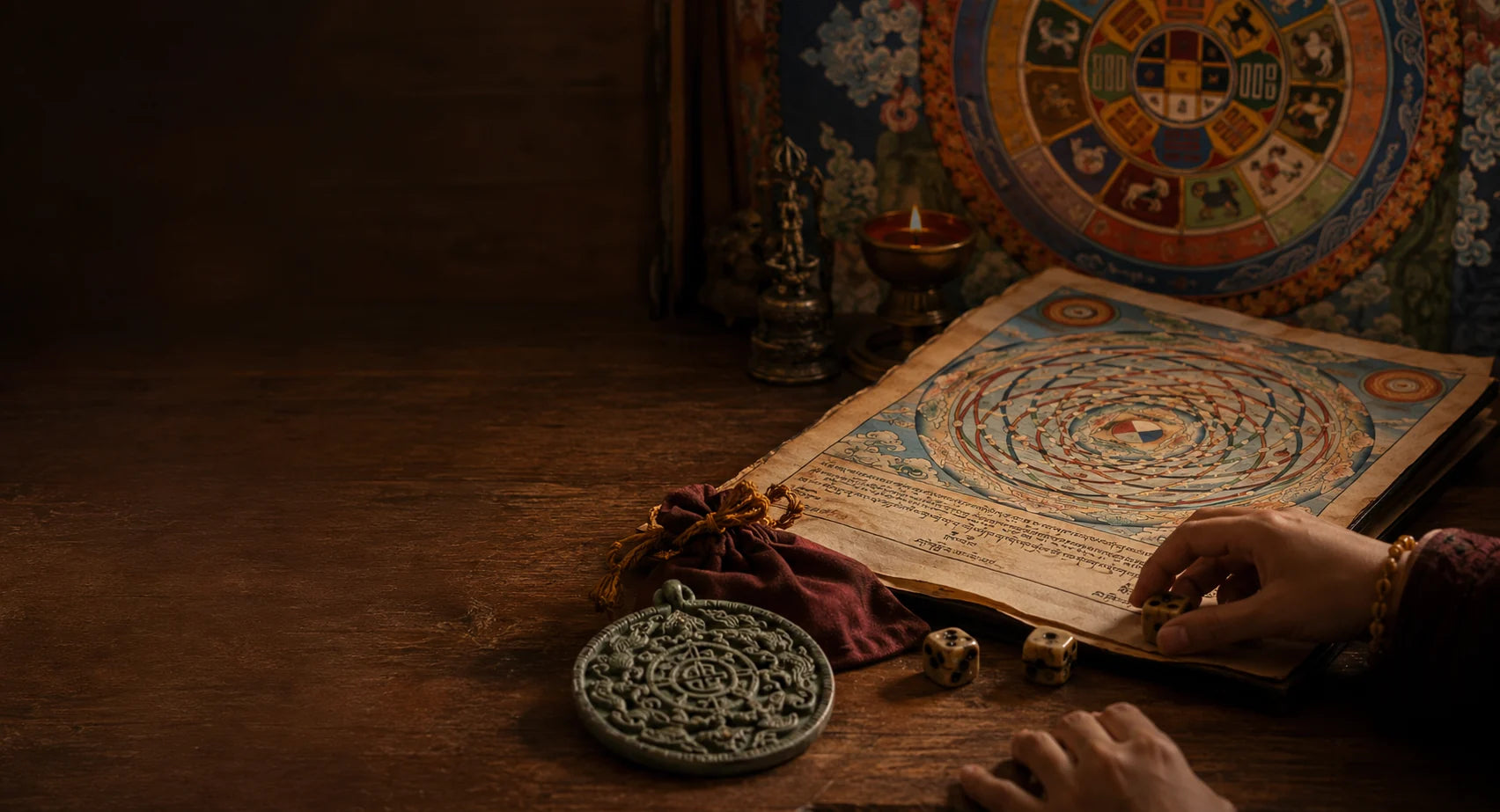

At first glance, Tibetan astrology and the Chinese zodiac can look almost identical. Both use a twelve-animal cycle. Both work with five elements. Both organize time through repeating combinations of animals and elements. A Tibetan chart may even contain trigrams and other symbols that are immediately familiar to someone who has studied Chinese cosmology.
So are Tibetan astrology and the Chinese zodiac the same system?
No. They share important historical building blocks, but Tibetan Astro-Science developed those materials inside a different calendrical, intellectual and ritual tradition. Tibetan scholars adapted Chinese-derived elemental methods, combined them with Tibetan calendrical conventions, and later integrated Indian-derived astronomical systems such as Kar-Tsi and Kalachakra.
The result is not a Tibetan copy of the Chinese zodiac. It is a layered Tibetan system with both shared Asian roots and distinct methods of calculation.
If you first want the basic Tibetan framework, read The Tibetan Zodiac: 12 Animals, Five Elements, and the 60-Year Calendar.
Quick Answer: Tibetan Astrology vs Chinese Zodiac
The Chinese zodiac most people know is the twelve-animal cycle attached to birth years. That popular zodiac is itself only one part of much broader Chinese calendrical and astrological traditions.
Tibetan astrology, or Tibetan Astro-Science, also uses a twelve-animal and five-element cycle, especially within Jung-Tsi, Tibetan Elemental Astrology. But it combines those factors with Tibetan calendar rules, Mewa numbers, Parkha trigrams, changing elemental relationships and, in other branches, Indian-derived planetary and astronomical calculations.
In short: the two traditions overlap historically, but they are not interchangeable.
Why Do Tibetan Astrology and the Chinese Zodiac Look So Similar?
The resemblance is not accidental. Chinese-derived calendrical and elemental knowledge entered Tibet over many centuries, with important transmissions beginning by the Tibetan imperial period and continuing through later Central Asian and Chinese contacts.
Among the ideas incorporated into Tibetan traditions were the twelve animals, five elements, trigrams and nine-number patterns. Tibetan scholars did not preserve these as an untouched imported package. They translated, reorganized and combined them with local calendrical practice and other bodies of knowledge.
This Chinese-derived stream is generally associated with Jung-Tsi. Tibetan Astro-Science also includes Kar-Tsi, a stream more closely connected with Indian mathematical astronomy and calendrical science. For the distinction between them, see Kar-Tsi and Jung-Tsi: Two Traditions in Tibetan Astro-Science.
Tibetan Astrology vs Chinese Zodiac: Key Differences at a Glance
| Feature | Tibetan astrology | Chinese zodiac / calendrical tradition |
|---|---|---|
| 12 animals | Used extensively in Jung-Tsi for years and other time cycles. | The 12 animals are widely associated with birth years and the Earthly Branches. |
| Five elements | Wood, Fire, Earth, Iron/Metal and Water. | Wood, Fire, Earth, Metal and Water. |
| 60-year cycle | Tibetan Rabjung cycles are conventionally counted from 1027, a Fire-Hare year. | The classical sexagenary cycle is built from 10 Heavenly Stems and 12 Earthly Branches and is conventionally enumerated from Jia-Zi, Wood-Rat. |
| New Year boundary | Uses the Tibetan calendar and Losar; year boundaries can vary by Tibetan calendrical tradition. | Popular zodiac-year assignment follows Chinese lunisolar calendar conventions rather than January 1. |
| Mewa | Integrated as a nine-number system within Tibetan Elemental Astrology. | Related nine-star and magic-square traditions exist in Chinese cosmology, but their use is not identical to Tibetan Mewa practice. |
| Parkha | Eight trigrams are used within a distinctly Tibetan system of natal and changing calculations. | The eight trigrams have deep roots in Chinese cosmology and the Yijing tradition. |
| Planets and astronomy | Kar-Tsi and Kalachakra add Indian-derived planetary, constellation and mathematical-astronomy methods. | Chinese astronomy and astrology have their own long planetary, stellar and calendrical traditions. |
| Can the systems be substituted? | No. A Tibetan calculation should use Tibetan calendrical rules and Tibetan methods. | No. A Chinese zodiac result does not automatically equal a full Tibetan astrological profile. |
1. The Twelve Animals Are Shared, but That Does Not Make the Systems Identical
The strongest resemblance is the familiar cycle of twelve animals. In English-language Tibetan sources, they are commonly rendered as Mouse, Ox, Tiger, Hare, Dragon, Snake, Horse, Sheep, Monkey, Bird, Dog and Pig.
Chinese-language zodiac lists are often translated as Rat, Ox, Tiger, Rabbit, Dragon, Snake, Horse, Goat, Monkey, Rooster, Dog and Pig.
Some of those differences are simply translation choices: Mouse/Rat, Hare/Rabbit, Sheep/Goat and Bird/Rooster should not be treated as proof of completely different zodiac animals.
The real difference lies in how the animals are embedded in the calculation. In Tibetan Elemental Astrology, animal signs interact with elements, Mewa, Parkha and other calendrical relationships. The animal is a coordinate inside a wider system, not the complete reading.

2. Both Use Five Elements, but “Iron” and “Metal” Need Context
Both traditions work with a five-element pattern usually translated as Wood, Fire, Earth, Metal and Water.
In English explanations of Tibetan astrology, the fourth element is often rendered as Iron rather than Metal. This does not mean Tibetan astrology invented a completely separate sixth or alternative element. It reflects Tibetan terminology and translation convention within a system historically related to Chinese-derived five-element thought.
More important than the English label is the way elements are paired with animals and interpreted in relationship to other astrological factors.
A simple statement such as “I am a Fire Horse” is therefore informative, but it still does not represent an entire Tibetan chart.
3. Both Have 60-Year Cycles, but They Are Organized Differently
This is one of the most interesting places where similarity can create confusion.
Classical Chinese calendrical reckoning uses a sexagenary cycle generated by combining ten Heavenly Stems with twelve Earthly Branches. The sequence is conventionally enumerated from Jia-Zi, the Wood-Rat combination.
Tibetan calendars also use repeating animal-element combinations across sixty years, but Tibetan Rabjung cycle counting follows a different convention. The first Rabjung is counted from 1027 CE, a Fire-Hare year in Tibetan reckoning.
That means both traditions can describe a sixty-year cycle while starting their conventional cycle counts from different points and grounding those cycles in different calendrical histories.
For the Tibetan cycle itself, see The Tibetan Zodiac: 12 Animals, Five Elements, and the 60-Year Calendar.
4. Tibetan Losar and Chinese New Year Are Not Necessarily the Same Date
One of the most practical differences appears when someone is born in January or February.
Neither Tibetan nor Chinese zodiac-year assignment should be calculated by simply changing signs on January 1. Both depend on lunisolar calendrical systems.
But Tibetan Losar and Chinese New Year do not always fall on exactly the same day. Rules governing months, intercalation and calendrical calculation developed differently. Tibetan calendars themselves can also contain school-specific calendrical conventions.
As a result, someone born near the New Year boundary can potentially receive a different year assignment if a website casually uses the Chinese New Year date as a substitute for Tibetan Losar.
This is why a serious Tibetan calculation begins with the Tibetan calendar rather than a generic “Asian zodiac” lookup table.
5. Heavenly Stems and Earthly Branches Are a Major Structural Difference
In classical Chinese calendrical astrology, the ten Heavenly Stems and twelve Earthly Branches form a fundamental framework for naming years, months, days and hours.
The popular twelve-animal zodiac is closely associated with the Earthly Branches, but the traditional Chinese calendrical system is much broader than twelve animal personalities.
Tibetan Elemental Astrology inherited and adapted related animal-element structures without simply reproducing the classical Chinese stem-branch system in the same form. Tibetan methods developed their own ways of assigning and combining animals and elements across periods of time.
This distinction matters because comparing “Tibetan astrology” only with the popular Chinese birth-year animal is not an equal comparison. Both traditions are much deeper than their simplified internet versions.
6. Mewa Has Chinese-Related Roots but a Tibetan Astrological Life of Its Own
Mewa, or sme ba, refers to the nine-number cycle used in Tibetan Elemental Astrology. The numbers are associated with colors and elemental qualities and are arranged through repeating patterns related to the nine-grid magic square.
Historically, this material is connected with Chinese-derived cosmological traditions. But the fact that two traditions share an ancestor does not mean their later calculations should be treated as interchangeable.
Within Tibetan astrology, Mewa is integrated with animal, element, Parkha and calendrical relationships and can be calculated in natal and changing contexts.
For the Tibetan method, read What Is Mewa in Tibetan Astrology? The Nine Numbers Explained.
7. Parkha Uses the Eight Trigrams, but Within a Tibetan Calculation System
The eight trigrams are among the clearest visual signs of Chinese historical influence. In Chinese intellectual history, the trigrams are deeply associated with the Yijing and a large body of cosmological interpretation.
In Tibetan astrology they appear as Parkha, or spar kha. They are used within Tibetan Elemental Astrology in relationships involving directions, elemental qualities and changing cycles.
A Tibetan Parkha calculation should therefore not be reduced to “the same Bagua with Tibetan labels.” The symbols share a historical lineage, while their placement inside Tibetan astrological practice reflects centuries of adaptation.
Continue with What Is Parkha in Tibetan Astrology? Understanding the Eight Trigrams.
8. Tibetan Astrology Also Contains an Indian-Derived Astronomical Layer
If Tibetan astrology consisted only of Chinese-derived animals, elements, numbers and trigrams, it would be easier to describe it as a regional branch of a Chinese system. But Tibetan Astro-Science developed through more than one stream.
Kar-Tsi brought Indian-derived astronomical and calendrical methods into Tibetan scholarship. The Kalachakra tradition contributed sophisticated calculations involving planetary cycles, lunar mansions, eclipse theory, calendrical mathematics and other astronomical concepts.
Tibetan scholars eventually worked with Chinese-derived Jung-Tsi and Indian-derived Kar-Tsi side by side and, in many contexts, in combination.
This synthesis is one of the strongest reasons the phrase “Tibetan astrology is just the Chinese zodiac” is historically inaccurate.
9. Tibetan Astrology Uses Animal-Element Relationships Beyond a Birth-Year Label
Popular Chinese-zodiac content online often centers on one question: “What animal am I?”
Tibetan Elemental Astrology can ask a wider set of relational questions. Traditional calculations may examine natal factors, changing years, elemental relationships, Mewa and Parkha, and specific periods of life.
A full traditional natal horoscope can become more detailed still, incorporating exact birth timing and other astro-scientific factors. See What Does a Traditional Tibetan Natal Horoscope Include?.
10. Does the Same Birth Year Always Give the Same Tibetan and Chinese Zodiac?
For many dates well inside a calendar year, the animal-year label will often appear to match because of the shared twelve-animal historical framework.
But it is unsafe to assume that every birth date will produce an identical result across both systems.
The biggest source of error is the New Year boundary. A person born close to Losar or Chinese New Year needs the correct calendar conversion for the tradition being used. The two New Years may not coincide.
Even when the broad animal-year label matches, the larger Tibetan profile still cannot be inferred from the Chinese zodiac animal alone.
11. What About Birth Month, Day and Hour?
Chinese calendrical astrology traditionally applies stem-branch relationships to years, months, days and double-hours. Tibetan Elemental Astrology also extends animal and elemental associations beyond the year, but the assignments and starting conventions are not simply identical copies of the Chinese pattern.
This is another reason online charts that substitute a Chinese four-pillars or zodiac calculator for a Tibetan calculation can be misleading.
Shared vocabulary does not guarantee shared arithmetic.
12. Is Tibetan Astrology Older Than the Chinese Zodiac?
The question is too simple for the historical evidence.
Chinese calendrical and cosmological systems involving cyclical signs, stems, branches and elements have very ancient histories. Tibetan astrology, as a distinct scholarly tradition, developed through the reception and reworking of knowledge from China, Central Asia and India alongside Tibetan calendrical and religious institutions.
It is more accurate to describe Tibetan Astro-Science as a historical synthesis than to frame the two traditions as competitors for which one “came first.”
13. Which Is More Accurate: Tibetan Astrology or the Chinese Zodiac?
There is no scientific basis for declaring one astrological tradition more predictively accurate than the other.
Both belong to long cultural systems for interpreting time, correspondence and human life. Their historical importance is real; their predictive claims are not scientifically established facts.
If you engage with either tradition today, it is useful to distinguish cultural understanding and symbolic reflection from guaranteed prediction.
Astrology should not replace medical, legal, financial or other professional advice.
Why This Difference Matters When Reading Tibetan Astrology Online
Many websites use the words “Tibetan zodiac,” “Chinese zodiac” and “Asian zodiac” almost interchangeably because the twelve animals are familiar and easy to display.
That shortcut hides the most interesting part of the subject.
Tibetan astrology is not defined only by the animals it shares with neighboring cultures. It is defined by the way Tibetan scholars organized those animals within a larger system of elements, Mewa, Parkha, Tibetan calendars, Kar-Tsi astronomy and inherited interpretive methods.
If a calculator claims to give a complete Tibetan horoscope using only a Gregorian birth year and a standard Chinese zodiac table, it is simplifying the tradition substantially.
Tibetan Astrology and Kailora’s Tibetan Energy Reading
Kailora’s Tibetan Energy Reading is a modern symbolic experience inspired by selected traditional references. It uses a birth-year animal, a five-element relationship and the current annual cycle to create a reflective reading around symbolism, intention and personal rhythm.
It is not presented as a complete traditional Tibetan astrological chart, a Chinese zodiac reading or a prediction of future events.
It does not reproduce the full technical calculations of Mewa, Parkha, Kar-Tsi or Kalachakra astronomy.
Discover Your Tibetan Energy Reading →
Frequently Asked Questions
Are Tibetan astrology and the Chinese zodiac the same?
No. Tibetan Elemental Astrology historically incorporates Chinese-derived animals, elements, trigrams and nine-number patterns, but Tibetan scholars adapted these within Tibetan calendrical practice and combined them with other traditions, including Indian-derived astronomy.
Do Tibetan and Chinese astrology use the same 12 animals?
They use closely corresponding twelve-animal cycles. English translations can differ—such as Mouse/Rat, Hare/Rabbit or Sheep/Goat—but those translation differences are less important than the different ways the cycles are calculated and interpreted.
Why does Tibetan astrology say Iron instead of Metal?
English Tibetan-astrology sources often translate the relevant element as Iron, while Chinese five-element discussions commonly use Metal. The terms belong to historically related five-element frameworks and should not be mistaken for entirely different elemental systems.
Is Tibetan New Year the same as Chinese New Year?
Not necessarily. Tibetan Losar and Chinese New Year often fall near one another, but different calendrical rules can produce different dates. This is especially important for people born close to a New Year boundary.
Does Tibetan astrology use the Chinese Heavenly Stems and Earthly Branches?
Tibetan astrology inherited structures historically related to Chinese cyclical systems, but Tibetan Elemental Astrology does not simply reproduce the classical Chinese stem-branch framework in the same way. Its animal-element, Mewa and Parkha calculations developed distinct Tibetan conventions.
Are Mewa and Parkha Chinese or Tibetan?
Their historical roots are connected with Chinese-derived cosmological systems, but Mewa and Parkha became integrated into Tibetan Elemental Astrology through Tibetan methods, terminology and calculations. It is more accurate to describe them as shared historical material adapted within Tibetan tradition than to label their modern Tibetan use as simply Chinese.
Can I use a Chinese zodiac calculator to find my Tibetan zodiac?
It may give a matching animal for many dates, but it should not be treated as a reliable Tibetan calculation—especially for births near Tibetan New Year. A proper Tibetan result uses Tibetan calendrical boundaries.
Is Tibetan astrology only based on Chinese astrology?
No. Chinese-derived Elemental Astrology is one major stream, but Tibetan Astro-Science also incorporates Indian-derived Kar-Tsi and Kalachakra astronomy and developed within Tibetan scholarly and calendrical traditions.
Continue Exploring Tibetan Astro-Science
- What Is Tibetan Astrology? A Beginner’s Guide to Tibetan Astro-Science
- The Tibetan Zodiac: 12 Animals, Five Elements, and the 60-Year Calendar
- Kar-Tsi and Jung-Tsi: Two Traditions in Tibetan Astro-Science
- What Is Mewa in Tibetan Astrology? The Nine Numbers Explained
- What Is Parkha in Tibetan Astrology? Understanding the Eight Trigrams
- What Does a Traditional Tibetan Natal Horoscope Include?
- What Is My Chinese Zodiac Sign? The Cultural Meaning of the 12 Animals
- Discover Your Tibetan Energy Reading
Cultural note: Tibetan and Chinese astrological practices are internally diverse, and terminology and calculation methods vary across texts, schools and regions. This guide compares broad historical structures for educational purposes rather than presenting either tradition as a scientifically validated predictive method.