





The word “oracle” can suggest fortune-telling to a modern reader. In Tibetan religious history, the Nechung Oracle belongs to a much more specific institution: a human medium associated with Nechung Monastery and the protector deity Pehar, historically consulted in matters affecting the Dalai Lama’s government and Tibetan religious life.
Understanding the tradition requires separating documented history from religious belief. Historical records can tell us about the monastery, the office of the oracle, ritual clothing, political consultation, and the continuity of the institution. Claims about divine possession or prophecy belong to Tibetan Buddhist religious belief and should be described as such rather than presented as scientifically established fact.
What Is the Nechung Oracle?
The Nechung Oracle is the best-known state-oracle institution in Tibetan history. The term can refer both to the office and to the human medium who serves in that role.
Within Tibetan Buddhist belief, the medium enters a trance during which a protector deity or divine emissary is understood to take possession and communicate through him. The medium is therefore not considered the source of the message in the ordinary sense; he serves as a vessel within the ritual.
The tradition is centered on Nechung Monastery, historically located near Lhasa and closely associated with the protector Pehar.
What Is Nechung Monastery?
Nechung Monastery became the institutional seat of the Tibetan state oracle. Its murals, shrines, protector imagery, and ritual spaces reflect the monastery’s connection with Pehar and the oracle tradition.
The complex was significantly expanded and renovated in the seventeenth century during the era of the Fifth Dalai Lama. This period was crucial in formalizing Nechung’s relationship with the Tibetan government and establishing the oracle as the principal state oracle.
The monastery is especially known for extensive wrathful imagery. These fierce paintings should not be mistaken for evidence of an “evil cult.” Wrathful protectors and tantric deities have specific roles within Tibetan Buddhist religious systems.
Who Is Pehar?
Pehar is a protector deity central to the Nechung tradition. Tibetan historical and mythic narratives connect Pehar with earlier periods of Tibetan Buddhism, including traditions surrounding Samye, Tibet’s first major Buddhist monastery.
Like many protector traditions, the stories are layered and vary across texts and lineages. They combine mythology, ritual history, institutional memory, and Buddhist interpretations of local divine beings.
For background on the monastery that appears in these traditional narratives, read Kailora’s guide to Samye Monastery and the early history of Tibetan Buddhism.
How Does an Oracle Ceremony Work?
Accounts of Nechung ceremonies describe an elaborate ritual environment rather than a casual question-and-answer session. Monks chant and play ritual instruments while the medium is dressed in specialized ceremonial clothing and equipment.
Within the religious interpretation of the ceremony, the medium enters trance as the deity descends. Historical descriptions emphasize physical intensity: movement, altered vocal delivery, heavy ritual garments, and the use of symbolic objects or weapons associated with the protector.
Questions can then be presented and responses interpreted. Such responses have traditionally been regarded by believers as oracular communication.
The Oracle’s Ritual Clothing and Objects
Nechung oracle imagery often shows the medium in elaborate dress with a ritual mirror at the chest and a substantial headdress. Weapons associated with the protector can also appear during trance ceremonies.
Museum collections preserve Tibetan ceremonial weapons whose decoration suggests ritual or oracular use. Such objects help us understand that an oracle ceremony was highly material: costume, metalwork, painting, music, architecture, and bodily movement all contributed to the event.
These objects should not be interpreted as ordinary weapons simply because they resemble spears, swords, bows, or arrows. Their ritual context changes their function.
Why Was It Called a “State Oracle”?
The word state reflects Nechung’s historical institutional role. Under the Fifth Dalai Lama, the oracle became closely linked with the Tibetan government. The Dalai Lama and officials consulted the oracle on political, religious, and practical questions at important moments.
This does not mean every government decision was dictated by an oracle. Tibetan governance included administrators, monastic institutions, aristocratic networks, legal customs, diplomatic realities, and many other forms of decision-making. The oracle was one institution within that larger system.
Recognizing that complexity helps avoid two extremes: treating the oracle as a fictional curiosity, or imagining that Tibetan political life operated only through prophecy.
Is the Nechung Oracle Just Fortune-Telling?
No. Although both involve questions about uncertain events, the cultural settings are very different.
Nechung belongs to a monastery, protector-deity tradition, state history, and formal Buddhist ritual system. The medium’s role is defined institutionally, and trance ceremonies are supported by monastic liturgy and specific religious interpretations.
Calling it simply “Tibetan fortune-telling” removes most of what makes the institution historically distinctive.
Oracles in the Wider Tibetan Cultural Landscape
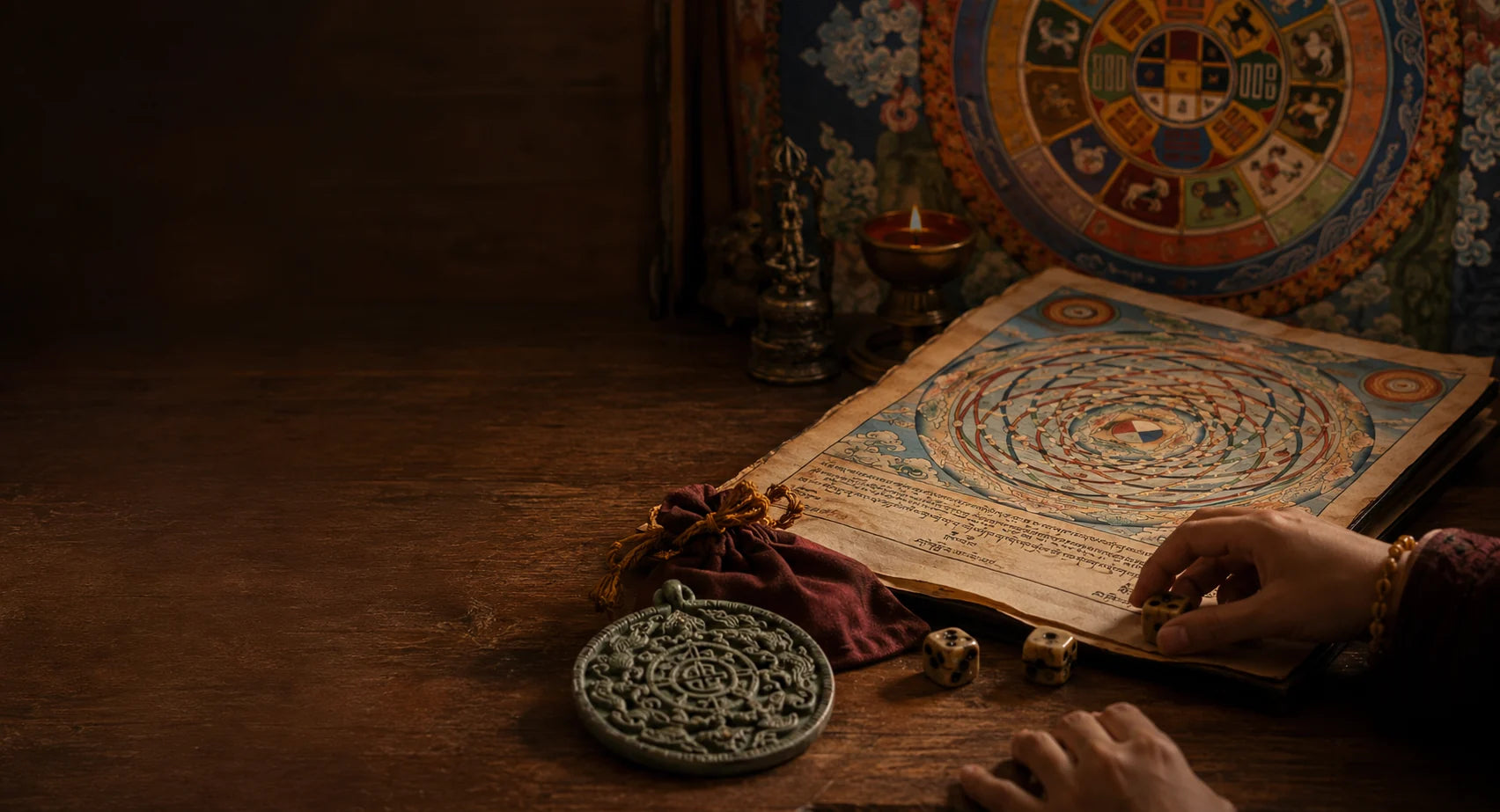
Nechung is the most famous Tibetan oracle institution, but it was not the only form of divination or spirit-medium practice in Tibetan societies. Historical sources describe astrology, dreams, omens, dice divination, geomancy, and other systems alongside human oracles.
This diversity reminds us that “Tibetan Buddhism” has never been only philosophy or meditation. Ritual technologies, protector traditions, healing systems, local gods, scholastic institutions, pilgrimage, art, and monastic practice all formed parts of a much larger cultural world.
Nechung and Guru Rinpoche
Traditional narratives surrounding Pehar and Tibetan protector deities often connect them with the eighth-century tantric master Padmasambhava, commonly known as Guru Rinpoche. Nechung’s own mural program includes Padmasambhava among the powerful tantric figures associated with the monastery’s sacred order.
These accounts belong to Tibetan religious history and mythology rather than to a modern documentary record of eighth-century events. That distinction should be preserved.
Readers interested in the figure at the center of many of these Tibetan narratives can continue with our guide to Guru Rinpoche, or Padmasambhava, in Tibetan Buddhism.
Why the Tradition Can Be Misunderstood
Images of trance, fierce murals, skull imagery, weapons, and heavy ceremonial costumes can make Nechung especially vulnerable to sensational storytelling. Western descriptions have sometimes framed Tibetan oracle traditions as mysterious, irrational, or occult without explaining their institutional setting.
A more useful approach is to ask the same questions we would ask of any religious institution: Who participates? What texts and rituals structure the event? What authority does the office possess? How has that authority changed over time? What do practitioners believe is happening?
Those questions produce cultural understanding rather than exoticism.
Traditional Belief and Historical Fact
It is worth making the distinction explicit. It is historically verifiable that Nechung Monastery served as the seat of Tibet’s state-oracle tradition, that human mediums held the office, that Dalai Lamas and Tibetan governments consulted the oracle, and that elaborate ritual ceremonies surrounded the institution.
The interpretation that a deity literally possesses the medium and communicates prophetic knowledge is a matter of Tibetan religious belief. Respectful writing does not need to dismiss that belief, but it also should not present it as an empirically proven mechanism.
Why Kailora Does Not Turn the Oracle into a Product Symbol
Some Tibetan cultural themes connect naturally with jewelry motifs. The Nechung Oracle is different. Its meaning is tied to a specific religious institution, protector tradition, historical office, and ritual practice.
For that reason, Kailora approaches this subject primarily as cultural education. We do not use the oracle tradition to promise divination, prediction, protection, or supernatural guidance through a product.
A Window into the Complexity of Tibetan Buddhism
The Nechung Oracle complicates simple ideas about what Buddhism is supposed to look like. Tibetan Buddhism can include rigorous philosophy and formal monastic debate, quiet meditation and elaborate ritual, compassionate bodhisattva imagery and fierce protectors, written scholarship and trance-medium traditions.
Nechung belongs to that complex world. Studied carefully, it offers more than a story about prophecy. It reveals how monastery, government, deity, art, music, ritual, and historical memory could intersect within Tibetan culture.