







Braided cords and knotted bracelets can look deceptively simple. A few strands, repeated turns, a sliding closure, perhaps a bead or tassel. But in Tibetan and Himalayan material culture, knotting also belongs to a much broader world of practical craft: fastening, wrapping, carrying, clothing, tools, religious objects, and contemporary jewelry.
Quick Answer
There is no single technique that can accurately be called “the Tibetan knot” for all jewelry. Tibetan communities use many forms of cord, braid, twist, and knotting, and techniques can move between practical and decorative uses. Smithsonian documentation of Tibetan jeweler Zanta provides a particularly useful example: she adapts traditional knots used for functional and religious purposes into contemporary jewelry, including a knotting technique traditionally used to make a sleeve for an axe. That makes Tibetan knotting best understood as a living craft language rather than a fixed bracelet formula.
Why Knotting Matters in a Mobile Material Culture
Before knotting becomes decoration, it solves physical problems. Cord can bind, suspend, close, connect, reinforce, carry, and repair. In pastoral and household settings, those functions matter because materials need to work.
This is one reason it is useful to place jewelry knotting beside textile and everyday craft rather than isolating it as a mystical symbol. Read How Are Tibetan Textiles Woven? for the wider context of spinning, fibers, wool, and woven construction.
A Documented Contemporary Example: Zanta’s Jewelry
The Smithsonian Center for Folklife and Cultural Heritage published the first-person account of Zanta, a Tibetan jeweler from a farming and herding community in Mawo, Sichuan. Her story is valuable because it shows how craft tradition can be adapted without pretending that every modern piece is an unchanged ancient object.
Zanta explains that she does not smith or solder in the same way as the metalsmith from her village. Instead, she uses traditional knots with both functional and religious uses. One necklace combined yak-bone buttons with a starji knotting technique traditionally used to make a sleeve for an axe. She also experiments with twisting, develops new knots, and combines traditional-looking forms with contemporary market preferences.
This is a strong model for understanding living craft: tradition can be a vocabulary, not a frozen template.
From Tool Technique to Jewelry Technique
A technique does not have to originate as jewelry-making in order to become meaningful jewelry craft. The same hand knowledge used to fasten or protect an object can be adapted to hold beads, create an adjustable section, frame a pendant, or build visual rhythm in a bracelet.
That transfer is especially important when discussing “Tibetan-inspired braided jewelry.” A modern bracelet may draw on a real regional culture of handwork while still being a contemporary design.
Are Braided Tibetan Bracelets Always Religious?
No. This is an important distinction.
Some cords and knots can appear in religious settings or be connected with blessed strings, amulets, or sacred objects. Others are functional, decorative, domestic, commercial, or personal. A colorful braided bracelet should not automatically be described as a monastery-blessed protection cord unless there is actual provenance for that claim.
Similarly, the presence of red cord does not by itself prove a specific ritual history. Color can have cultural associations, but product-specific meaning requires product-specific evidence.
What Materials Are Used in Contemporary Knotted Jewelry?
Contemporary makers may work with cotton, wool, synthetic cord, leather, metal, beads, bone, seeds, stones, or mixed materials. The choice affects durability, texture, weight, and how the knot holds tension.
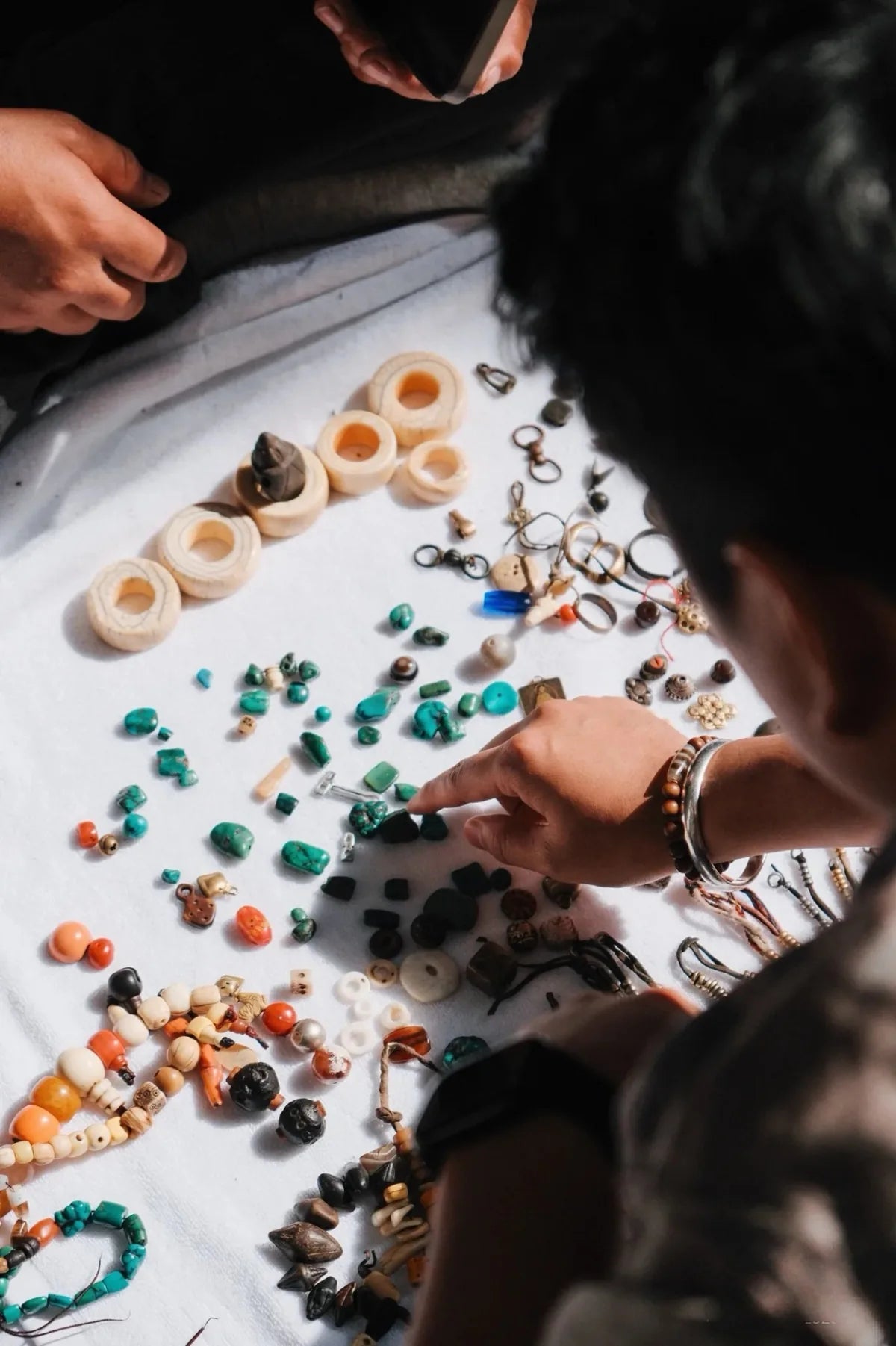
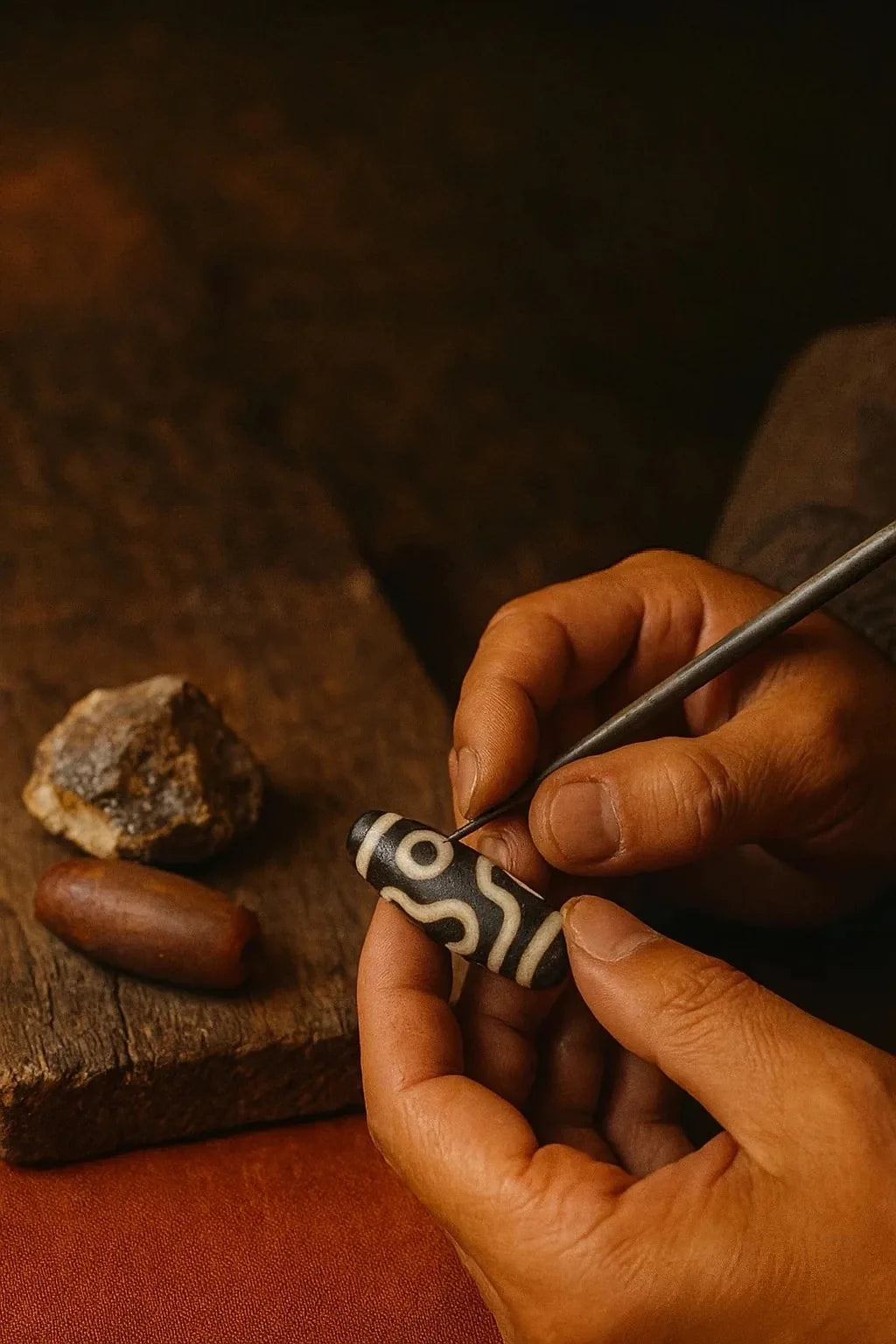
Zanta’s Smithsonian account describes using available materials, spinning wool for jewelry, incorporating Dzi stones, yak-bone buttons, sacred motifs, and gau-inspired forms. That range is a reminder that Tibetan jewelry does not have to be reduced to silver and turquoise alone.
Braiding, Knotting and Weaving Are Not the Same Thing
These terms overlap in casual product descriptions but refer to different structural actions:
| Technique | Basic idea | Common jewelry effect |
|---|---|---|
| Knotting | Interlocking or tightening cord around itself or another element | Closures, spacers, decorative nodes, structural joins |
| Braiding | Interlacing several strands in a repeated sequence | Flexible bands and patterned cords |
| Twisting | Rotating fibers or cords around one another | Rope-like texture and tension |
| Weaving | Interlacing warp and weft or related systems | Flat or dimensional textile structures |
A single bracelet can combine more than one of these methods.
How Knotted Cord Changes the Meaning of a Jewelry Object
Metal jewelry often emphasizes permanence and weight. Cord introduces different qualities: flexibility, touch, visible handwork, repairability, and movement. A knot also records process. You can see where one material has been pulled around another.
For contemporary Tibetan-inspired jewelry, that visible construction can be more culturally responsible than simply attaching a generic “Tibetan symbol” to a mass-produced chain. Craft method itself can become part of the story.
Knots, Dzi Beads and Portable Adornment
Knotted cords are especially practical for beads because they can separate, secure, suspend, or frame individual elements. Kailora’s Dzi pieces and braided bracelets use this structural relationship in contemporary form.
For the bead history itself, explore Tibetan Dzi Beads. The presence of a Dzi bead does not make every knot around it ancient; the bead and the cord may have different histories.
How Kailora Uses Braided and Knotted Construction
Kailora’s Nomad Thread Handwoven Cotton Cord Bracelet uses layered knots, braided sections, cotton cord, and tassel details in a contemporary Tibetan-inspired design. It is not presented as a replica of one historic bracelet type.
The broader Woven & Braided collection groups pieces by visible handwork and cord construction, while Tibetan Braided Bracelets focuses more specifically on bracelet formats.
A Contemporary Kailora Lens
Kailora takes inspiration from the idea that handwork carries memory through technique. A knot can be practical, decorative, learned from an older use, modified by a maker, or invented for a new object. That flexibility is part of what makes living craft different from museum imitation.
Our intention categories such as Vital Energy are contemporary brand language. They do not claim that a particular braid pattern has a fixed Tibetan Buddhist energy meaning.
What to Ask When Buying “Tibetan Knotted Jewelry”
- Is the item actually hand-knotted or only designed to look braided?
- What is the cord material?
- Where was the piece made?
- Is a specific traditional technique documented, or is “Tibetan-inspired” the more accurate description?
- Are religious or protective claims supported by provenance?
- Can the closure be adjusted without stressing the cord?
Frequently Asked Questions
Is there one traditional Tibetan jewelry knot?
No. Tibetan and Himalayan knotting includes multiple functional, religious, textile, and decorative techniques. Reducing them to one universal “Tibetan knot” is misleading.
Are Tibetan braided bracelets always blessed?
No. A bracelet should only be described as blessed or ritually consecrated when that specific provenance is known.
Can a practical knot become a jewelry technique?
Yes. Smithsonian documentation of Tibetan jeweler Zanta shows a traditional technique associated with an axe sleeve being adapted into a contemporary necklace.
Is handwoven the same as hand-knotted?
Not exactly. Product descriptions should identify the actual construction where possible; a piece may combine weaving, braiding, twisting, and knotting.