





Why do so many Buddhist prayer beads contain 108 beads? The number is familiar enough to appear on malas sold around the world, yet the cultural history behind it is often reduced to a single sentence—or to a list of modern spiritual claims.
In Tibetan Buddhist practice, prayer beads are first and foremost practical ritual tools. They help a practitioner count repeated recitations, including mantras and prayers. The number 108 belongs to a much wider Buddhist and Indic numerical tradition, and its significance has accumulated through different teachings, texts, lineages, and ritual systems over time.
Quick Answer
A full Buddhist mala commonly contains 108 beads because 108 is an important traditional counting number across Buddhist practice. In Tibetan contexts, a mala can help count mantra or prayer repetitions, while marker beads, counters, and other components may organize larger totals. There is no single explanation for 108 that applies identically to every Buddhist school or lineage.
What Is a Tibetan Buddhist Mala?
A mala is a string of beads used to keep count during repeated religious practice. In Tibetan Buddhist contexts, beads may be used while reciting mantras, prayers, or other prescribed formulas. Historic examples preserved in museum collections show that malas were not merely decorative necklaces: they were working ritual objects designed for repeated handling.
The Rubin Museum of Himalayan Art, for example, preserves nineteenth-century Tibetan prayer beads consisting of 108 beads, with the sequence organized into groups by separator beads. Other historic malas include counters and additional components that help practitioners keep track of larger numbers of repetitions.
This material evidence is useful because it moves the discussion away from vague ideas about “mala energy” and back toward what the object actually does: it counts practice.
Why 108?
It is tempting to look for one definitive origin story for the number 108. In reality, Buddhist traditions preserve multiple ways of interpreting it.
Across South Asian religious history, 108 became an important sacred and mnemonic number. Buddhist traditions inherited and developed the number in many contexts. Depending on the teaching or school, 108 may be connected with classifications of mental afflictions, categories of experience, textual collections, sacred names, or prescribed repetitions.
These explanations are not necessarily contradictory, but they are also not interchangeable. A modern article that declares “108 means exactly this” usually makes the tradition look simpler than it is.
For the everyday use of a mala, however, there is a straightforward practical point: 108 provides a standardized full round of counting. Repeating that round makes it easier to structure a larger practice.
How Are 108 Beads Counted?
A practitioner moves through the beads one by one while reciting. The specific hand technique, direction, and handling of special beads can vary by lineage and practice, so religious instruction is best learned from a qualified teacher rather than generalized from jewelry marketing.
Historic Tibetan malas also show that 108 does not always appear as an undifferentiated circle. Some examples use separator beads to divide the sequence into smaller groups. A well-documented nineteenth-century Tibetan bodhiseed mala in the Rubin Museum is arranged in four groups of 27 beads. Since 27 × 4 = 108, the structure creates smaller counting units inside the full round.
Additional counters can be attached to a mala to record multiple rounds. This turns a simple string of beads into a compact counting system capable of tracking much larger totals.
Is Every Buddhist Mala Exactly 108 Beads?
No. A full 108-bead mala is common, but shorter counting strings also exist. Fifty-four and twenty-seven are especially easy to understand because they divide 108 into halves and quarters.
Different practices may use different bead counts, and not every object marketed today as a “mala” follows a historical ritual structure. That is why bead count alone cannot tell you whether an object is a religious implement, a contemporary necklace, or something designed to bridge both worlds.
If you are comparing common modern formats, see our guide to 54 vs. 108 mala beads.
What About the Larger Bead, Tassel, and Counters?
Modern mala descriptions often focus on a single “guru bead,” but Tibetan prayer beads can be structurally more varied than a standardized commercial template suggests.
Historic examples may include larger terminal or marker beads, separator beads, metal fittings, small counting devices, cords, and materials chosen for particular ritual contexts. The exact vocabulary and symbolic interpretation can depend on the object and tradition.
A tassel, meanwhile, is common on many modern malas but should not automatically be treated as proof of a specific Tibetan ritual form. When looking at a prayer-bead object, it is more useful to ask how its components are arranged and what function they serve.
Why Materials Matter
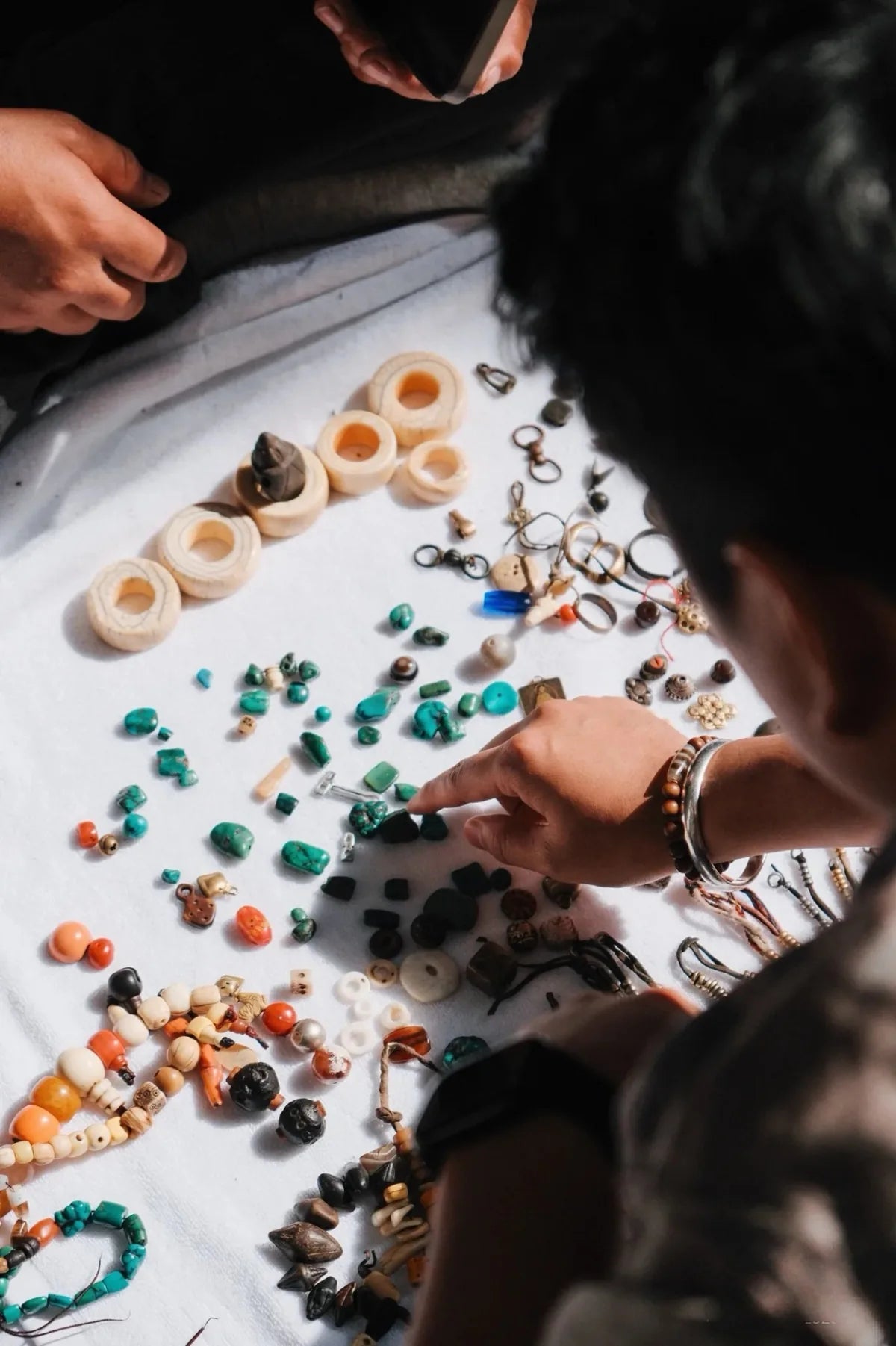
Traditional prayer beads have been made from seeds, wood, bone, stone, coral, shell, precious materials, and other substances. In Tibetan Buddhist ritual systems, particular materials can be associated with particular kinds of practice.
That does not mean every stone bracelet or necklace carries an automatic religious effect. Material associations belong to specific cultural and ritual contexts, and consecration or lineage practice cannot be inferred from appearance alone.
For contemporary jewelry, the material can still matter in another sense: weight, texture, durability, color, hand feel, and personal association all shape how an object is experienced.
Prayer Beads, Repetition, and Attention
The physical logic of a mala is remarkably simple. One bead marks one repetition. The hand moves, the voice or mind recites, and the count advances.
That tactile rhythm can support attention because the practitioner does not need to calculate every repetition mentally. The object holds the count while the person remains engaged with the practice.
This is one reason prayer beads have remained useful across centuries: they combine symbolic meaning with an extremely practical design.

Traditional Use and Kailora's Contemporary Interpretation
Traditional context: Tibetan Buddhist prayer beads are ritual counting tools used within religious practice.
Kailora's contemporary interpretation: a 108-bead design can also become a wearable reminder of repetition, patience, intention, and the discipline of returning attention to what matters.
Those two contexts should not be confused. Kailora jewelry is not presented as a substitute for religious instruction or as automatically possessing sacred efficacy. The cultural story comes first; the personal interpretation comes after.
For readers drawn to the complete 108-bead format, explore Kailora's 108 Mala Beads collection.
How to Choose Between a Ritual Mala and Mala-Inspired Jewelry
If your purpose is formal Buddhist practice, the most reliable approach is to follow the instructions of your teacher or lineage regarding bead count, materials, handling, and use.
If your purpose is personal reflection or jewelry, you have more freedom. You may care most about craftsmanship, bead size, material, comfort, length, or the symbolism you personally associate with 108.
The difference is not whether one object is “better.” It is whether we describe each object honestly.
Can You Wear a 108-Bead Mala?
A contemporary 108-bead strand may be worn as a long necklace or, when its construction is designed for it, as a multi-wrap piece. Check bead size, cord or elastic construction, terminal elements, weight, and product-specific sizing before wearing it in a way that places tension on the strand.
If your priority is everyday wear, see Hand Mala vs. Mala Necklace. For maintenance, read How to Care for Mala Beads, Dzi Beads & Natural Stone Jewelry.
Frequently Asked Questions
Why are there 108 beads in a mala?
108 is a traditional sacred and counting number used across Buddhist practice. Multiple symbolic explanations exist, so it is more accurate to treat 108 as a long-established religious number than to claim one universal origin.
Do Tibetan malas always have 108 beads?
No. 108 is a common full count, but shorter bead strings and other configurations are also used.
What is the purpose of separator beads?
They can divide the mala into smaller counting units. Some historic Tibetan examples divide 108 into four groups of 27.
Can I wear a 108-bead mala as jewelry?
Many people do, but a contemporary wearable design should not automatically be described as a consecrated ritual object. Cultural origin, intended use, and religious status are separate questions.
Is 54 better than 108?
Not inherently. A 54-bead design is shorter and represents half of 108, while a full 108-bead strand gives the traditional full count. The appropriate choice depends on practice, design, and intended use.
A Number That Becomes Meaningful Through Practice
The significance of 108 does not come from the number floating by itself. It comes from generations of people using numbers, beads, recitation, and repetition to structure religious practice.
Once that context is understood, a mala becomes more than an accessory—and 108 becomes more than a mysterious spiritual number.
Continue exploring the wider visual language of Tibetan-inspired design in Kailora's Tibetan Jewelry Symbol Meanings guide.
Continue with the Tibetan Culture Guide for related articles on symbols, ritual objects, sacred art, and material culture.