

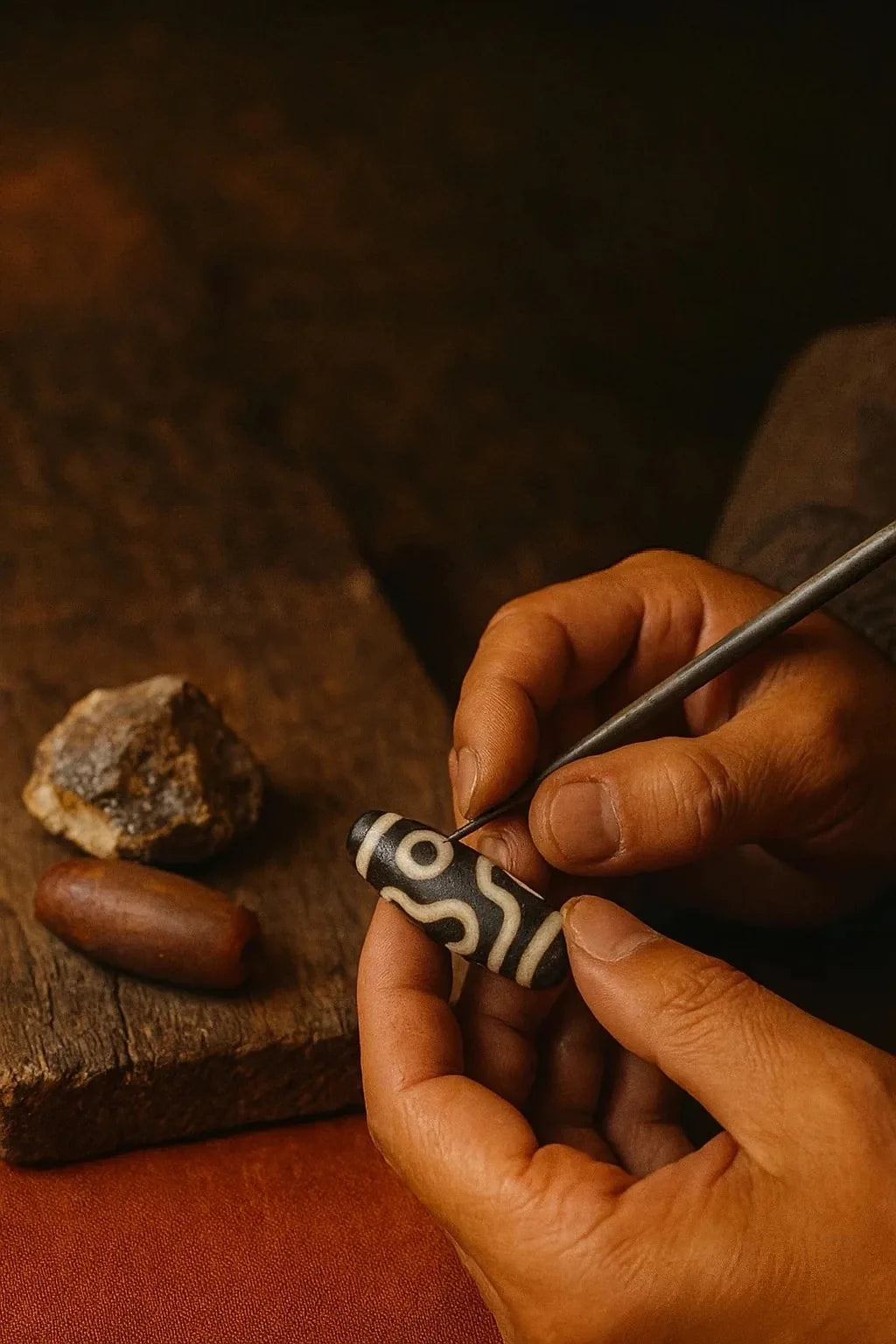










Dzi beads are often described as agate beads, but that shorthand can create a false equivalence. Agate is a gem material. Dzi is a culturally meaningful bead category identified by form, patterned surface, historical context, and the traditions surrounding the bead.
This guide separates those layers so you can understand what a Dzi bead may be made from, what an eye or stripe pattern does—and does not—tell you, and which claims require more evidence before you buy.
Quick answer: Many characteristic Dzi beads are made of agate. The Getty Art & Architecture Thesaurus describes Dzi beads as patterned beads that are generally made of agate. But “Dzi” is not the name of a mineral species. A specific bead’s material, treatment, age, and provenance still need to be described or verified separately. Saying “agate” does not by itself prove that a bead is an old Tibetan Dzi, and seeing an eye-like pattern does not by itself prove how that pattern was formed.
Dzi is a bead category, not a mineral name
The clearest way to avoid confusion is to ask two different questions:
- What is the bead made of? This is a material-identification question.
- What kind of bead is it? This is a cultural, design, and object-classification question.
Agate answers the first question. Dzi answers the second.
The Getty Art & Architecture Thesaurus describes Dzi beads as patterned beads—cylindrical, tubular, or round—with designs that can include eye-like circles, ovals, wavy lines, stripes, or rectangles. Getty notes that they are generally made of agate and may have etched or carved patterns.
That wording is important. “Generally made of agate” means agate is strongly associated with the bead type. It does not turn the word “Dzi” into a synonym for the mineral agate.
Why is agate so closely associated with Dzi beads?
Agate is a banded variety of chalcedony in the quartz family. It can naturally contain contrasting zones, bands, circles, and other structures that make it visually well suited to patterned bead work. It is also durable enough for beads, can take a good polish, and has a long history of use in carved and drilled ornaments across Asia.
For a deeper material explanation—including agate banding, natural eye patterns, color treatment, and the distinction between agate and chalcedony—read Agate: Gemology, Meaning, Treatments & Dzi Bead Context.
What do museums actually document?
Museum evidence helps clarify the relationship without forcing a single origin story.
The Rubin Museum of Himalayan Art holds a set of 19th-century Tibetan prayer beads whose listed materials include coral, turquoise, jade, dzi, clay, and silk. This is useful historical evidence that Dzi appears within documented Tibetan prayer-bead material culture. The museum listing, however, names “dzi” as a material/category in the object record; it does not identify the Dzi component there as a specific mineral species.
The British Museum holds ancient banded agate beads from Afghanistan, including examples dated around the first and second centuries CE. Its curators compare some of these beads with Tibetan dZi beads because they are “allied in shape, form and material.” The museum still identifies those objects as Afghan agate beads—not as Tibetan Dzi beads.
This distinction matters because visual or material similarity can show relationships between bead traditions without proving that two objects are culturally identical or share the same origin.
Are all Dzi beads agate?
A safer answer is: agate is characteristic and common, but the word “Dzi” alone should not be treated as a laboratory material identification.
Getty’s institutional vocabulary says Dzi beads are generally made of agate. That supports the strong material association. But when evaluating a specific piece of jewelry, the seller should still state what the particular bead is made from rather than relying on “Dzi” to do two jobs at once.
For example, Kailora product descriptions that say Natural Agate Dzi deliberately separate the material claim (“natural agate”) from the bead/design context (“Dzi”). The phrasing applies to those specific pieces; it is not intended as a universal definition of every object sold under the Dzi name.
Material and pattern are two separate questions
A bead can be identified as agate while still leaving another question unanswered: how did its visible pattern form?
Agate can contain natural bands, concentric zones, and eye-like structures. Dzi beads, meanwhile, are recognized for intentionally meaningful surface motifs such as eyes, lines, waves, and geometric forms.
So a circular pattern on a bead should not automatically be interpreted in one direction or the other. The circle may relate to natural agate banding, an intentionally produced Dzi pattern, or a combination of natural stone structure and human craftsmanship.
Natural eye agate vs a Dzi eye motif
Natural eye agate is a descriptive gem-material term. Concentric or eye-like zones can arise from the stone’s natural growth and banding, and the final appearance depends heavily on how rough material is cut and polished.
A Dzi eye motif belongs to a cultural and decorative vocabulary. Eye counts and arrangements are often given symbolic interpretations in Dzi traditions and modern Dzi communities.
The visual resemblance between the two does not make them the same phenomenon. A naturally occurring “eye” should not automatically receive a numbered Dzi meaning, and a Dzi eye design should not automatically be marketed as a naturally formed eye in the agate.
For the symbolism side rather than the material side, see What Does a Dzi Bead Symbolize?.
What has scientific testing found in an actual Dzi bead?
A 2020 study published in Heritage examined one three-eye Dzi bead using synchrotron-based X-ray methods and other analytical techniques. The researchers identified the studied bead as agate dominated by silica and found evidence that the ring patterns involved crafted etching on the agate surface.
This is valuable because it demonstrates how advanced analysis can separate material composition from manufactured pattern features in a real specimen.
It should not be generalized into a universal manufacturing recipe for all Dzi beads. It is one scientifically examined specimen, not proof that every Dzi bead was made in exactly the same way.
Natural color vs dyed or treated agate
Even after a bead is identified as agate or chalcedony, its color may raise another question.
The Gemological Institute of America documents dyeing as a long-established treatment for chalcedony. Dye can be introduced into porous material to create or strengthen color, and some treatments may not be obvious from appearance alone.
That means neither vivid color nor muted color is a reliable universal home test. Natural chalcedony can show strong color, while treated material can sometimes look visually convincing.
If treatment status is important to the value of a purchase, ask for clear disclosure. For consequential or high-value claims, qualified gemological testing is more dependable than scratching, heating, chemical soaking, or other destructive “authenticity” tests.
Can you identify a Dzi bead by eye alone?
You can observe useful features—shape, polish, banding, pattern placement, drilling, wear, surface texture, and construction—but appearance alone usually cannot establish every claim a seller might make.
A photograph cannot reliably prove all of the following at once:
- exact gem material;
- natural versus treated color;
- how a pattern was produced;
- age;
- geographic provenance;
- continuous cultural history of a specific bead.
Those are different evidence questions and should be treated separately.
Does agate prove a Dzi bead is old or authentic?
No. Identifying agate establishes material, not age or provenance.
An agate bead can be newly made, old, antique, archaeological, Dzi-related, or unrelated to Dzi. Likewise, a pattern that resembles a historical Dzi motif does not by itself establish when or where the bead was made.
This is one of the most important buying distinctions: material authenticity is not the same as historical authenticity.
Claims such as “ancient,” “antique,” “old Tibetan,” or a precise historical date require stronger provenance than a visual resemblance or an agate identification alone.
How Kailora describes Dzi materials
Kailora separates material description from symbolic interpretation wherever possible.
The Three-Eye Dzi Agate Bracelet, for example, explicitly identifies agate in the product name. The Dzi Agate Cord Necklace and Natural Agate Dzi Bead Earrings do the same.
These material labels describe the pieces Kailora sells. Symbolic language such as intuition, awakening, grounding, or abundance belongs to Kailora’s contemporary intention framework and should not be read as a mineral property or a guaranteed spiritual result.
How to choose a Dzi bead or Dzi-inspired piece
- Read the material line first. Look for a specific disclosure such as natural agate rather than assuming “Dzi” tells you the mineral.
- Separate pattern from material. An eye motif and an eye-like natural agate structure are not automatically the same thing.
- Ask about treatment when it matters. Color treatment can occur in chalcedony, and visual inspection is not always conclusive.
- Treat age claims independently. Agate does not prove that a bead is ancient or antique.
- Be cautious with precise provenance claims. A Tibetan-inspired design, a Tibetan cultural reference, and a documented Tibetan historical object are different categories.
- Evaluate construction. Cord, elastic, drilling, fittings, bead edges, and surface finish matter to everyday durability.
- Choose symbolism as intention, not guarantee. Let the bead remind you of a quality or practice rather than expecting a material to deliver a promised outcome.
For bracelet-specific guidance, read What Are Dzi Bead Bracelets?.
Frequently asked questions
What are Dzi beads usually made of?
The Getty Art & Architecture Thesaurus says Dzi beads are generally made of agate. For an individual bead, however, material should still be disclosed or identified separately rather than inferred from the Dzi name alone.
Is Dzi a type of agate?
Not in mineralogical classification. Agate is a banded chalcedony gem material. Dzi is a patterned bead category with Tibetan cultural associations. A Dzi bead may be made of agate, but “Dzi” and “agate” answer different questions.
Is an eye agate bead automatically a Dzi bead?
No. Natural agate can form concentric eye-like patterns. A Dzi eye belongs to a separate cultural and design vocabulary.
Are Dzi eye patterns always natural?
No such universal assumption should be made. Dzi patterns may involve human craftsmanship, while agate itself can also contain natural bands and eyes. One scientific study of a three-eye Dzi specimen found agate with crafted etched ring patterns.
Can I tell if a Dzi bead is ancient from a photo?
A photo can show visible characteristics, but it cannot reliably establish age and provenance by itself. Strong historical claims need supporting provenance, comparative scholarship, or appropriate specialist analysis.
Does a natural agate Dzi bead have guaranteed spiritual effects?
No. Material identity does not scientifically establish protection, luck, healing, wealth, or other guaranteed outcomes. Kailora treats symbolic jewelry as a wearable reminder for reflection and intention.
Explore Dzi and agate at Kailora
Browse the Tibetan Dzi Beads collection for Dzi-related designs and the Agate collection for agate-centered jewelry. If you want to compare the material side with the symbolic side, read the Agate Gemology Guide together with What Does a Dzi Bead Symbolize?.
For mixed-material care, see How to Care for Mala Beads, Dzi Beads, and Natural Stone Jewelry.
Editorial note: This guide separates gem material, cultural object classification, pattern formation, treatment, and historical provenance. Kailora’s intention language is contemporary and symbolic; it is not a medical, scientific, protective, financial, or spiritual guarantee.