


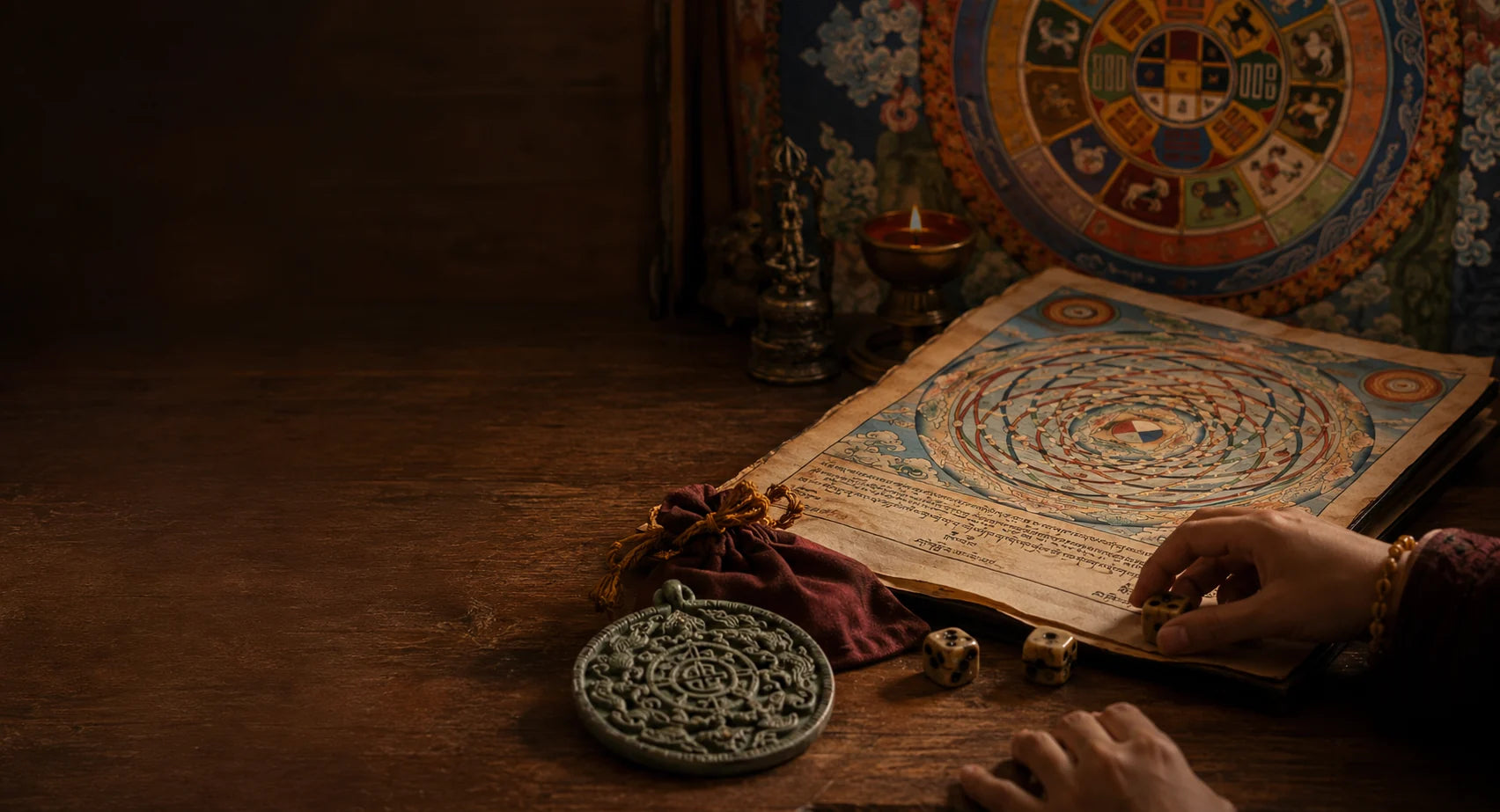

Some symbols are inherited before we ever choose them.
A zodiac animal may come from the year we were born. It may remind us of a parent or grandparent who shares the same sign. Or, over time, it may take on a more personal meaning—a quality we recognize in ourselves, or one we want to carry more consciously into everyday life.
For centuries, the twelve animals of the Chinese zodiac have turned the passage of time into a language of symbols: Rat, Ox, Tiger, Rabbit, Dragon, Snake, Horse, Goat, Monkey, Rooster, Dog and Pig.
At Kailora, we wanted to explore what happens when this symbolic language leaves the calendar and enters something smaller, softer and more intimate: thread, cloth and the movement of a hand.
The result is a collection of twelve Chinese zodiac brooches, individually hand-embroidered in Tibet.
Not simply twelve animals. Twelve symbols, carried forward in thread.
The Chinese Zodiac: A Twelve-Year Language of Time
The Chinese zodiac is built around a repeating twelve-year animal cycle within the traditional Chinese calendrical system. Each year is associated with one of twelve animals, and those animals are traditionally paired with the Twelve Earthly Branches.

This is why Kailora keeps the traditional pairing in the names of the twelve designs rather than reducing them to animal names alone:
子鼠 · Zi Rat
丑牛 · Chou Ox
寅虎 · Yin Tiger
卯兔 · Mao Rabbit
辰龍 · Chen Dragon
巳蛇 · Si Snake
午馬 · Wu Horse
未羊 · Wei Goat
申猴 · Shen Monkey
酉雞 · You Rooster
戌狗 · Xu Dog
亥豬 · Hai Pig
The animal is the image we recognize. The Earthly Branch connects that image to a much older system of cyclical time. Together, they carry more cultural depth than a simple animal motif.

For a deeper guide to birth years, family symbolism and the cultural meanings traditionally associated with all twelve animals, read What Is My Chinese Zodiac Sign? The Cultural Meaning of the 12 Animals.
Twelve Animals, Twelve Symbolic Qualities
The meanings connected with zodiac animals have accumulated through storytelling, visual culture and everyday tradition. They should not be treated as fixed rules about personality or destiny. For this collection, Kailora uses a concise symbolic language:
子鼠 · Zi Rat — Wit · Adaptability
丑牛 · Chou Ox — Steadiness · Strength
寅虎 · Yin Tiger — Courage · Vitality
卯兔 · Mao Rabbit — Grace · Sensitivity
辰龍 · Chen Dragon — Power · Auspiciousness
巳蛇 · Si Snake — Wisdom · Transformation
午馬 · Wu Horse — Freedom · Progress
未羊 · Wei Goat — Peace · Creativity
申猴 · Shen Monkey — Curiosity · Ingenuity
酉雞 · You Rooster — Clarity · Confidence
戌狗 · Xu Dog — Loyalty · Protection
亥豬 · Hai Pig — Abundance · Kindness
These are symbolic themes, not predictions, guarantees of luck, or promises of spiritual outcomes.
From Symbol to Stitch
A symbol can be printed thousands of times and remain exactly the same. Embroidery does something different.
Thread has tension. Cloth gives beneath the hand. Curves must be built from individual stitches. Small changes in pressure, spacing and direction become part of the finished image.

That is why hand embroidery always carries a trace of the person who made it.
The twelve Kailora zodiac brooches are created using a cotton-linen textile base and cotton-linen embroidery thread. The animal begins as a form. Then, stitch by stitch, its outline, expression and texture emerge.

A Tiger becomes recognizable through the direction of a line. A Rabbit through the curve of an ear. A Dragon through the rhythm of its body.
The result is intentionally different from the perfect repetition of machine production. Two brooches depicting the same zodiac animal may share one design, but small variations in thread, contour and stitch remain. We see those differences not as flaws, but as evidence of the hand.
Chinese Symbolism, Handcrafted in Tibet
It is important to distinguish the cultural origin of the symbol from the place where this particular object is made.
The Chinese zodiac belongs to Chinese calendrical and cultural traditions. These Kailora brooches are hand-embroidered in Tibet.
The two facts can exist together without being confused. The zodiac provides the symbolic language. The handcraft gives that language material form.
Kailora creates Tibetan-inspired ritual jewelry and meaningful wearable objects, while naming the cultural source of each symbol as clearly as possible. When a design draws on a tradition outside Tibet, we believe that origin should remain visible rather than being absorbed into a vague “Himalayan” label.
Tibet also has its own complex astrological traditions, including animal-element cycles that historically interacted with systems from neighboring cultures. They should not simply be treated as another name for the Chinese zodiac. For a closer comparison, read Tibetan Astrology vs Chinese Zodiac: What’s Similar and What’s Different?
Quick Facts About This Collection
- Cultural reference
- Traditional Chinese zodiac and the Twelve Earthly Branches.
- Place of craftsmanship
- Tibet.
- Craft
- Hand embroidery.
- Materials
- Cotton-linen textile and cotton-linen embroidery thread.
- Designs
- Twelve animal brooches, from 子鼠 · Zi Rat through 亥豬 · Hai Pig.
Why Kailora Chose to Turn the Zodiac Into Something Wearable
Small wearable objects have always had a relationship with memory. We keep things close because they remind us—of a place, a person, a promise, who we were, or who we are trying to become.
That idea sits at the center of Kailora. For us, symbolism becomes most meaningful when it can leave the page and enter ordinary life.

A zodiac brooch does not need to predict your future to matter. A Tiger can remind someone to act with courage. A Dog can recall loyalty to a person or principle. A Horse can accompany someone moving into a new phase of life. A Rabbit can represent softness at a time when the world feels loud.
The meaning does not have to be dramatic. Sometimes a symbol only needs to be present.
This is part of what we mean by Wear your intention.
How to Choose Your Chinese Zodiac Brooch

Choose the Animal Connected to Your Birth Year
The most traditional starting point is the zodiac animal associated with the lunar year in which you were born. Because the Chinese zodiac follows the traditional lunisolar calendar rather than beginning automatically on January 1, people born in January or early February should check the exact Lunar New Year date for their birth year.
Your Gregorian birth year alone may not always identify the correct sign. This is especially worth checking when choosing a zodiac piece as a gift.
Choose the Symbol That Speaks to You
Birth year does not have to be the only reason to carry a zodiac animal. You may simply feel connected to what a particular animal represents, or choose the sign of someone important to you.
In that sense, the zodiac can become a language of relationships as much as a language of years.
A Small Symbol From Tibet, Carried Into Everyday Life
A brooch is modest in scale. That is part of its appeal. It does not need to dominate what you wear. It can sit quietly on a jacket, coat, scarf, knitwear or fabric bag.

From a distance, it may simply appear to be an embroidered animal. Closer, there is more to discover: the thread, the handmade irregularities, the traditional zodiac pairing, the animal you chose, and whatever meaning you decided to give it.
In that way, an object made far away can enter an ordinary day without becoming costume or decoration for decoration’s sake. It becomes personal—a small symbol, a piece of handwork, a connection carried with you.
Twelve Animals. Twelve Stories. One Chosen Symbol.
The twelve zodiac animals have travelled through centuries of calendars, art, objects, family stories and cultural memory. In Kailora’s hand-embroidered brooch collection, they take another form: cotton-linen cloth, thread, individual stitches, and a piece made by hand in Tibet.
Choose the zodiac animal connected to the year you entered the world. Or choose the symbol that speaks most clearly to where you are now.
Either way, the meaning begins before the object—and continues with the person who carries it.
Explore the Chinese Zodiac Hand-Embroidered Brooch — Handcrafted in Tibet →
Wear your intention.