
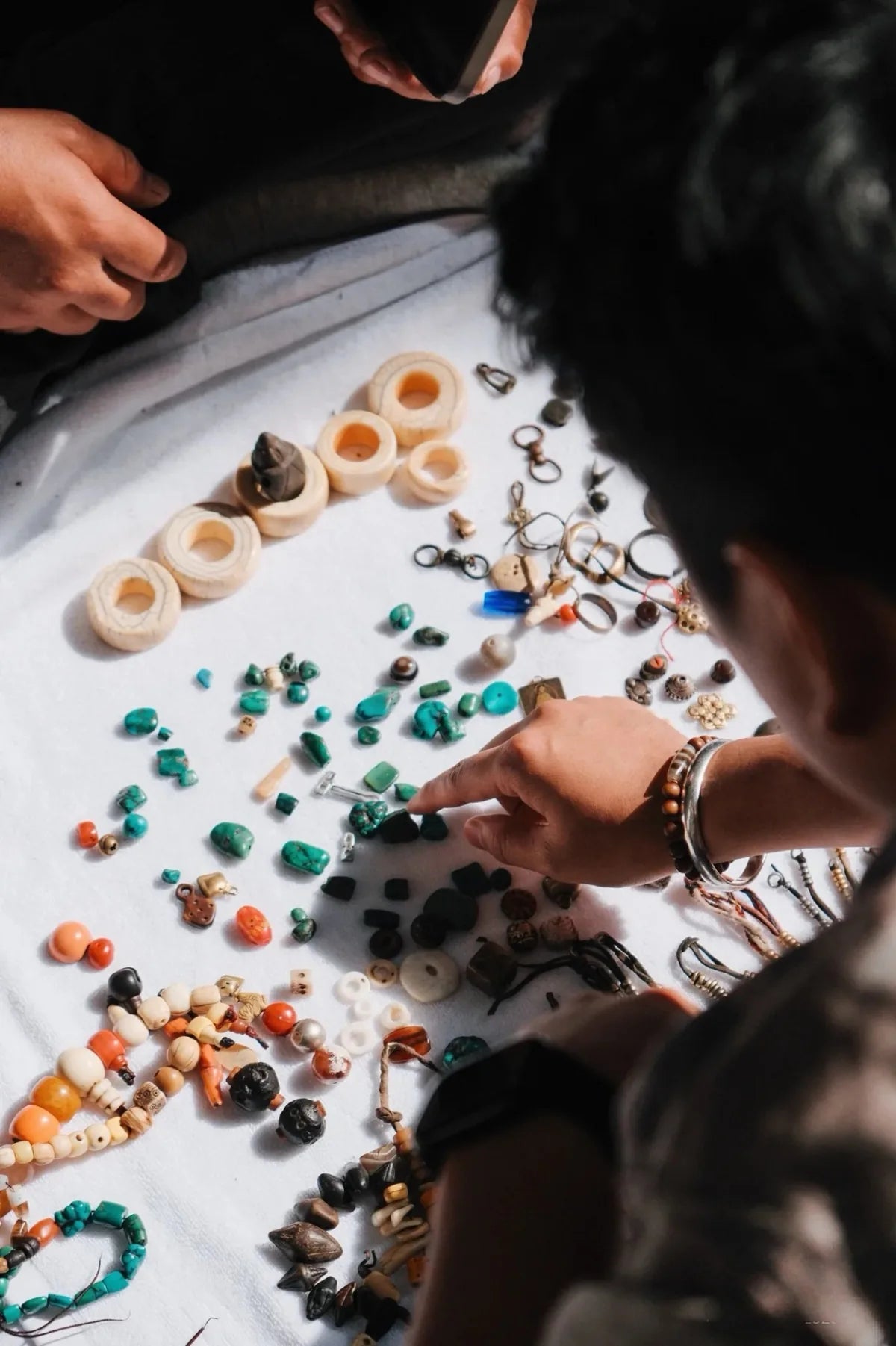
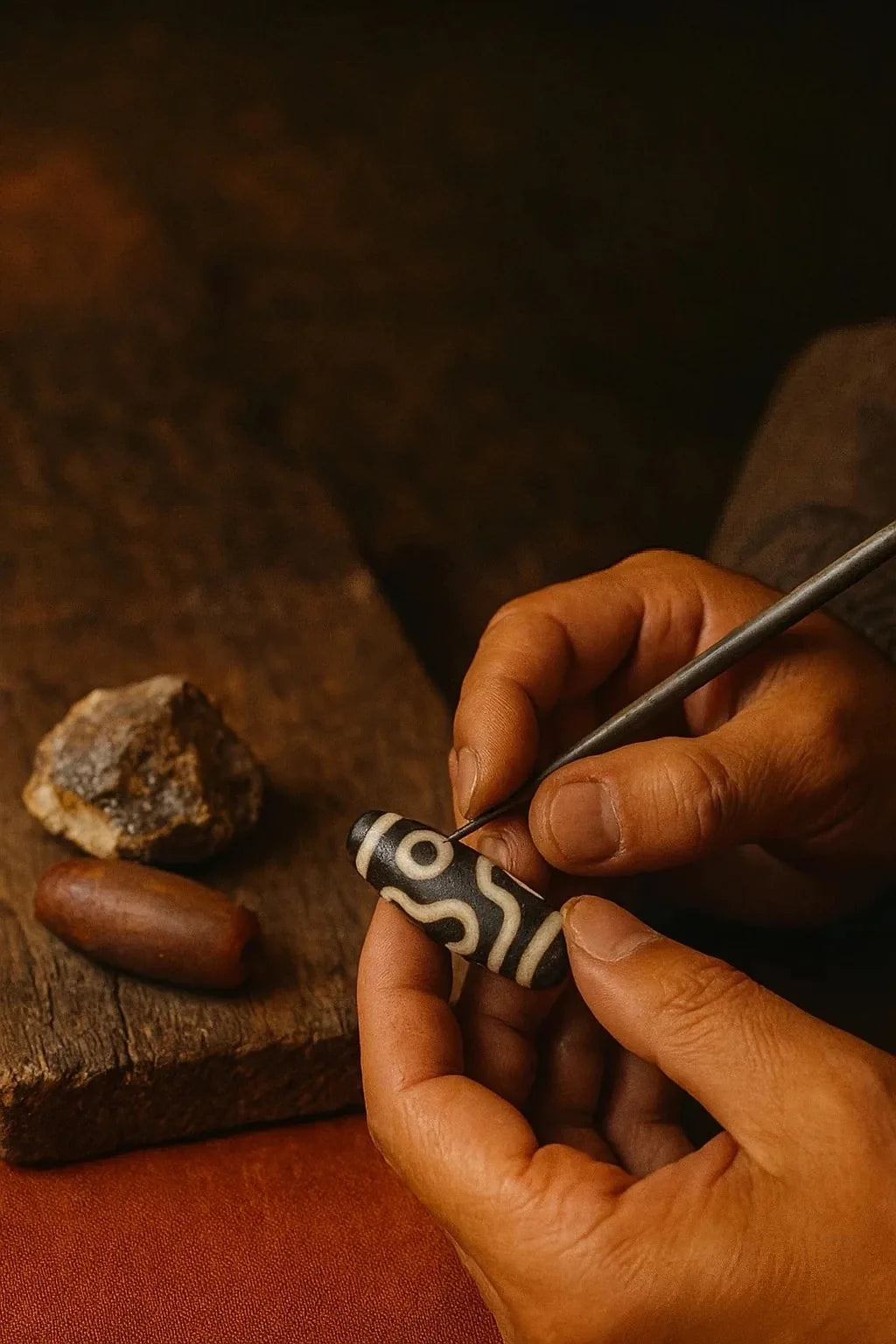


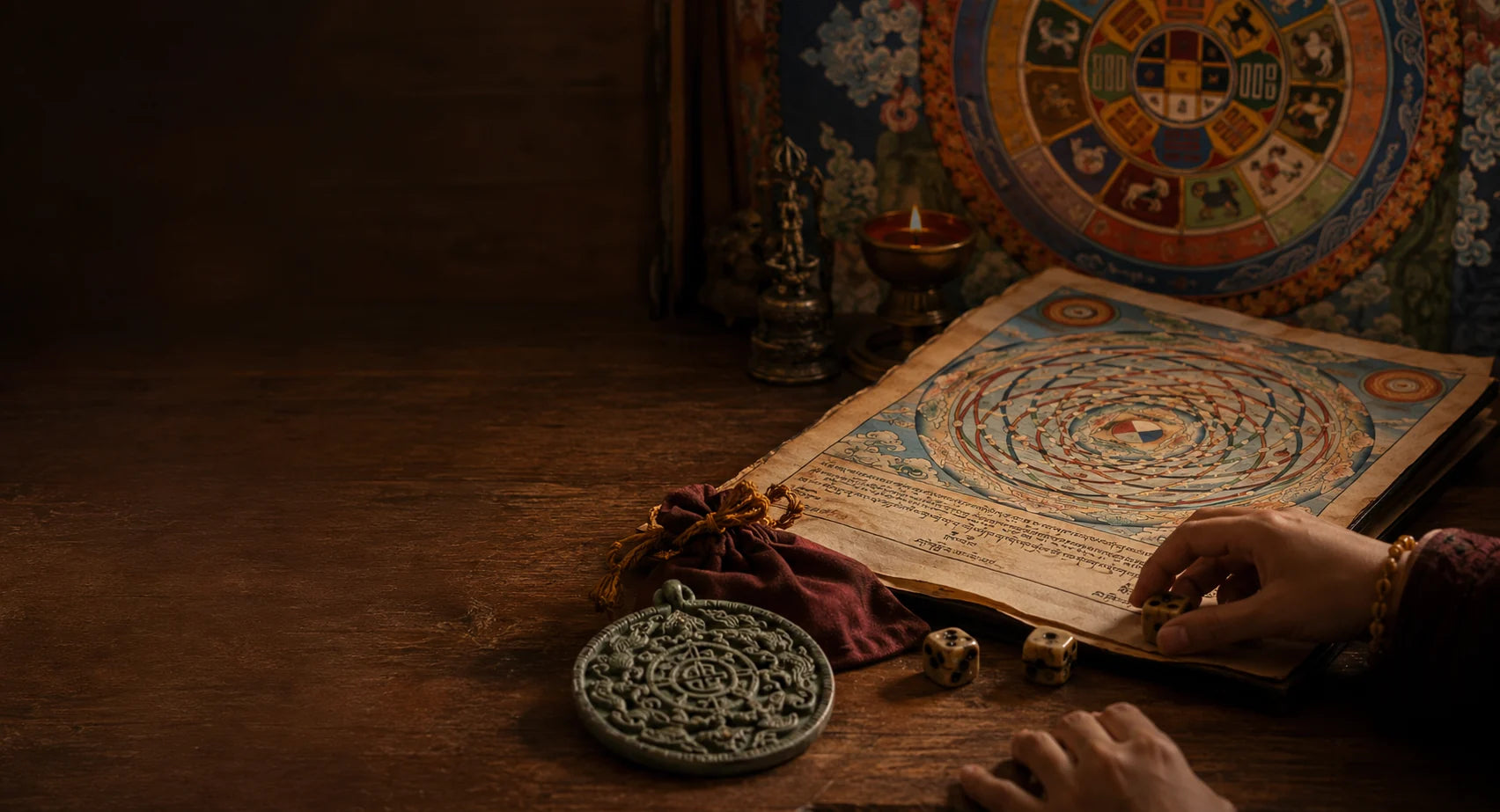

Across Tibetan paintings, textiles, ritual objects, architecture, and decorative arts, certain symbols appear again and again.
A lotus. A pair of golden fish. A beautifully knotted line with no visible beginning or end. A vase filled with treasure. A white conch shell. A parasol. A victory banner. And a wheel.
Together, they are known as the Eight Auspicious Symbols, one of the most recognizable groups of symbols associated with Tibetan Buddhism.
In Sanskrit, the group is commonly known as the Ashtamangala, meaning “eight auspicious signs.” The symbols have roots in wider Indian religious and royal traditions and became deeply integrated into Tibetan Buddhist visual culture.
They are not simply decorative motifs. Over centuries, they have appeared across sacred paintings, textiles, ritual implements, furniture, architectural decoration, and everyday objects, carrying layers of religious and cultural meaning.
This guide introduces each of the eight symbols, what it commonly represents, and how to understand these images without reducing them to generic ideas of “luck” or “energy.”
Quick Answer
The Eight Auspicious Symbols are the Precious Parasol, Pair of Golden Fish, Treasure Vase, Lotus, Right-Turning Conch Shell, Endless Knot, Victory Banner, and Dharma Wheel. In Tibetan Buddhism they form a traditional group of auspicious signs associated with themes such as refuge, freedom, abundance, purity, continuity, spiritual victory, and the Dharma.
The Eight Auspicious Symbols at a Glance
- The Precious Parasol
- The Pair of Golden Fish
- The Treasure Vase
- The Lotus
- The Right-Turning Conch Shell
- The Endless Knot
- The Victory Banner
- The Dharma Wheel
The precise interpretation of each symbol can vary depending on text, lineage, artistic setting, and ritual context. What follows is therefore a cultural introduction rather than a claim that every Tibetan tradition interprets each image in exactly the same way.
The Eight Auspicious Symbols should also not be confused with another Buddhist auspicious set, the Seven Symbols of Royal Power. The two groups overlap in the wider visual world of auspicious and royal symbolism, but they are distinct sets with different histories and iconographic roles.
Where Do the Eight Auspicious Symbols Come From?
The Eight Auspicious Symbols did not originate as a uniquely Tibetan set.
Their history reaches back into the broader religious and cultural world of India. As Buddhist teachings, artistic traditions, texts, teachers, and ritual practices moved across the Himalayas, these auspicious images became an important part of Tibetan Buddhist art and material culture.
In Tibet and the wider Himalayan world, the symbols can appear individually or together as a complete group. They may decorate a thangka, frame a sacred image, appear on a ritual vessel, be painted onto furniture, woven into textiles, or become part of an ornamental design.
That repeated presence is important. It means the Eight Auspicious Symbols function as a kind of visual language—one that can communicate ideas of protection, purity, abundance, Dharma, continuity, and spiritual accomplishment without relying on long written explanations.
1. The Precious Parasol
The parasol has a long history as a symbol of dignity and high status in South Asian culture.
In Buddhist symbolism, its protective shade developed into a metaphor for shelter and protection.
Just as a physical parasol shields someone from the intensity of the sun, the symbolic parasol can suggest protection from harmful influences, obstacles, and suffering. In Tibetan Buddhist visual culture, it can therefore carry ideas of both dignity and spiritual refuge.
The important distinction is that the parasol is not simply a magical “protection charm.” Its meaning is rooted in a much broader Buddhist language of refuge and protection.

2. The Pair of Golden Fish
Two golden fish are usually shown together.
Because fish move freely through water, the pair became associated with freedom, ease, and fearlessness.
Different traditions add additional layers of meaning, including happiness, abundance, fertility, and liberation. Visually, the two fish also introduce an unusual sense of movement into the otherwise highly structured set of eight symbols.
Rather than being trapped by the water surrounding them, the fish move naturally within it. This is one reason the image has often been interpreted as an emblem of freedom from fear and constraint.

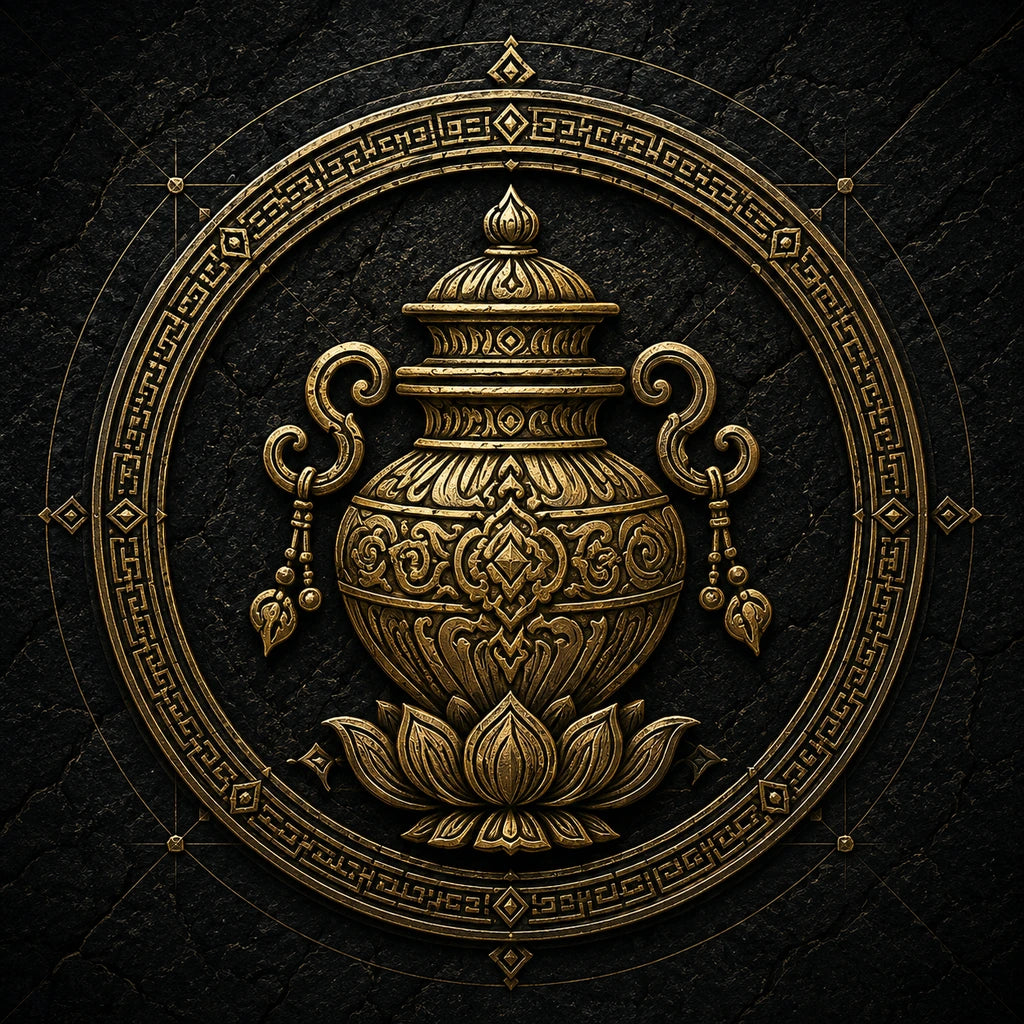
3. The Treasure Vase
The treasure vase—often called bumpa in Tibetan contexts—is one of the richest symbols in the group.
It is generally associated with abundance, longevity, prosperity, blessings, and inexhaustible treasure.
The idea is not limited to material wealth. In Buddhist contexts, “treasure” can also refer to spiritual qualities, teachings, merit, wisdom, and the conditions that support practice.
The vase is therefore best understood as an image of fullness: something precious that continues to give without being exhausted.
This is also an important example of how a traditional symbol can be misunderstood when translated only through modern wellness language. “Abundance” is part of its symbolism, but the traditional concept is broader than the modern idea of simply “manifesting wealth.”

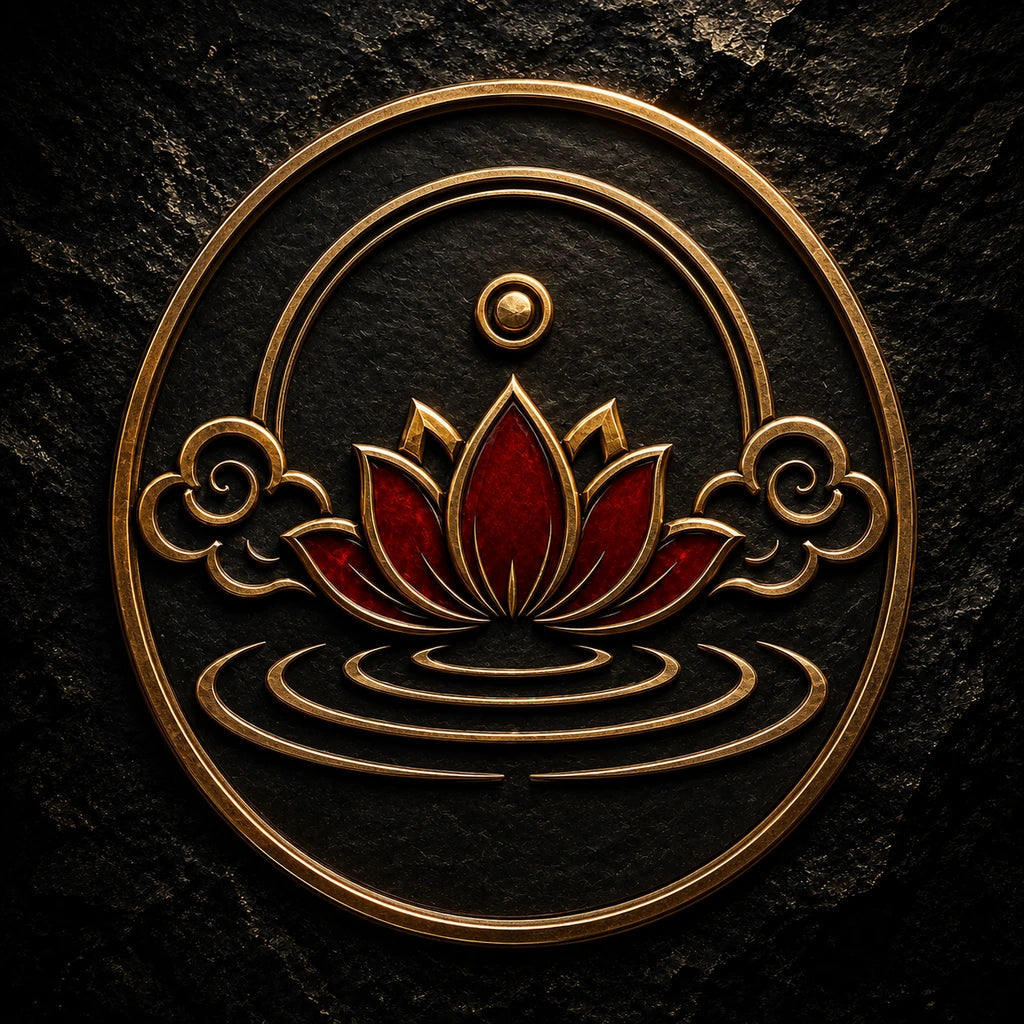
4. The Lotus
The lotus is among the most widely recognized symbols in Buddhist traditions.
Its imagery comes from a simple but powerful natural observation: the plant grows from muddy water while its blossom opens above the surface.
For this reason, the lotus became associated with purity, spiritual development, and awakening.
The metaphor does not suggest that purity requires escaping the world. Instead, the lotus demonstrates how clarity and beauty can emerge from difficult or imperfect conditions.
Within Tibetan Buddhist art, lotuses frequently appear as seats supporting buddhas, bodhisattvas, teachers, and deities, as well as in decorative and symbolic compositions.
If you want to explore this symbol in greater depth, read Kailora’s guide to the symbolic meaning of the lotus.

5. The Right-Turning Conch Shell
The auspicious conch is traditionally shown as a white shell whose spiral turns to the right.
Its symbolism is strongly connected with sound.
A conch can carry sound across a great distance, and in Buddhist imagery it became associated with the far-reaching sound of the Dharma—the Buddha’s teachings.
For this reason, the conch does not primarily symbolize “energy,” despite how it may sometimes be presented in contemporary spiritual design. Its traditional metaphor is closer to proclamation, teaching, awakening, and the spreading of the Dharma.
The direction of the spiral also matters visually: the right-turning conch is specifically identified as an auspicious form in the traditional group.
This symbolic conch should be distinguished from the actual ritual conch trumpet, or dung-dkar, used as a sound-producing instrument in Tibetan Buddhist ceremonial contexts. The image and the ritual object are related through the conch form, but they are not the same category.

6. The Endless Knot
The Endless Knot is formed from a continuous interwoven line without a visible beginning or end.
It is one of the symbols most readily adapted into modern design because of its strong geometry.
Traditional interpretations connect the knot with ideas such as continuity, interdependence, connection, and the inseparability of wisdom and compassion.
Its absence of a clear beginning or ending also makes it a powerful visual expression of relationships that cannot be understood in isolation.
Rather than viewing the knot simply as a symbol of “infinity,” it is more useful to see its interwoven structure as part of a Buddhist understanding of interconnected conditions.
Kailora explores this symbol separately in our guide to the meaning of the Endless Knot.

7. The Victory Banner
The victory banner has roots in older symbols of triumph.
Within Buddhist symbolism, however, victory was reinterpreted as spiritual victory.
It can represent overcoming obstacles, ignorance, harmful tendencies, and forces that stand in the way of awakening.
This distinction matters. The banner is not primarily about defeating another person. Its deeper symbolism turns the idea of victory inward: the more significant struggle is with confusion, attachment, ignorance, and the obstacles encountered on the spiritual path.
That gives the symbol a very different tone from an ordinary military banner.

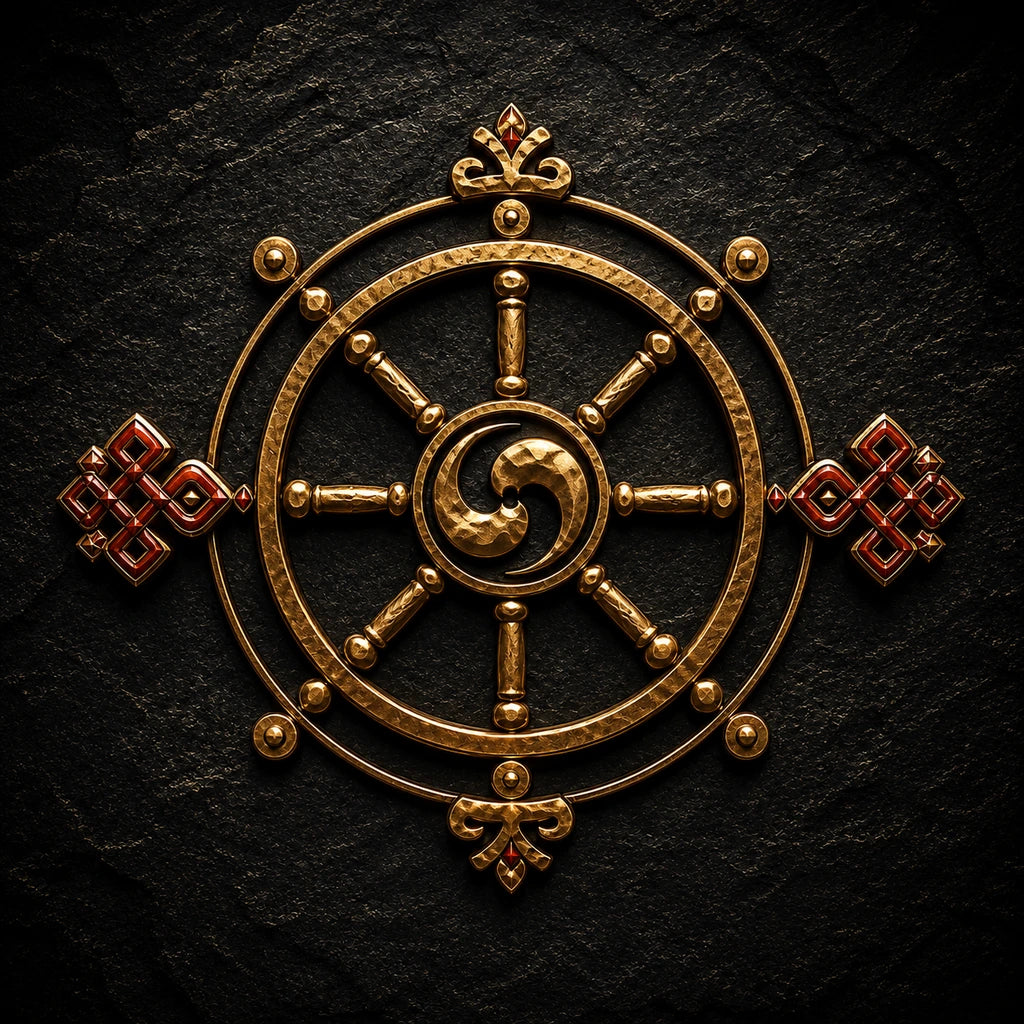
8. The Dharma Wheel
The wheel is one of Buddhism’s foundational symbols.
Often called the Dharma Wheel or Dharmachakra, it represents the Buddha’s teachings and the continuing transmission of the Dharma.
The image of “turning the wheel” became a metaphor for teaching the Dharma.
Eight-spoked versions of the wheel are also commonly associated with the Noble Eightfold Path, although the wheel appears in multiple forms and contexts throughout Buddhist art.
The Dharma Wheel should not be confused with a prayer wheel. A Dharma Wheel is primarily a symbolic image associated with Buddhist teaching. A Tibetan prayer wheel, by contrast, is a physical ritual object traditionally containing written mantras or sacred texts and designed to be rotated.
For the ritual object itself, read What Is a Tibetan Prayer Wheel? Mantras, Merit, and Why It Turns Clockwise.

Why Do the Eight Symbols Appear So Often in Tibetan Art?
One reason is that Tibetan Buddhist visual culture communicates through symbols with remarkable density.
An artwork does not need to explain everything with written text. A lotus, wheel, conch, vajra, animal, color, posture, or ritual object can immediately add layers of meaning to an image for someone familiar with the visual language.
The Eight Auspicious Symbols are particularly effective because they can function individually, as a complete set, as offerings, as decorative motifs, as attributes held by figures, or as framing elements around larger sacred compositions.
Museum collections preserve examples of the symbols on Tibetan and Himalayan paintings, textiles, ritual objects, furniture, armor, and other material objects.
This tells us something important: symbolism in Tibetan culture is not separate from material culture. Meaning is often carried through things people see, make, offer, use, preserve, and pass down.
Are the Eight Auspicious Symbols “Lucky Symbols”?
Calling them “lucky symbols” is not completely wrong, but it is incomplete.
“Auspicious” is a better word.
The symbols are connected with favorable conditions, blessings, well-being, and spiritual qualities, but their meanings go far beyond the modern idea of an object that simply brings good luck.
A Dharma Wheel is tied to teaching. A conch is tied to the transmission of Dharma. A lotus evokes purity and awakening. A victory banner refers to overcoming obstacles. An Endless Knot can point toward continuity and interdependence.
Understanding those distinctions makes the symbols much more interesting than treating all eight as interchangeable good-luck charms.
Traditional Meaning and Modern Interpretation
This distinction is especially important when traditional Tibetan imagery enters modern jewelry, fashion, or wellness culture.
A symbol may inspire a contemporary idea, but the contemporary interpretation should not be presented as though it were the only traditional Tibetan meaning.
Traditional context:
The Treasure Vase belongs to the Eight Auspicious Symbols and is associated with abundance, longevity, blessings, and inexhaustible treasure.
Modern personal interpretation:
Someone today might wear a vase-inspired symbol as a reminder to recognize abundance in everyday life.
Both ideas can exist. The important thing is to identify where tradition ends and personal interpretation begins.
That principle guides how Kailora approaches Tibetan jewelry symbol meanings: first understand the cultural context, then consider how a symbol might speak to modern life.
How Kailora Approaches Tibetan-Inspired Symbolism
Kailora draws inspiration from Himalayan visual culture and Tibetan symbolic traditions while recognizing that sacred symbols have histories far deeper than modern jewelry.
For us, learning the story behind a symbol matters as much as its visual beauty.
A lotus can become a personal reminder of clarity. An Endless Knot may invite reflection on connection. A vase may inspire thoughts of gratitude and abundance.
But these are Kailora interpretations for contemporary life, not replacements for the symbols’ traditional Buddhist meanings.
That distinction allows traditional culture and modern personal meaning to exist side by side without flattening one into the other.
You can learn more about Kailora’s approach to Tibetan-inspired jewelry.
Related Tibetan Cultural Guides
Continue with Tibetan prayer wheels, Tibetan thangka painting, and Tibetan Buddhist mandalas to see how symbols function within ritual objects and sacred art.
Frequently Asked Questions
What are the Eight Auspicious Symbols of Tibetan Buddhism?
They are the Precious Parasol, Pair of Golden Fish, Treasure Vase, Lotus, Right-Turning Conch Shell, Endless Knot, Victory Banner, and Dharma Wheel.
Are the Eight Auspicious Symbols originally Tibetan?
Not exclusively. Their history is connected with older Indian auspicious and Buddhist traditions. They later became deeply integrated into Tibetan Buddhist art, ritual, and material culture.
Are all eight symbols supposed to bring good luck?
They are traditionally considered auspicious, but each symbol has its own religious and cultural associations. Reducing all eight to generic “good luck” loses much of their meaning.
Is a Dharma Wheel the same as a Tibetan prayer wheel?
No. The Dharma Wheel is a Buddhist symbol associated with the Dharma and its teaching. A prayer wheel is a physical ritual object that traditionally contains mantras or sacred texts and is rotated as part of religious practice.
Can the Eight Auspicious Symbols be used in jewelry?
They have historically appeared across many kinds of material and decorative objects. In contemporary jewelry, they can also be used as symbolic design elements. When sacred imagery is used, understanding its original context is a more respectful approach than treating it as decoration alone.
Symbols Become More Meaningful When Their Stories Are Known
The Eight Auspicious Symbols show how much meaning can be carried by a small visual form.
A fish, knot, flower, shell, vase, banner, parasol, or wheel may look simple at first. Behind each image is a much larger history of Buddhist thought, artistic exchange, ritual life, and Tibetan visual culture.
Learning those histories changes the way we see the objects themselves.
And that is where Kailora’s cultural journey begins—not by turning ancient symbols into modern claims, but by learning what they have meant before asking what they might mean to us today.
Explore more Tibetan-inspired jewelry and symbolic designs from Kailora.
Continue exploring this wider context in the Tibetan Culture Guide, which connects symbols, ritual objects, sacred art, and pilgrimage across the Kailora Journal.