


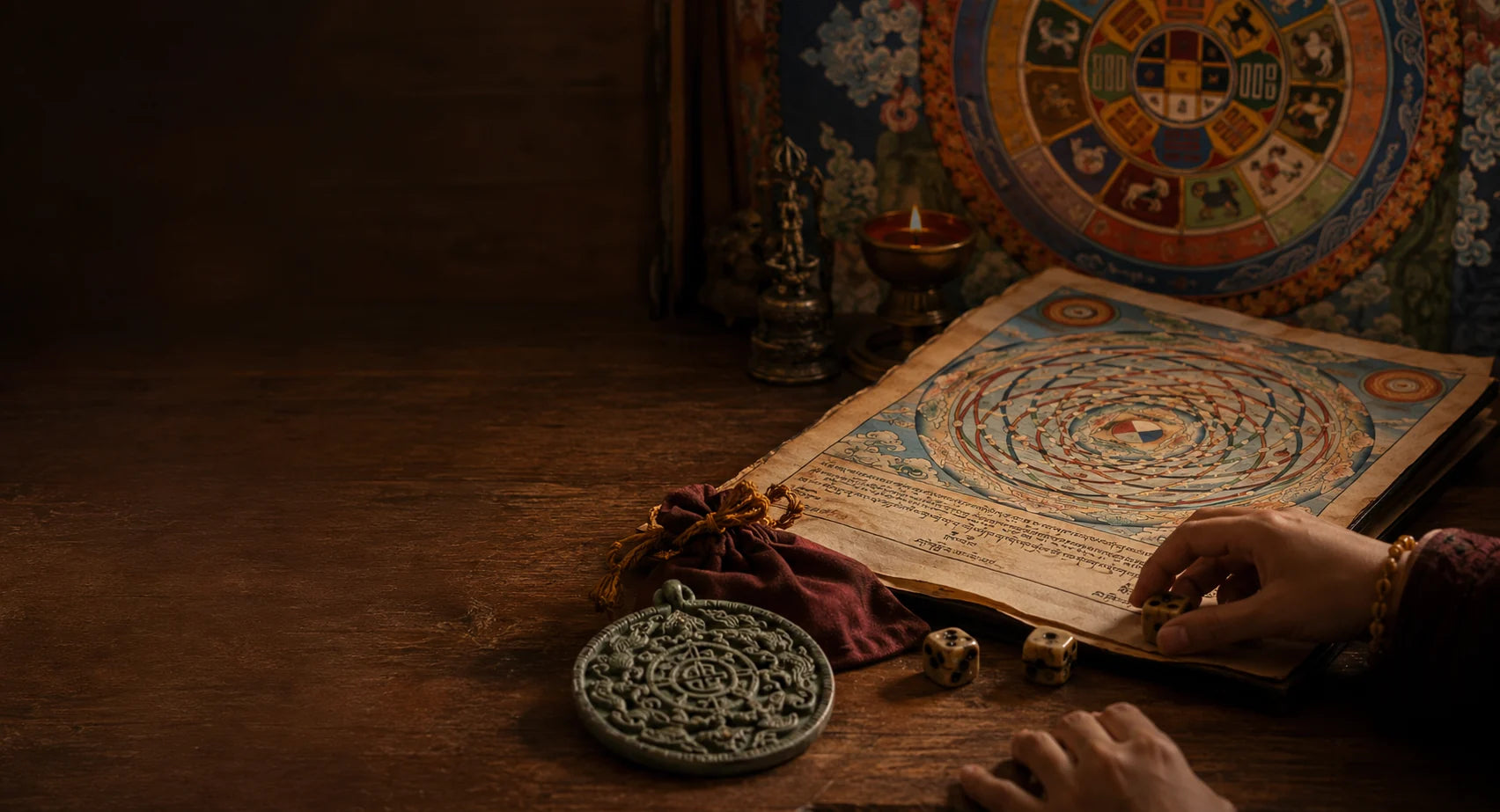

To many modern viewers, the word mandala immediately suggests a circular geometric pattern: perfect symmetry, repeating lines, and a center surrounded by rings of color.
That visual impression is not entirely wrong—but it is only the surface.
In Tibetan Buddhism, a mandala is not simply a decorative pattern designed around a circle. It can represent an entire sacred world: a structured environment used in meditation, ritual, visualization, initiation, and religious teaching.
A better question is not simply, “What pattern do I see?” but:
What world is this image asking the practitioner to enter?
Quick Answer
A Tibetan Buddhist mandala is a sacred diagram or representation of an ordered religious universe, often centered on a deity and structured as a palace. It can support visualization, meditation, initiation, ritual practice, and cosmological teaching.
What Does “Mandala” Mean?
The word mandala comes from Sanskrit. In Tibetan Buddhist contexts, the Tibetan term kyilkhor is also commonly used and is often explained as a circle or enclosure organized around a center.
That idea of a center is fundamental.
In many tantric Buddhist palace mandalas, a principal deity occupies the center, surrounded by additional figures, architectural structures, symbolic boundaries, directions, and layers of sacred space.
The center is not simply the most visually attractive part of the composition. It is the organizing principle of the entire mandala. Everything around it has a relationship to that center.
This is why the mandala can be understood simultaneously as a religious image, a diagram, a palace, a map, and a structured visualization of a sacred universe.
A Mandala Is Not Just a Circle
One of the most common misunderstandings about mandalas is that mandala = circular pattern.
Traditional Tibetan Buddhist mandalas are often much more architecturally complex. A familiar palace mandala may appear as a square structure set within surrounding circular zones. The square can represent the palace of the central deity, while entrances, walls, boundaries, and directional areas organize the sacred environment.

Another well-known circular Tibetan Buddhist image, the Wheel of Life or Bhavachakra, is not simply another mandala. It functions as a visual teaching about samsara, karma, the six realms, dependent origination, and liberation. Similar circular appearance does not make two religious images the same category.
But this does not mean every mandala follows one universal template.
Different tantric systems have different deities, colors, figures, directional associations, palace structures, and ritual instructions. It would therefore be misleading to say that every mandala has exactly the same gates, colors, figures, or symbolic meaning.
The mandala is a category of religious visualization—not one single fixed diagram.
Why Is There a Palace at the Center?
When viewed from above, a painted mandala may look flat. But practitioners do not necessarily understand it as a flat pattern.
Many mandalas represent a three-dimensional celestial palace.
During visualization practice, the lines and shapes of the image may be understood spatially: a line can represent a wall, an opening can represent an entrance, a surrounding ring can mark a boundary, and the center can represent the heart of the deity’s sacred environment.
In this sense, the mandala is almost architectural.
It is a building drawn as a diagram—or, more accurately, a sacred environment compressed into an image.
Moving from the Outside Toward the Center
A mandala can also be understood as a journey through increasingly sacred space.
The practitioner begins outside, encounters boundaries, enters the palace, and moves toward the center.
This movement does not necessarily happen physically. It can happen through visualization.
In certain tantric practices, a practitioner imagines entering the deity’s mandala, sometimes using a painting or three-dimensional model as a support. The mandala therefore functions less like a poster and more like mental architecture.
The practitioner does not only observe it from the outside. Through meditation, the mandala becomes a world to be entered, visualized, and experienced.
What Is the Purpose of a Mandala?
There is no single use shared by every mandala, but traditional Tibetan Buddhist contexts include several important functions.
Meditation and Visualization
Mandala images can provide a precise focus for visualization practice. A practitioner may mentally reconstruct the palace, its central deity, surrounding figures, and sacred environment.
Tantric Initiation
Certain mandalas are used during initiation or empowerment rituals. These practices belong to specific teachers, texts, lineages, and ritual systems; they are not simply public art-viewing experiences.
Representing Sacred Presence
A mandala can serve as a representation of sacred presence within ritual space.
Offering the Universe
Mandala forms can also appear in ritual offerings in which the universe itself is symbolically offered.
This is why it is difficult to explain a mandala accurately without mentioning religious practice. Its geometry and its ritual function are intertwined.
Who Lives Inside a Mandala?
In many Tibetan Buddhist mandalas, the center is occupied by a principal deity. Additional sacred figures may appear around that deity in carefully organized positions.
These figures are not decorative characters added to fill empty space. Their identities, positions, gestures, colors, attributes, and relationships can be defined by the specific ritual system associated with that mandala.
Directions and colors can also carry system-specific meanings. But there is no universal color dictionary that explains every Tibetan mandala.
A color or direction in one practice should not automatically be assigned the same meaning in another. The specific religious context comes first.
Are Mandalas Always Painted?
No.
A mandala is not defined by a single artistic medium. Tibetan Buddhist mandalas can appear as paintings, sand constructions, three-dimensional palace models, ritual arrangements, architectural forms, and metal cosmological models.

Some mandalas can be painted on a thangka. Others may be built rather than painted.
So when people say “mandala art,” they are referring to only one possible visual form of a much broader religious concept.
Mandala vs. Thangka: What Is the Difference?
This distinction is important.
A thangka describes a type of Tibetan hanging scroll.
A mandala describes a sacred diagram, cosmic structure, or deity’s sacred environment.
Therefore, a mandala can be painted on a thangka—but not every thangka is a mandala.
A thangka might instead depict a Buddha, bodhisattva, teacher, lineage, narrative scene, or another Buddhist subject.
A simple way to remember the difference is:
Thangka = object format.
Mandala = sacred visual structure or concept.
What Is a Tibetan Sand Mandala?
The sand mandala is probably the form that has become most familiar to international audiences.
Instead of painting the image permanently onto cloth, trained practitioners create the mandala using extremely fine colored material, gradually building the design through precise placement.

The process can require extraordinary concentration and precision. Specialized metal funnels are traditionally used in some sand-mandala practices to release grains in controlled lines.
But the purpose is not simply to demonstrate technical skill.
The finished image belongs to ritual practice—and the story does not necessarily end when the mandala looks complete.
Why Are Sand Mandalas Destroyed?
One of the most powerful—and most frequently oversimplified—ideas associated with Tibetan mandalas is the ritual dismantling of certain sand mandalas.
After the mandala has fulfilled its ritual purpose, practitioners may deliberately sweep away the carefully constructed image. In documented ceremonies, the material can then be carried away and dispersed, including into flowing water.

The point is not that the work was meaningless. Quite the opposite.
Its impermanence is part of the meaning.
Days of concentration, thousands of precise movements, and a highly complex image may culminate in deliberate dissolution.
However, an important qualification is necessary:
Not every mandala is destroyed.
Painted thangka mandalas can survive for centuries. Three-dimensional metal mandalas can be preserved. Architectural mandalas remain in temples.
The ritual dismantling most people have seen online refers specifically to particular traditions of sand mandala practice, not to every mandala in Tibetan Buddhism.
Is a Sand Mandala Made from Ordinary Beach Sand?
Not necessarily.
Materials can vary. Public mandala projects may use finely crushed and colored mineral material rather than ordinary beach sand.
The visual effect is created grain by grain, which makes the eventual dismantling especially striking: the more effort invested in making the form, the more clearly its impermanence can be seen.
Where Did Tibetan Mandalas Come From?
Mandala traditions did not originate in Tibet in isolation.
Buddhist mandala traditions developed in India and later entered Tibet through religious transmission, teachers, texts, artists, and monastic networks. In Tibet, these traditions developed distinctive local forms and visual languages.
This is consistent with the larger history of Tibetan Buddhist art, which developed through long periods of exchange with India, Nepal, Kashmir, China, and other regions of Asia.
Tibetan mandalas became distinctive, but they belong to a much larger history of Buddhist transmission.
Can an Entire Building Be a Mandala?
In certain contexts, yes.
Once we understand a mandala as an organized sacred environment rather than simply a picture, this becomes easier to understand.
Mandala concepts can be expressed through architecture, three-dimensional models, sculpture, and arrangements of sacred images within ritual space.
The same underlying idea can therefore be expressed on cloth, in sand, in metal, through sculpture, or through architecture.
The mandala is ultimately about organized sacred space.
Mandala, Mount Meru, and Sacred Geography
Mandala imagery also intersects with Buddhist cosmology.
Some ritual mandala systems represent the Buddhist universe through structures centered on Mount Meru, the cosmic mountain of Buddhist cosmological traditions.
This creates an interesting connection with our guide to kora and Mount Kailash.
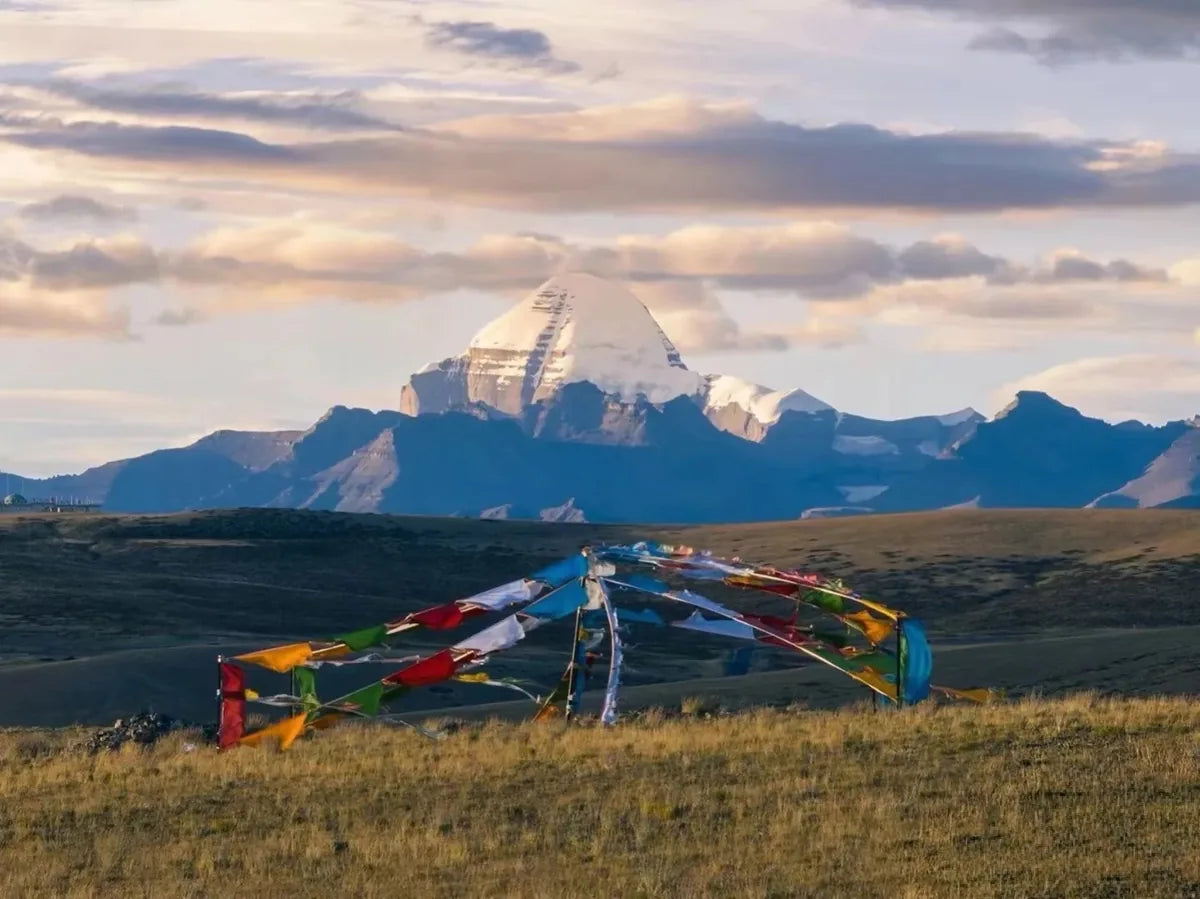
Mount Kailash has been associated with Mount Meru in certain Buddhist traditions, although Kailash has its own complex sacred history across Buddhism, Hinduism, Jainism, and Bön.
We should therefore avoid saying that “Mount Kailash is literally a mandala.” A more accurate observation is that Tibetan sacred geography and mandala cosmology can share a way of organizing the world around a spiritually significant center.
Is a Mandala “Sacred Geometry”?
This modern phrase requires some care.
Yes, mandalas often use extremely precise geometry. Symmetry, orientation, circles, squares, axes, directional organization, and repeated proportions can all be fundamental to the design.
But calling a Tibetan Buddhist mandala merely “sacred geometry” removes much of its religious content.
A mandala is not sacred simply because its shapes are mathematically beautiful. Its meaning also comes from the deity, ritual text, lineage, practitioner, visualization, initiation, and religious purpose associated with the image.
Geometry organizes the sacred world. It is not the entire sacred world.
What Modern Mandala Patterns Leave Out
Today, “mandala” appears everywhere: coloring books, yoga studios, home décor, tattoos, graphic design, meditation apps, and jewelry.
Many of these designs are simply radial geometric patterns inspired loosely by the visual idea of a mandala.
There is nothing inherently wrong with enjoying symmetrical design. But a modern radial pattern should not automatically be presented as though it has the same religious status as a Tibetan Buddhist tantric mandala.
They may look related. They are not necessarily the same thing.
The traditional mandala is tied to a specific religious system. The modern pattern may be inspired by its appearance. Context creates the difference.
Traditional Meaning and Modern Reflection
Mandala imagery can still offer modern viewers meaningful ideas.
A person today might see the mandala as a reminder of centeredness, order, relationship, or returning attention inward.
Those reflections can be valuable, but they should be described as modern personal interpretations inspired by the mandala, not universal definitions of Tibetan Buddhism.
Traditionally, the mandala belongs to a more specific world of Buddhist cosmology, tantric visualization, deity practice, ritual, initiation, and sacred representation.
The modern interpretation begins only after we understand that context.
How Kailora Approaches Mandala-Inspired Visual Language
For Kailora, the mandala is useful not because it gives us permission to place a random circular symbol onto a product and call it “Tibetan energy.”
Its deeper lesson is about structure and relationship.
A mandala shows how a center relates to its surroundings, how individual forms belong to a larger system, and how visual beauty can carry meaning beyond decoration.
This is close to the principle behind Kailora’s broader approach to Tibetan-inspired symbolism: first understand the cultural structure behind an image, then consider what part of that structure can responsibly inspire contemporary design.
The goal is not to turn a tantric mandala into a fashion motif. It is to learn from the visual world that created it.
A Map That Is Meant to Be Entered
A map usually tells us how to travel through physical space: turn left, cross a river, follow a road, reach a destination.
A mandala is a different kind of map.
Its roads may be symbolic. Its palace may exist within visualization. Its center may represent sacred presence. Its journey may take place through meditation rather than geography.
But the idea of movement remains:
from outside toward inside,
from complexity toward center,
from ordinary perception toward a transformed way of seeing.
Perhaps that is why the mandala remains such a powerful visual form.
It does not simply show a sacred world.
It invites the practitioner to imagine entering one.
To continue exploring Tibetan Buddhist visual culture, read What Is a Thangka?, explore the Eight Auspicious Symbols, or learn more about the Kailora Brand Story.
Frequently Asked Questions
What is a Tibetan Buddhist mandala?
A Tibetan Buddhist mandala is a sacred diagram or representation of a cosmic environment, often centered on a deity and represented as a palace surrounded by organized sacred space. It can be used for meditation, visualization, ritual, initiation, and other tantric Buddhist practices.
Does mandala mean “circle”?
The Sanskrit word is commonly associated with the idea of a circle, while the Tibetan term kyilkhor is often described as a circle or enclosure organized around a central point. In Tibetan Buddhist practice, however, mandalas can include complex square palace structures within surrounding circular zones.
Is every mandala circular?
No. Circular boundaries are common, but many Buddhist palace mandalas contain square architectural structures within circles. Mandalas can also appear as three-dimensional models, architecture, or ritual arrangements.
What is the difference between a mandala and a thangka?
A thangka is a Tibetan hanging scroll format. A mandala is a sacred diagram or cosmic structure. A mandala can be painted on a thangka, but not every thangka is a mandala.
Why do monks destroy sand mandalas?
In many ritual sand-mandala ceremonies, the completed mandala is deliberately dismantled after fulfilling its ritual purpose. This can express the Buddhist teaching of impermanence. This practice should not be generalized to every type of mandala.
Are all mandalas made from sand?
No. Mandalas may be painted, constructed from sand, built as three-dimensional models, expressed through architecture, or arranged from ritual objects and images.
Is a modern mandala coloring pattern the same as a Tibetan Buddhist mandala?
Not necessarily. A modern radial design may be visually inspired by mandala geometry, but traditional Tibetan Buddhist mandalas belong to specific religious practices, texts, deities, and ritual contexts.
Continue exploring this wider context in the Tibetan Culture Guide, which connects symbols, ritual objects, sacred art, and pilgrimage across the Kailora Journal.