






Quick answer: Mani stones are stones carved, inscribed, or sometimes painted with Buddhist mantras, prayers, sacred syllables, texts, or images in Tibetan and Himalayan cultural contexts. They are especially associated with Om Mani Padme Hum, the six-syllable mantra of Avalokiteshvara—Chenrezig in Tibetan Buddhism—but not every Mani stone carries exactly the same inscription.
Across Tibetan and Himalayan landscapes, these stones appear beside monasteries, along mountain roads, at high passes, near villages, and on pilgrimage routes. Individual stones may be stacked into piles or accumulated into long Mani walls. Their meaning comes from more than the words carved into them: craftsmanship, devotional intention, repeated placement, pilgrimage, and sacred geography all matter.
What Is a Mani Stone?
A Mani stone is a stone bearing Buddhist sacred writing or imagery. Examples range from small pebbles and flat slabs to large boulders and inscriptions cut directly into rock faces. Some are carefully colored; others remain the natural color of the stone.
The term “Mani” is strongly associated with Om Mani Padme Hum. Yet Mani-stone traditions are broader than one mantra. Stones may preserve longer prayers, sacred words, other formulas, images, or combinations of text and iconography.
Does Every Mani Stone Say Om Mani Padme Hum?
No. Om Mani Padme Hum is extremely common, but it is not the only possible inscription. The category includes stones carved with other Buddhist prayers, sacred words, texts, and religious images.
This distinction is useful because it prevents a common oversimplification: a Mani stone is not simply “a rock with six syllables on it.” It belongs to a wider culture of sacred inscription.
For the mantra itself, read What Does Om Mani Padme Hum Mean?. For the bodhisattva associated with it, see Who Is Chenrezig?.
Why Is Om Mani Padme Hum So Common on Mani Stones?
The six-syllable mantra is closely associated with Chenrezig, the bodhisattva of compassion. In Tibetan Buddhist culture it can be spoken, written, printed, carved, placed inside prayer wheels, or counted with prayer beads.
Carving the mantra into stone gives sacred writing a durable physical presence. A spoken recitation passes through time; an inscription can remain visible to generations of travelers and practitioners.
That does not mean the stone should be described as a device that automatically “broadcasts frequency” or clears negative energy. Such language belongs to modern spiritual marketing rather than a precise historical explanation. Traditional context is better approached through prayer, devotion, merit, sacred inscription, and religious place.
How Are Mani Stones Carved?
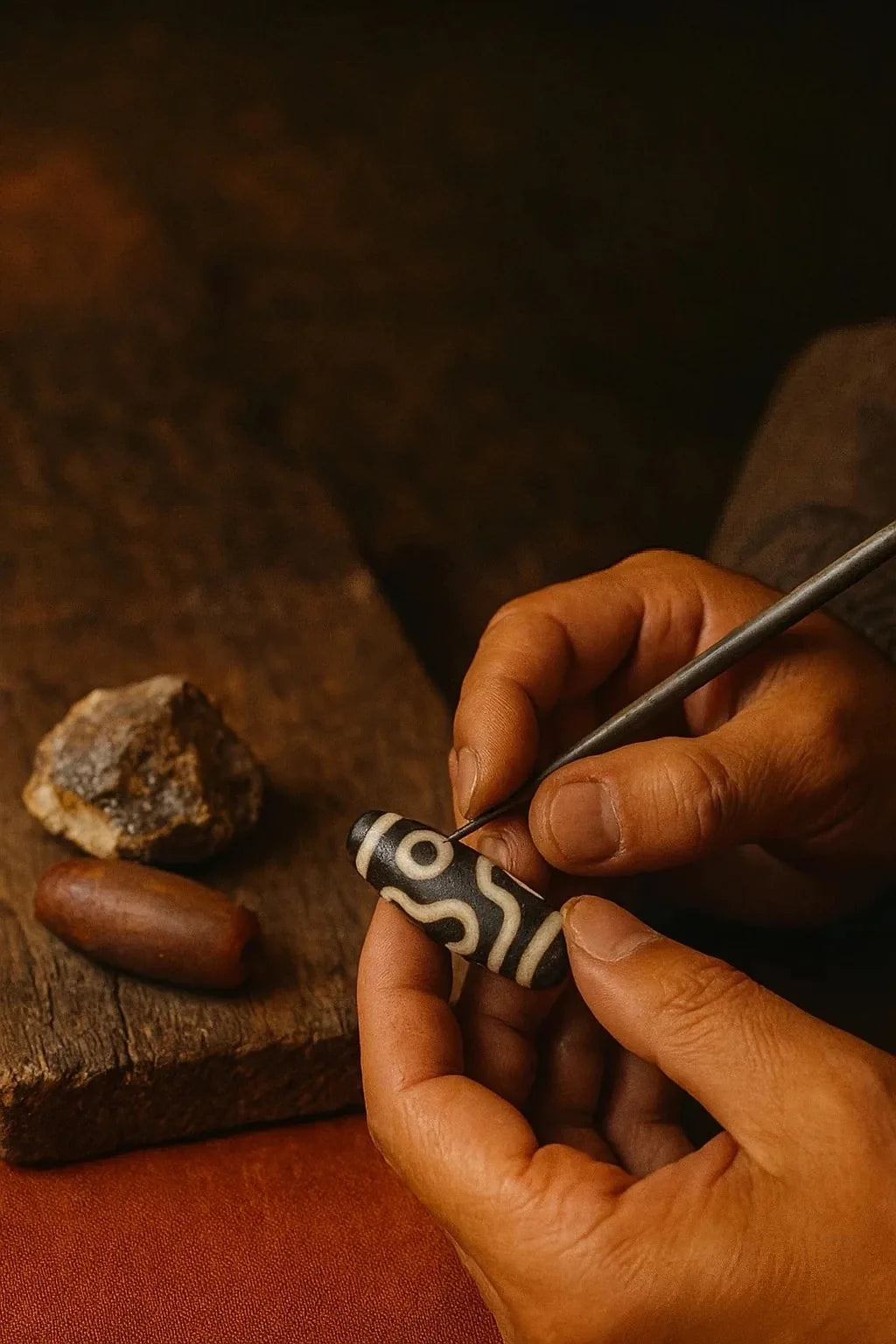
Traditional and contemporary carvers work with the physical properties of the stone: shape, hardness, grain, depth, and available surface. Hammer and chisel are basic tools, although modern equipment may also be used.
Some inscriptions are cut into the surface. Others are worked in relief so letters or images stand above the surrounding stone. Color may be added after carving. The result can range from a simple line of script to an elaborate composition of text, figures, and decorative borders.
Calling the process “printing on stone” misses the craft involved. Carving requires control of line, spacing, depth, and the irregularities of the material.
What Is a Mani Wall?
A Mani wall is an accumulation of carved prayer stones arranged into a wall or long stacked structure. Such walls may grow over many years as additional stones are placed by individuals and communities.
That cumulative quality is important. A Mani wall is not necessarily a single artwork made at one moment. It may preserve many acts of carving, offering, placement, repair, and continued use.
In this sense, sacred landscape is partly built through repetition: one stone becomes many, and a path gradually becomes marked by devotion.
Why Are Mani Stones Found on Roads, Passes, and Pilgrimage Routes?
Location is part of their cultural meaning. Mountain passes, monasteries, caves, springs, pilgrimage routes, and other sites can become religiously significant within Tibetan landscapes. Placing sacred inscriptions in these locations joins written practice to movement through place.
Mani walls are especially relevant to kora, the practice of circumambulating sacred places. They also belong to the wider subject explored in Tibetan Buddhist sacred geography, where mountains, monasteries, routes, caves, and ritual movement can form an interconnected religious landscape.
Do People Walk Around Mani Walls?
In many Tibetan Buddhist settings, Mani walls and other sacred structures become part of patterns of circumambulation. Practitioners commonly move clockwise around Buddhist sacred objects and sites, keeping them to the right.
Local arrangements still matter, so one should not turn this into a universal rule for every wall in every community. The broader point is that a Mani wall may participate in movement and practice, not simply visual display.
Are Mani Stones Art, Prayer, or Religious Practice?
They can be understood through all three categories. A carved stone may demonstrate considerable artistic skill, yet describing it only as “folk art” can hide why it was made. At the same time, calling it only a prayer can overlook the material knowledge and craftsmanship required to create it.
A more complete description is that Mani stones are religious objects made through skilled material practice. Their artistic, devotional, and landscape functions can overlap.
Are Mani Stones the Same as Prayer Wheels?
No. A Tibetan prayer wheel is a rotating ritual object containing or bearing written mantra. A Mani stone fixes sacred writing into stone. The two objects work differently, but together they show how Buddhist text can become material—carved, printed, enclosed, turned, seen, and encountered through movement.
Can You Take a Mani Stone Home?
A stone that forms part of an active Mani wall, shrine, monastery environment, pilgrimage route, or sacred landscape should not be treated as a free souvenir. Removing it changes a structure and separates the object from the context that gives it meaning.
A contemporary carving legitimately made for sale by an artisan is a different situation. Provenance and context matter.
Are Mani Stones “Protection Stones”?
Modern websites sometimes market Mani stones as guaranteed protection objects, luck charms, or energy amplifiers. That framing is too narrow and can distort the tradition.
Within Buddhist contexts, sacred inscriptions may be understood as spiritually meaningful and may be associated with beneficial or protective aims in particular practices. But this should not be converted into a commercial promise that a stone automatically prevents harm or produces a measurable energetic effect.
Frequently Asked Questions
What does “Mani stone” mean?
It commonly refers to a stone carved with Tibetan Buddhist mantras, prayers, sacred words, texts, or images, especially in Tibetan and Himalayan cultural settings.
Are all Mani stones carved with Om Mani Padme Hum?
No. The six-syllable mantra is widespread, but other prayers, sacred words, texts, and images also appear.
What is a Mani wall?
A Mani wall is a stacked accumulation of carved prayer stones, often found near monasteries, villages, passes, sacred places, and pilgrimage routes.
Why are Mani stones associated with pilgrimage?
Because sacred inscriptions are often placed along routes and at religiously significant locations, joining devotional practice with movement through landscape.
Can I remove a Mani stone from a wall?
Stones belonging to an active sacred site or Mani wall should not be removed as souvenirs.
Do Mani stones clear negative energy?
“Negative-energy clearing” is modern wellness language, not a precise historical definition of Mani-stone practice. Traditional context is better understood through prayer, devotion, merit, sacred inscription, and place.
Cultural note: Mani-stone inscriptions, arrangements, carving traditions, and devotional meanings vary by region and community. Existing stones and walls should be treated as parts of living cultural landscapes rather than collectible objects.
Continue exploring related practices in the Kailora Tibetan Culture Guide.