




Amber appears in historic Tibetan jewelry beside materials such as silver, jade, turquoise, coral, glass, and cloth. Its warm color can make it look immediately “Tibetan” to a modern shopper, but the more interesting story is not a simple claim that amber belongs to one place. It is a story of material movement, trade, adornment, and regional taste.
Quick Answer
Was amber used in Tibetan jewelry? Yes. Museum collections preserve 19th- and early-20th-century Tibetan necklaces made with amber, including a 19th-century Tibet necklace at The Metropolitan Museum of Art combining amber, jade, and silver. Other Tibetan necklaces combine amber with turquoise, coral, glass, metal, cotton, and additional stones. These objects show that amber was genuinely part of Tibetan adornment, while Himalayan trade networks remind us that many valued jewelry materials moved long distances before being worn in Tibet.
What Is Amber?
Amber is fossilized tree resin rather than a crystalline mineral. That distinction matters when discussing jewelry materials. Its color can range from pale yellow and honey to orange, brown, red, or more opaque tones, and natural pieces may contain internal textures or inclusions.
Because amber is organic and comparatively soft, it should also be cared for differently from harder gemstones. Harsh chemicals, heat, abrasion, and aggressive polishing can damage it.
Was Amber Really Worn in Tibet?
Yes. This is one of the areas where museum objects provide stronger evidence than modern spiritual marketing.
The Metropolitan Museum of Art holds a 19th-century necklace identified to Tibet and made from amber, jade, and silver. Another Tibetan necklace dated 1875–1925 combines glass, silver, turquoise, stone, coral, cobalt-colored material, amber, ivory, and cotton.
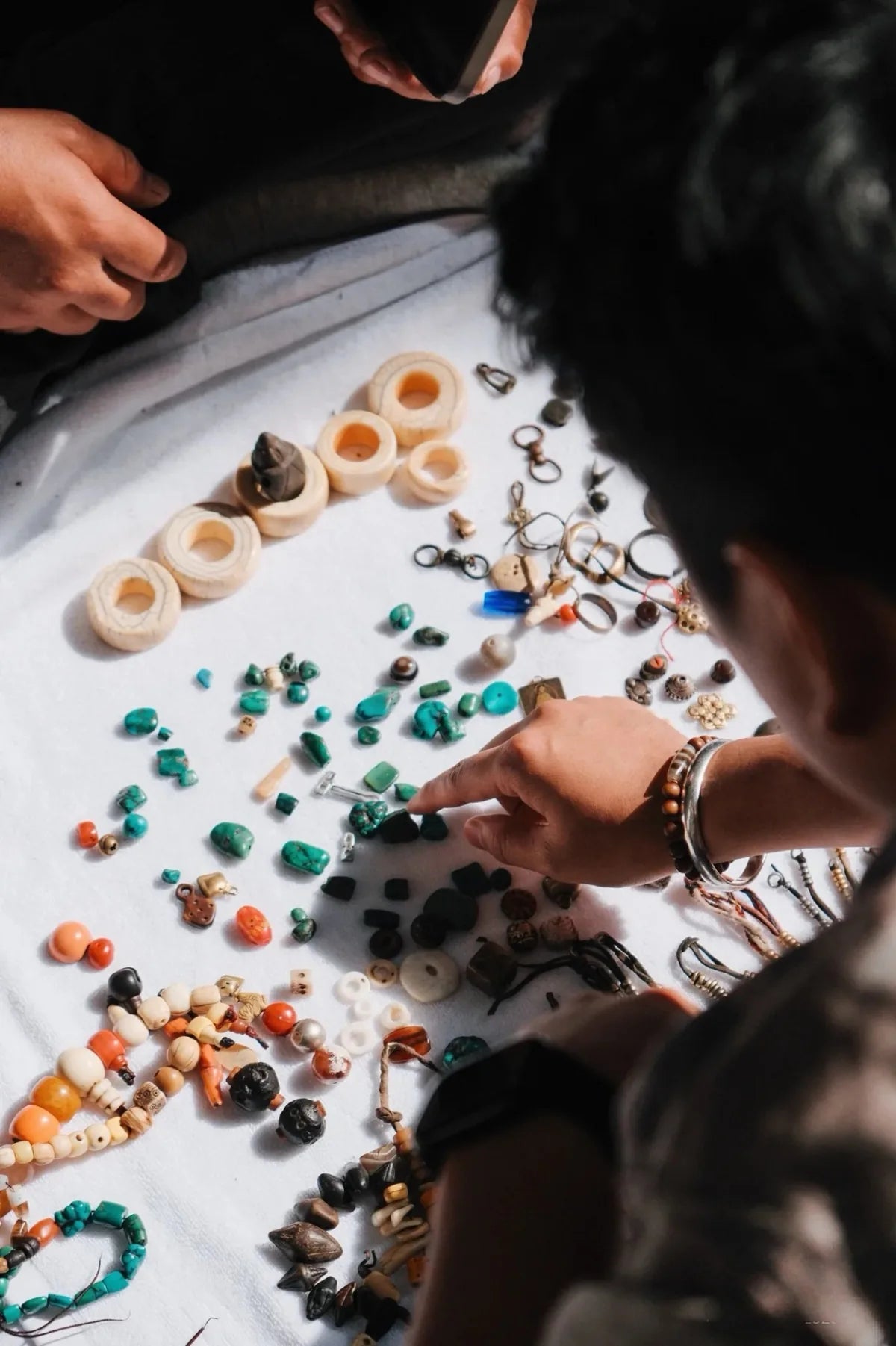
These objects are useful because they show amber not in isolation but as part of a broader material vocabulary. Tibetan adornment could bring together several colors, textures, metals, organic materials, and stones in one composition.
For a broader overview of that visual culture, read How Is Jewelry Worn with Traditional Tibetan Dress?.
Amber, Turquoise, Coral and Silver
Modern summaries often try to assign one fixed spiritual meaning to each Tibetan jewelry material. Historic objects tell a more complex story.
Amber could appear beside turquoise, coral, silver, jade, glass, and textiles. The value of a piece could involve rarity, color, workmanship, family ownership, trade access, regional style, and social display as much as a single symbolic definition.
This does not mean symbolism was absent. It means the safest interpretation begins with the object and its documented context rather than reverse-engineering a universal “amber means X” formula.
Did Tibetan Amber Come From Tibet?
It is better to ask where a specific piece of amber came from than to assume that all amber in Tibetan jewelry was locally sourced.
The Himalayan world was crossed by long-distance trade routes linking Tibet with Nepal, India, Kashmir, Central Asia, China, and other regions. The Ashmolean Museum’s Himalayan trade-route research emphasizes that mountain passes carried merchants, pilgrims, teachers, and commodities across these connected landscapes.
Amber itself occurs in multiple geological regions of the world, including northern Europe and Myanmar. Without provenance or gemological testing, a modern seller should not confidently assign a geographic origin to an old amber bead simply because it appears in Tibetan jewelry.
Why Trade Matters to Tibetan Jewelry History
Thinking through trade corrects a common misconception: cultural authenticity does not require every material to have been mined where an object was worn.
Tibetan material culture developed through exchange as well as local craft. Imported materials could be restrung, mounted, inherited, repaired, combined with Tibetan metalwork, or incorporated into regional forms of dress. The result could still be distinctly Tibetan in use and composition.
This same principle helps explain why historic Tibetan jewelry can contain materials associated with distant ecological zones. The object’s cultural life and the raw material’s geological origin are not the same question.
Natural Amber vs. Imitation Amber
Amber has been imitated for a long time because warm translucent beads are visually attractive and natural material can be valuable. Modern imitation materials may include plastics, resins, pressed or reconstructed material, dyed substitutes, and other look-alikes.
Visual inspection alone is often insufficient for confident identification. Color is not proof. A seller should disclose what is actually known about a material and avoid presenting uncertain beads as rare antique Tibetan amber.
For shoppers, useful questions include:
- Is the seller describing the material as natural amber, pressed amber, resin, or simply amber-colored?
- Is there any testing or supplier documentation?
- Is geographic origin actually known?
- Are claims based on the object itself, or on generic spiritual marketing?
How Amber Was Part of Personal Adornment
Historic Tibetan jewelry was not one uniform national costume. Forms of dress and ornament differed across regions, communities, gender, wealth, occasion, and historical period.
Amber should therefore be understood as one material within a larger system of personal adornment rather than as a badge worn identically everywhere in Tibet. That regional caution is especially important when looking at museum objects whose labels may provide a broad culture designation but not a complete biography of the original wearer.
Amber in Contemporary Tibetan-Inspired Jewelry
Contemporary designers can draw on the historical presence of amber without pretending to reproduce an antique Tibetan object. The ethical distinction is simple: describe the material honestly, distinguish a modern design from a historic form, and avoid inventing ancient promises of wealth, healing, or protection.
Kailora’s Natural Amber Cord Bracelet is a contemporary Tibetan-inspired bracelet. Its relationship to historic Tibetan amber jewelry lies in material and visual reference, not in a claim that the bracelet reproduces a specific traditional regional costume.
A Contemporary Kailora Lens
Kailora places this amber bracelet within Karma & Balance. That is a modern brand interpretation built around warmth, balance, and daily intention. It should not be confused with a universal Tibetan Buddhist teaching about amber.
The historical claim we can make is narrower and stronger: amber is documented in Tibetan jewelry, and Tibetan adornment participated in far-reaching material networks.
How to Care for Amber Jewelry
- Avoid perfume, alcohol, household cleaners, and harsh chemicals.
- Keep amber away from high heat and prolonged strong sunlight.
- Wipe gently with a soft dry or slightly damp cloth.
- Store separately from harder stones and metal edges that may scratch it.
- Do not assume ultrasonic or steam cleaning is safe.
Frequently Asked Questions
Is amber a gemstone?
In jewelry it is commonly grouped with gems, but scientifically amber is fossilized organic resin rather than a mineral crystal.
Did Tibetans historically wear amber?
Yes. Museum collections preserve Tibetan necklaces containing amber, including 19th-century examples.
Is all “Tibetan amber” mined in Tibet?
No such assumption should be made. Amber circulated through long-distance trade, and a specific bead’s geological origin requires evidence.
Does Tibetan amber guarantee luck or healing?
No. Historical use and cultural value do not establish guaranteed medical, financial, or supernatural outcomes.
How can I tell if amber is natural?
Some imitations can look convincing. Reliable identification may require gemological testing or trustworthy provenance rather than color-based home tests alone.