






A 108-bead mala is often explained as a tool for counting one round of mantra recitation. But Tibetan prayer beads can include another layer of counting: small attachments known as counters. These make it possible to keep track of many completed rounds without relying on memory.
Quick answer: Tibetan mala counters are attachments fixed to a strand of prayer beads. Historical examples show paired counters used to record completed rounds, allowing practitioners to accumulate hundreds or thousands of recitations over time.
Why 108 beads are only the beginning
A standard Tibetan prayer-bead strand, or trengwa, often contains 108 beads. A practitioner moves bead by bead while reciting a mantra, prayer, or devotional formula. Completing the strand creates one countable cycle, but sustained practices may involve many cycles.
That is where counters become useful. They turn the mala from a one-round counting device into a system for tracking larger accumulations.
For the basic structure and meaning of the strand itself, begin with What Are 108 Mala Beads?.
What do Tibetan mala counters look like?
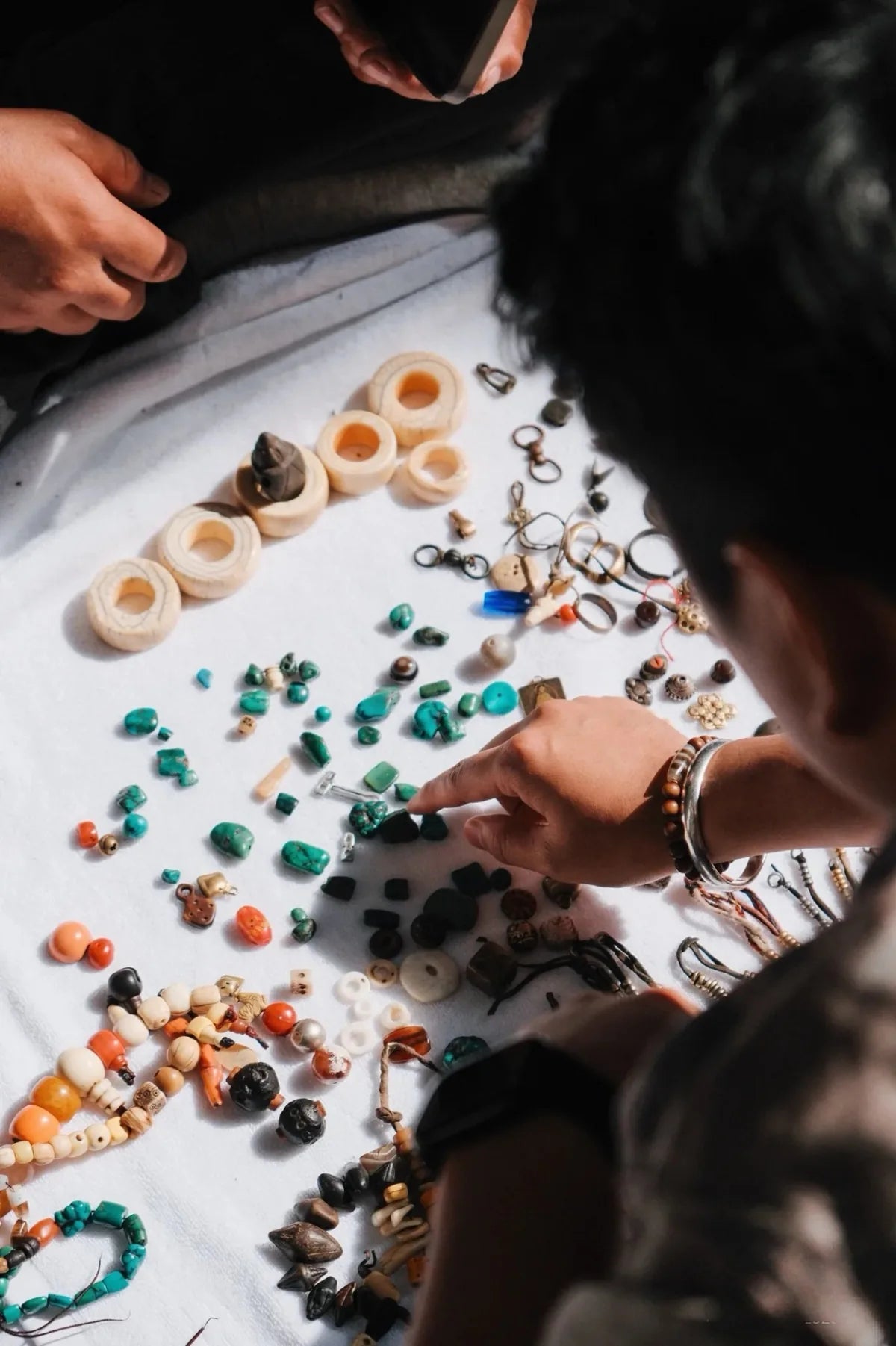
Museum examples show counters suspended from the main strand on short cords or leather attachments. They can incorporate metal ornaments and small movable elements. Their exact appearance varies, because Tibetan prayer beads are often highly personal objects rather than perfectly standardized factory products.
An early nineteenth-century Tibetan strand preserved by the Rubin Museum contains 108 beads, coral separators, a guru bead, and two sets of counters. Its structure shows how counting tools became part of the physical architecture of the mala.

How do mala counters count hundreds and thousands?
The simplest way to understand the system is hierarchical counting. The 108 main beads record individual recitations within a round. Counter attachments then record completed rounds or larger units. Historical descriptions of Tibetan strands document one pair of counters used for hundreds and another pair used for thousands of recitations.
Exact practice instructions can differ across lineages and rituals, so a museum object should not be treated as a universal instruction manual. What the objects clearly demonstrate is the principle: the practitioner can preserve a running total far beyond one circuit of 108 beads.
Why are some malas divided into groups of 27?
Many Tibetan 108-bead strands use separator beads that divide the main sequence into four groups of 27. This helps the user orient themselves on the strand and may support practices organized around smaller counting units. Some historical strands include additional markers for even more specific recitation structures.
This physical segmentation is a reminder that prayer beads are designed objects. Bead count, separators, guru bead, tassel, attachments, and counters all participate in how the strand is handled.
Mala counters also reveal personal practice
Prayer beads often acquire additions over time. Counters may be practical, decorative, inherited, replaced, or personalized. A twentieth-century Tibetan turquoise strand in the Rubin collection, for example, includes owner-added items on one counter. Other historical strands combine precious materials, everyday components, and unexpected attachments.
This makes a mala different from a purely abstract symbol. It can bear the marks of repeated handling and individual life.
Do modern malas need counters?
No. A contemporary mala can be used without counters, and many people wear mala-inspired necklaces primarily as symbolic jewelry. Counters are relevant when someone wants to understand traditional counting systems or maintain a disciplined recitation total.
Kailora’s Clear Quartz 108 Mala Wrap Necklace draws on the visual rhythm of the 108-bead strand. It should be distinguished from a ritually prescribed mala with lineage-specific counting equipment.

Ritual object vs. mala-inspired jewelry
A historical or practitioner-used trengwa may be a working religious object. A modern necklace inspired by mala structure can instead function as wearable symbolism, personal intention jewelry, or an aesthetic interpretation. Similar form does not automatically imply identical ritual status.
That distinction matters especially when discussing “blessed” jewelry. Unless provenance is documented, a seller should not imply that a modern piece has undergone religious consecration.
Frequently asked questions
What are the small attachments on Tibetan prayer beads?
They may be counters, tassels, separators, or personal attachments. Counters help track completed rounds of recitation.
Do all Tibetan malas have counters?
No. Historical examples vary widely in materials and attachments. Counters are common in many Tibetan Buddhist prayer-bead traditions but are not a requirement for every strand.
Are mala counters jewelry charms?
They can be visually decorative, but their traditional function is practical and ritual: helping the practitioner keep count.
Continue with the Tibetan Culture Guide for the wider material and ritual context.