


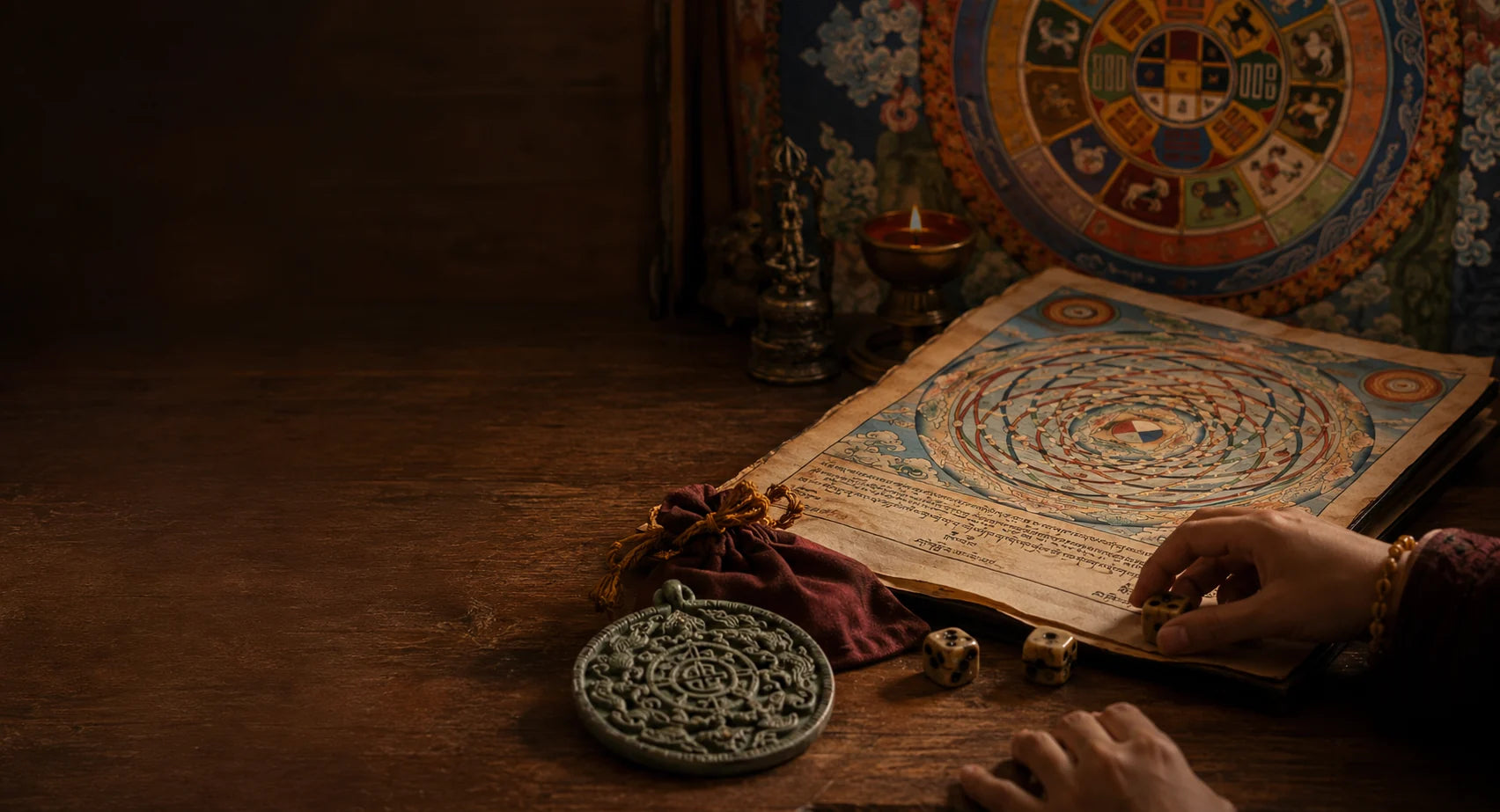

A Tibetan Buddhist tsakali can fit in the hand, yet a complete set may represent an entire ritual world. These small painted cards depict Buddhas, bodhisattvas, protectors, ritual objects, and other sacred subjects. In Vajrayana contexts they could be arranged, displayed, and used during initiation and visualization practices.
Because of their size, tsakali are sometimes compared with modern collectible cards. That comparison helps describe their physical format, but it can obscure their religious function. Tsakali were not created primarily as portable souvenirs. They belonged to ritual systems.
What Are Tsakali?
Tsakali are small painted or printed images used in Tibetan and Himalayan Buddhist traditions. Surviving museum examples are often made on paper and may carry inscriptions on the reverse. They frequently survive as parts of larger sets rather than as isolated pictures.
The subjects can include deities, lineage figures, symbolic objects, offerings, cosmological scenes, and elements associated with a ritual cycle. Their small scale made it possible to handle, arrange, transport, and sequence many images during a ceremony.
Why Are Tsakali So Small?
The scale is part of their usefulness. A large thangka generally presents a complete composition on a hanging textile. A set of tsakali can instead be moved one by one, reorganized, placed around a ritual space, or shown to a disciple in a prescribed order.
This makes them especially well suited to practices in which a teacher guides a practitioner through a sequence of deities or symbolic stages. The cards can function as visual anchors within a much larger ritual that also involves oral instruction, mantra, visualization, and empowerment.
Tsakali and the Creation of Ritual Space
One of the most striking documented uses of tsakali is their arrangement as a mandala. A set may be placed on the ground to create an ordered sacred space corresponding to a ritual cosmos.
That does not mean every tsakali set is simply a “mini mandala.” Rather, the cards can participate in mandalic organization when a specific ritual calls for it. Their meaning depends on the set, sequence, deity cycle, and instructions associated with them.
For a broader introduction to this visual and ritual idea, read our guide to Tibetan mandala meaning and symbolism.
How Tsakali Were Used in Initiation
In Vajrayana Buddhism, initiation or empowerment connects a practitioner with a particular practice under the guidance of a qualified teacher. Historical tsakali sets could assist this process by giving visual form to deities and ritual stages described in recitation and instruction.
The image on a card was therefore not meant to stand alone as an illustration. It worked together with spoken teachings and ritual action. Some cards also preserve Tibetan writing or Sanskrit-derived sacred syllables on their reverse, reinforcing the relationship between image and liturgy.
Tsakali and Visualization
Visualization is central to many Vajrayana practices. A practitioner may be instructed to imagine a deity, palace, symbolic object, or sequence in precise detail. A painted card can provide a visual reference, but the practice is not reducible to looking at an image.
This distinction is useful for modern viewers. Museum displays often present individual tsakali as artworks, allowing us to admire their line, pigment, iconography, and age. Historically, however, many were active ritual tools.
Tsakali vs. Thangka: What Is the Difference?
Both tsakali and thangkas belong to Tibetan Buddhist visual culture, but their formats and functions can differ substantially.
A thangka is typically a larger portable painting mounted as a scroll. It may depict a central deity, lineage, mandala, narrative, or teaching scene and can be hung for devotion, ritual, or instruction. Tsakali are much smaller and often designed to operate as a set.
The distinction is not simply “big painting versus small painting.” It is about how the images are handled and used. You can explore the larger painting tradition in Kailora’s guide to what thangka painting is and our introduction to Regong thangka painting.
What Do Tsakali Depict?
There is no single universal subject. Surviving sets include celestial Buddhas, bodhisattvas, wrathful protectors, consorts, ritual implements, cosmological realms, and many other figures.
The diversity is important. A single card removed from its set may be visually beautiful, but its full function can be difficult to understand without knowing the larger sequence. This is similar to reading one page from a ritual manual: the page matters, but so does what comes before and after it.
Portable Sacred Art
Tsakali are an excellent example of how portability shaped Himalayan religious art. Tibetan Buddhism developed across enormous geographic distances. Teachers, pilgrims, monasteries, and communities needed visual and textual materials that could move.
Small sacred images, manuscripts, molds, printed texts, and votive objects all participated in this mobile religious culture. In that sense, tsakali can be considered alongside Tibetan tsa-tsa votive tablets: both are relatively small material objects, yet they belong to practices much larger than their physical size.
Why “Buddhist Collectible Cards” Is an Incomplete Description
Modern card culture gives us an easy visual analogy, but it also introduces the wrong expectations. Tsakali were not primarily designed for trading, casual collecting, or entertainment. A historical set could carry ritual authority because of how it was consecrated, transmitted, arranged, and used.
When museums separate individual cards for display, the contemporary viewer should remember that the original object may have been one member of a coordinated ritual ensemble.
Traditional Meaning and a Contemporary Way of Looking
Traditionally, tsakali belong to Vajrayana ritual, initiation, visualization, and sacred art. That religious context should come first.
For a contemporary viewer outside those practices, the cards may also suggest a broader idea: a complex path can be approached through small, carefully ordered steps. At Kailora, that is a personal reflection inspired by the format—not a traditional doctrinal definition of tsakali.
We avoid describing the cards as objects that automatically transmit power or produce spiritual results simply through possession. Their historical meaning comes from practice, teacher, ritual context, and tradition.
Small Images, Large Worlds
Tsakali challenge the assumption that sacred art must be monumental. A card only a few inches wide can contain a deity, a symbolic universe, or one stage of an elaborate initiation.
Their importance lies not only in what is painted on the surface, but in what the image was designed to do: guide attention, organize ritual space, support instruction, and connect visual form with a living practice.