



“Crystal” and “gemstone” are often used as if they mean the same thing. In jewelry shopping, the overlap is real—but the words describe different ideas.
A piece of quartz can be a mineral, a crystal, and a gemstone at the same time. Amber can be used as a gem even though it is fossilized resin rather than a mineral. Lapis lazuli is commonly treated as a gemstone even though it is a rock made from more than one mineral.
Understanding these categories makes material descriptions easier to read and helps separate gemology from modern spiritual marketing.
Quick Answer
A crystal describes ordered internal structure; a gemstone describes a material valued and prepared for adornment. Many gemstones are minerals and many mineral specimens are crystalline, but the categories are not identical. Gem materials can also include rocks, mineraloids, and organic substances. “Healing crystal” is a contemporary spiritual or retail category, not a formal gemological classification.
What Is a Mineral?
In introductory gemology and geology, a mineral is a naturally occurring solid with a characteristic chemical composition and an ordered internal structure. Quartz, corundum, beryl, and feldspar are familiar mineral examples.
A mineral name refers to what a material is scientifically. It does not tell us whether the specimen is attractive enough for jewelry, whether it formed a visible crystal shape, or whether it has been cut and polished.
What Is a Crystal?
A crystal is defined by an ordered arrangement of atoms or molecules. When growth conditions allow, that internal order can produce recognizable external crystal faces and geometric habits.
In everyday retail language, however, “crystal” is used much more loosely. Bead sellers may call polished quartz, tumbled stones, carved mineral objects, or an entire spiritual-product category “crystals” even when the original crystal faces are no longer visible.
This is why the question “Is this a crystal?” can have two answers: a scientific answer about structure and a commercial answer about how the product is being marketed.
What Is a Gemstone?
A gemstone is a material valued for use in adornment or decorative objects, usually because of qualities such as color, transparency, rarity, durability, optical effects, polish, or cultural value.
Most familiar gems are minerals, but not all are. The gemstone category can also include:
- rocks, such as lapis lazuli;
- mineraloids, such as opal;
- organic gem materials, such as amber, pearl, and coral.
So “gemstone” is primarily a use-and-value category rather than one mineralogical structure.
Crystal vs. Gemstone at a Glance
| Term | What it mainly describes | Example |
|---|---|---|
| Mineral | Natural material defined by composition and structure | Quartz |
| Crystal | Ordered internal atomic structure; sometimes visible crystal form | A natural quartz crystal point |
| Gemstone | Material selected and used for jewelry or ornament | Faceted amethyst or polished turquoise |
| Rock | Aggregate of one or more minerals or related materials | Lapis lazuli |
Can the Same Material Be Both a Crystal and a Gemstone?
Yes. Quartz is the clearest example.
A naturally formed quartz specimen is crystalline and belongs to the mineral quartz. If attractive quartz is cut, polished, drilled, or otherwise prepared for jewelry, it also functions as a gemstone.
Amethyst, citrine, rose quartz, smoky quartz, and clear quartz are varieties or forms within the wider quartz family used in jewelry. Their retail names describe color or appearance while the underlying mineral remains quartz.
For Kailora’s contemporary interpretation of one of these materials, see Clear Quartz Bracelet Meaning & Which Wrist to Wear It On. That article clearly separates material facts from spiritual associations.
Are All Gemstones Crystals?
No.
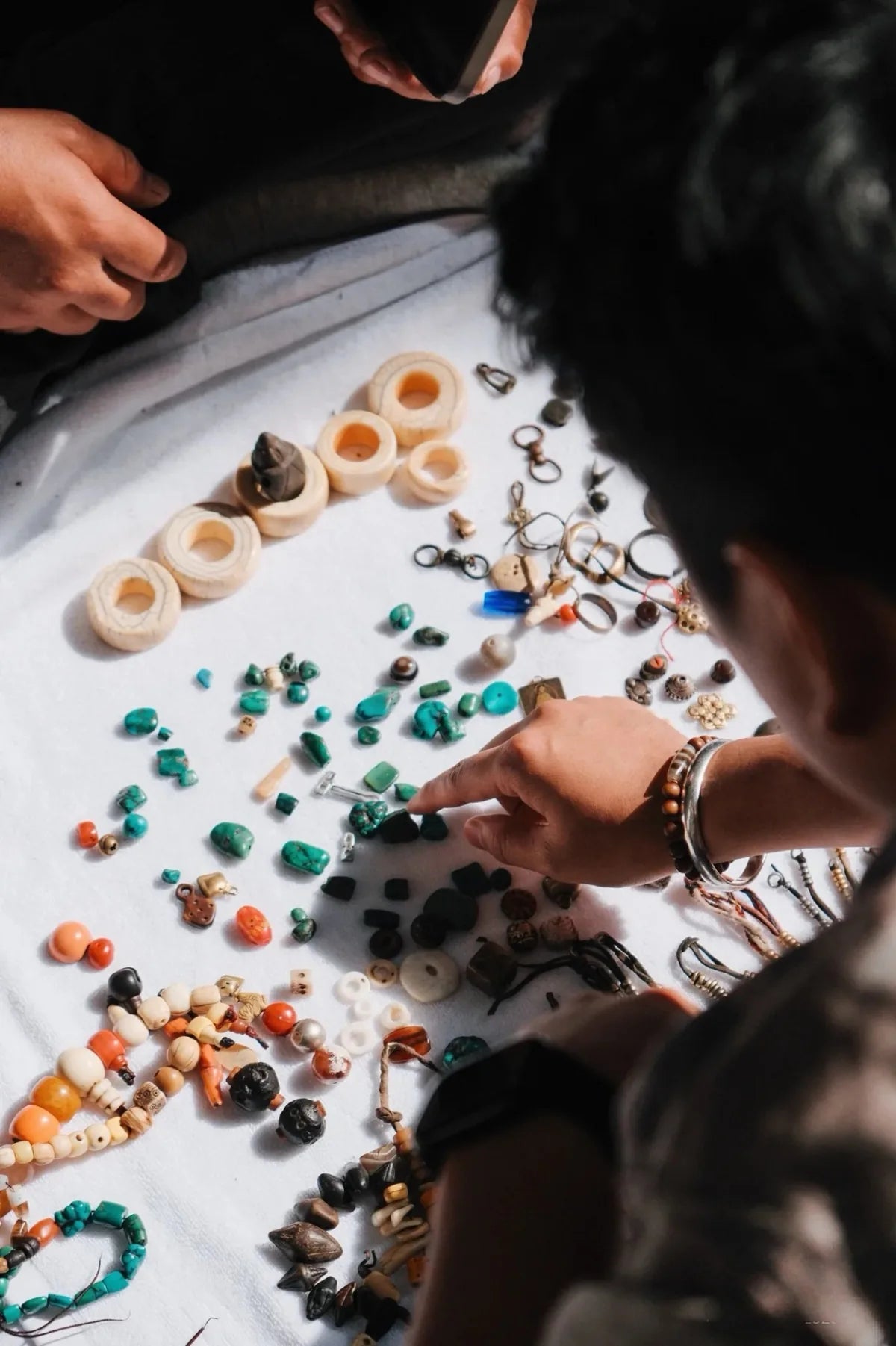
Amber is a useful counterexample. It is fossilized plant resin and is valued as a gem material, but it is not a mineral crystal. Historic Tibetan jewelry nevertheless includes amber, showing that cultural value in adornment does not depend on fitting one modern mineral category.
Read Tibetan Amber: History, Jewelry & Trade for its material and cultural context.
Coral is another organic gem material rather than a mineral crystal. Its use in Tibetan jewelry reflects long-distance trade and adornment history. See Coral in Tibetan Jewelry.
Are All Crystals Gemstones?
No. A mineral can crystallize beautifully without being used as a gem. Some crystals are too small, fragile, opaque, common, included, or otherwise unsuitable for ordinary jewelry use.
“Gem quality” therefore does not simply mean “this material formed a crystal.” It usually refers to qualities that make a particular specimen desirable for cutting, polishing, carving, collecting, or adornment.
Where Does Turquoise Fit?
Turquoise is a mineral and a historically important gem material. It is usually encountered in jewelry as polished or shaped material rather than as transparent faceted crystals.
This is a good reminder that a gemstone does not need to look like the clear pointed “crystal” image common in wellness marketing.
For the material history, symbolism, and jewelry context, read Tibetan Turquoise: History, Gemology, Symbolism & Jewelry.
What Is a Rock?
A rock is an aggregate of one or more minerals, mineraloids, or related geological materials. This matters in jewelry because some famous gem materials are rocks rather than single minerals.
Lapis lazuli, for example, is valued for its blue appearance but is not one single mineral species. A product can therefore be a genuine natural gem material without fitting the simplified formula “one gemstone = one mineral.”
What Is a Mineraloid?
A mineraloid is a naturally occurring mineral-like substance that does not meet all the structural requirements of a mineral. Opal is the classic gemological example.
For shoppers, the practical lesson is simple: the word “gemstone” is broader than “mineral.”
Natural, Synthetic, and Imitation: A Different Question
Whether something is a crystal or gemstone is separate from whether it is natural, laboratory-grown, treated, or imitation.
- Natural: formed in nature, although it may later be cut or treated.
- Synthetic / laboratory-grown: made by humans but with essentially the same chemical composition and crystal structure as the natural counterpart.
- Imitation / simulant: made to resemble another material without having the same composition and structure.
- Treated: natural or synthetic material whose appearance or durability has been altered by an accepted or disclosed process.
Good product descriptions should disclose what is actually known instead of using “crystal” as a substitute for provenance.
Does “Natural Crystal” Automatically Mean Untreated?
No. “Natural” generally refers to geological origin; treatment is a separate issue. A natural stone can still be heated, dyed, impregnated, coated, stabilized, irradiated, or otherwise modified depending on the material.
For buyers, transparent disclosure is more useful than vague language such as “100% energy crystal.”
What Does “Healing Crystal” Mean?
“Healing crystal” is common language in contemporary spiritual and wellness communities. It groups stones according to beliefs, personal rituals, symbolic associations, or subjective experiences rather than formal gemological classification.
People may use a stone as a reminder of calm, focus, protection, intention, or personal meaning. Those practices can be meaningful to the wearer, but they should be distinguished from scientifically established medical treatment.
Kailora uses intention language in this contemporary symbolic sense. Jewelry is not presented as diagnosing, treating, curing, or preventing disease.
Why This Difference Matters When Buying Jewelry
A clearer vocabulary helps you ask better questions:
- What is the actual material?
- Is it a mineral, rock, organic gem material, glass, resin, or another substance?
- Is it natural, synthetic, imitation, or treated?
- Is the seller describing documented material facts or contemporary spiritual interpretation?
- Are origin and treatment claims supported by supplier information or testing?
These questions are more useful than assuming every bead labeled “crystal” has the same origin or properties.
Traditional Material Meaning vs. Modern Spiritual Meaning
Materials can have long cultural histories without those histories being identical to modern crystal-healing charts. Turquoise, amber, coral, agate, quartz, silver, and other materials entered Tibetan and Himalayan adornment through different routes, crafts, social settings, and religious contexts.
A contemporary meaning—such as wearing clear quartz as a reminder of clarity—can coexist with that history when it is labeled honestly as a modern interpretation.
Kailora’s Approach to Crystal and Gemstone Language
Kailora aims to describe the physical material first and the symbolic interpretation second.
When a piece contains quartz, turquoise, amber, agate, or another gem material, the product description should identify the material as accurately as available sourcing information allows. Intention categories such as Protection & Grounding or Intuition & Awakening are Kailora’s contemporary editorial framework, not scientific classifications of stones.
Frequently Asked Questions
Is a crystal a gemstone?
It can be. If a crystalline material such as quartz is selected and prepared for jewelry or ornament, it can be both a crystal and a gemstone.
Is every gemstone a mineral?
No. Gem materials also include rocks, mineraloids, and organic substances such as amber, coral, and pearl.
Is quartz a crystal or gemstone?
Quartz is a mineral with a crystalline structure. When suitable quartz is used for jewelry, it is also a gemstone.
Is amber a crystal?
No. Amber is fossilized plant resin. It is an organic gem material rather than a mineral crystal.
Does natural gemstone mean untreated?
No. Natural origin and treatment status are separate questions.
Are crystal healing meanings scientific facts?
No. Crystal-healing meanings belong mainly to traditional, contemporary spiritual, cultural, or personal belief frameworks depending on the claim. They should not be presented as established medical effects.
Continue Exploring Materials
Continue with Tibetan Turquoise, Tibetan Amber, Coral in Tibetan Jewelry, or browse Kailora Tibetan-inspired jewelry.
Editorial note: Kailora separates documented material information from cultural tradition, contemporary spiritual interpretation, and personal experience.