

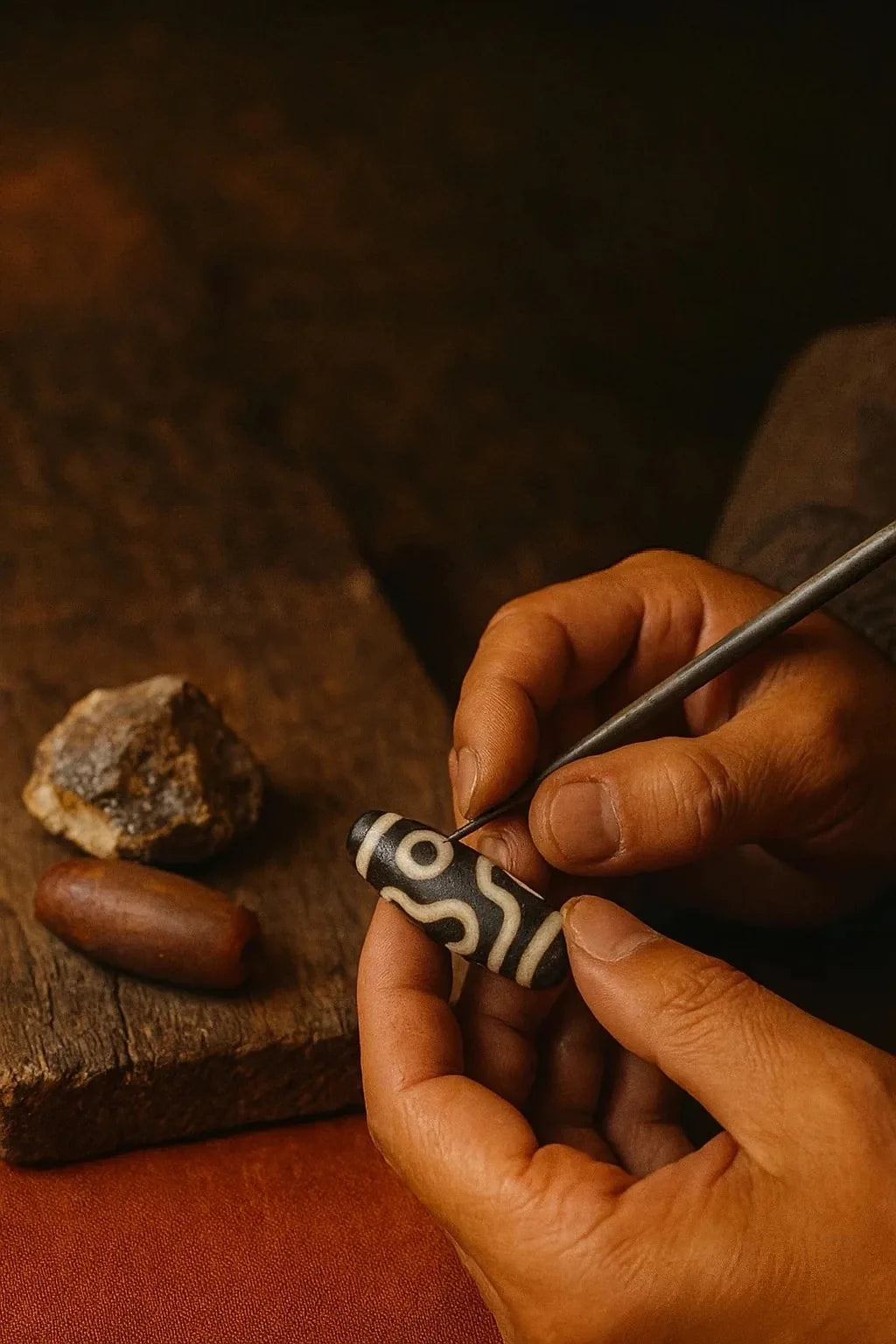










What does a 9-Eye Dzi bead mean? In contemporary Dzi traditions, the Nine-Eye Dzi is commonly described as a symbol of completeness, protection, abundance, wisdom, authority, and broad good fortune. Because it gathers nine eye motifs into one bead, it is often treated as an “all-around” Dzi for people who do not want to focus on only one intention.
As with other numbered Dzi meanings, the details vary. There is no reliable basis for claiming that every Tibetan Buddhist tradition teaches one fixed checklist of nine guaranteed benefits. Modern Nine-Eye interpretations have been shaped by Tibetan and Himalayan bead culture, collectors, Chinese symbolic traditions, and global spiritual jewelry markets. This guide keeps that distinction visible while explaining the meaning people are actually searching for today.
What makes a Dzi bead “Nine-Eye”?
A Nine-Eye Dzi is identified by nine circular or eye-like motifs arranged across the surface of the bead. Many contemporary Dzi beads are made from agate or chalcedony, with contrasting patterns created or enhanced through human processing. “Dzi” describes the bead tradition and patterned object; it is not a separate mineral species.
If you want the material side first, read Agate: Gemology, Meaning, Treatments & Dzi Bead Context. If you want the wider symbolic history, start with What Does a Dzi Bead Symbolize?

Why does the number nine matter?
Nine carries positive and complete-sounding associations in several Asian symbolic systems, which is one reason modern Dzi markets frequently treat a nine-eye pattern as especially comprehensive. In commercial and contemporary spiritual descriptions, the Nine-Eye Dzi often sits near the top of numbered-eye hierarchies.
However, it is better to say “nine is interpreted as completeness in contemporary Dzi symbolism” than to claim that a Nine-Eye Dzi has one universally documented ancient Tibetan formula. Number symbolism changes across place, period, school, and community.
9-Eye Dzi meaning: protection
Protection is one of the most common modern associations. Here, “protection” can be understood symbolically as maintaining boundaries, staying grounded under pressure, and carrying a visible reminder to move carefully through difficult situations.
Some wearers describe Dzi beads as protective amulets. Kailora does not present a bead as a physical shield or guarantee against harm. Instead, the protective meaning is treated as part of living amulet culture and contemporary intention practice.
9-Eye Dzi meaning: abundance and opportunity
Nine-Eye Dzi beads are also widely associated with prosperity, opportunity, status, and expanding resources. In a practical intention ritual, abundance can mean more than money: enough time, stronger relationships, useful opportunities, creative momentum, or the capacity to share what you have.
This makes the Nine-Eye Dzi compatible with Kailora’s Manifestation & Abundance journey, as long as the symbol is used as an intention anchor rather than a promise that wearing it will cause financial gain.
9-Eye Dzi meaning: wisdom and wider perspective
The repeated eye motif naturally lends itself to the language of seeing, awareness, discernment, and perspective. A Nine-Eye Dzi can therefore be used as a reminder to look beyond the first answer, notice patterns, and make decisions with a wider field of view.
That interpretation also overlaps with Kailora’s Intuition & Awakening journey, where “awakening” is framed as greater awareness rather than a guaranteed supernatural state.
Is a 9-Eye Dzi “more powerful” than a 3-Eye Dzi?
Not in any measurable scientific sense. The two patterns simply carry different modern symbolic emphases.
- Three-Eye Dzi: commonly linked with wealth, health, happiness, and balanced prosperity.
- Nine-Eye Dzi: commonly linked with broad protection, completeness, abundance, wisdom, and all-around auspiciousness.
Choosing nine eyes because the number is “higher” is less useful than choosing the pattern whose symbolism fits your intention. You can compare the 3-Eye Dzi meaning before deciding.

How should you wear a Nine-Eye Dzi?
A Nine-Eye Dzi can be worn as a necklace, bracelet, or part of a layered bead arrangement. There is no universal Tibetan rule that every numbered Dzi must sit on one specific side of the body.
Modern energy practices sometimes use a left-receiving/right-expressing model. If that framework is personally meaningful, you can use it as a contemporary ritual convention. It should not be presented as a universal rule.
For everyday use, consider three practical points:
- Visibility: keep the patterned bead where you can notice it if you use it as an intention reminder.
- Comfort: choose an adjustable or correctly sized construction so the jewelry can be worn without distraction.
- Care: avoid harsh chemicals, impact, and prolonged soaking, especially when agate is combined with cord, metal, or other materials.
How to choose a Nine-Eye Dzi bead
Check the stated material. If the bead is agate, the seller should identify it as agate rather than treating Dzi as a mineral name.
Look for clear photographs. The pattern should be visible from enough angles to understand what you are buying.
Separate appearance from age. A weathered or antique-looking finish does not prove ancient age. Provenance requires evidence.
Do not pay for supernatural guarantees. Symbolism can be meaningful without a seller promising immunity from misfortune, automatic wealth, or guaranteed health.
Nine-Eye Dzi jewelry at Kailora
The Kailora Dzi Agate Cord Necklace with Zaki Lhamo Charm is available in a Nine-Eye Dzi variant as well as Three-Eye, Six-Eye, and Treasure Vase options. The necklace uses an adjustable cotton cord and agate Dzi beads, allowing the wearer to choose the pattern whose symbolism best matches a personal intention.

For more styles, explore the Tibetan Dzi Beads collection and our Dzi bracelet buying guide.
Dzi meanings described here reflect contemporary symbolism, collector traditions, cultural interpretation, and personal spiritual practice. They are not medical or financial advice and do not guarantee health, protection, prosperity, luck, or other outcomes.