








What does a 3-Eye Dzi bead mean? In contemporary Dzi symbolism, the Three-Eye Dzi is commonly associated with a three-part idea of wealth, health, and happiness—or, in some interpretations, material abundance, physical well-being, and inner or spiritual richness. It is often chosen as a symbol of balanced prosperity rather than money alone.
That popular interpretation is useful, but it needs context. The exact “wealth + health + happiness” formula is not a single universal Tibetan Buddhist doctrine. Modern Dzi meanings have developed through Tibetan and Himalayan jewelry culture, Chinese collecting traditions, commercial symbolism, and contemporary spiritual practice. The safest way to understand a Three-Eye Dzi is therefore as a patterned agate bead with deep cultural value and a widely used modern symbolic interpretation—not as a guaranteed prosperity device.
What is a Dzi bead?
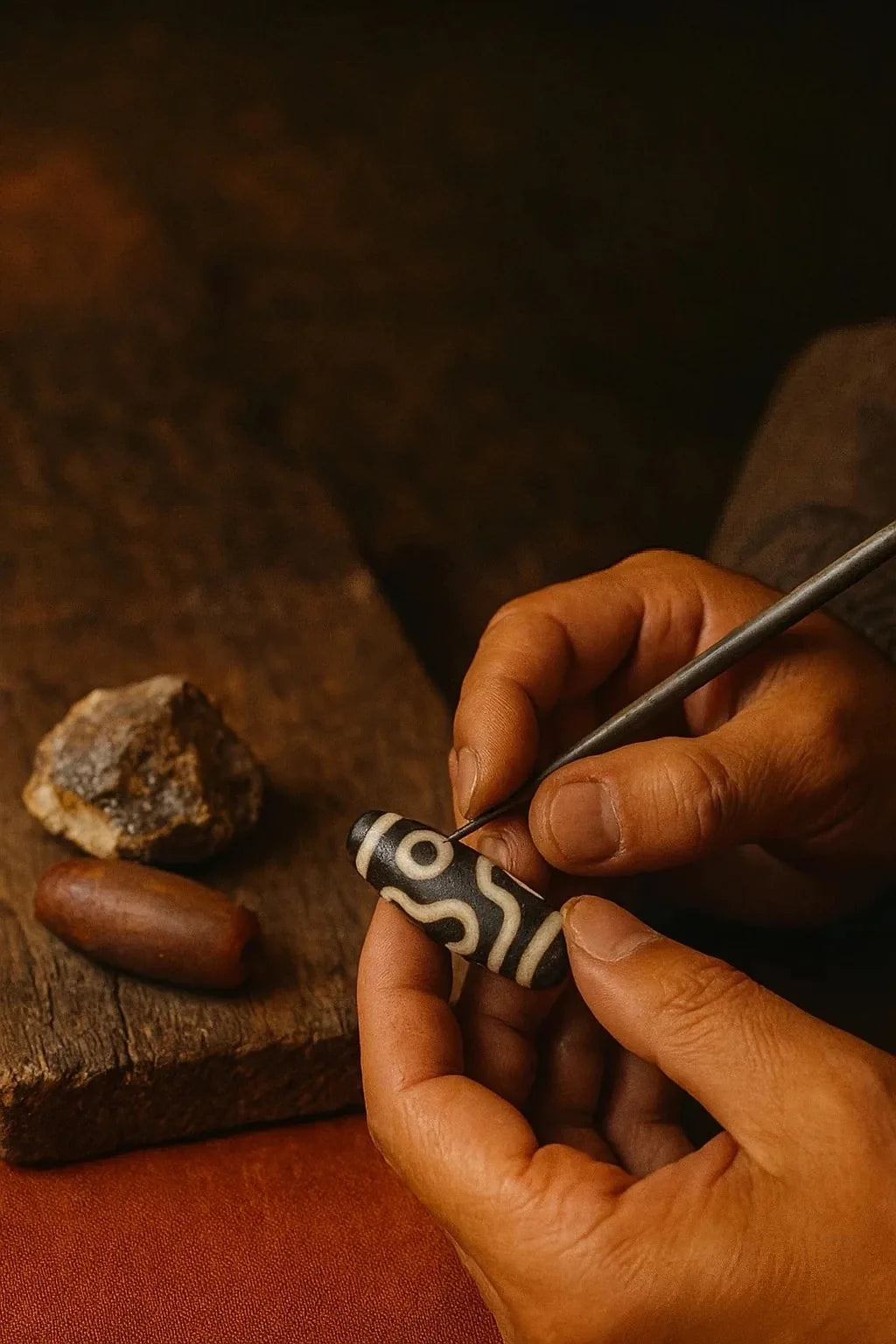
Dzi beads are patterned beads strongly associated with Tibetan and Himalayan adornment. Many modern Dzi beads are made from agate or related chalcedony materials. Their designs may include circles described as “eyes,” stripes, waves, geometric bands, vase-like motifs, or combinations of these elements.
The word Dzi describes the bead tradition and visual category; it is not the name of a mineral. That distinction matters. You can learn more in our guides to Dzi bead materials and Dzi beads vs. agate.

Why are there three “eyes”?
On a Three-Eye Dzi, the circular motifs are visually read as three eyes. In today’s Dzi market, eye counts are frequently used as a vocabulary for different intentions. The three-eye form is one of the most recognizable because three creates an easy symbolic structure: three dimensions of a flourishing life rather than one narrow form of success.
Depending on the source or community, you may see the three eyes described as:
- Wealth, health, and happiness
- Material, physical, and spiritual abundance
- Prosperity, longevity, and fulfillment
- Awareness across several areas of life
These are contemporary interpretive frameworks. They should not be presented as if every Tibetan practitioner, collector, or Buddhist school assigns exactly the same three meanings.
3-Eye Dzi meaning: wealth
“Wealth” is often the first keyword attached to a Three-Eye Dzi. A more useful interpretation is resourcefulness and the ability to recognize opportunity. In intention-based jewelry, a wearer may use the bead as a cue to pay attention to money habits, work decisions, generosity, or long-term goals.
This is very different from promising that wearing a bead will create income. Symbolic jewelry can support a ritual or mindset; it cannot replace financial planning, work, or chance.
3-Eye Dzi meaning: health
The second eye is often linked with health or vitality in modern descriptions. Kailora treats this as a symbolic theme of caring for the body, maintaining steadiness, and remembering daily well-being practices. A Dzi bead is not a medical treatment, diagnostic object, or substitute for professional health care.
If “health” is part of your intention, the useful question is: What action will this bead remind me to take? That might be rest, movement, a calmer routine, or simply checking in with yourself.
3-Eye Dzi meaning: happiness
The third eye is commonly associated with happiness, fulfillment, or inner richness. Here too, the symbol works best as a reminder rather than a promise. Happiness can be interpreted as gratitude, connection, purpose, or the ability to notice enoughness instead of constantly seeking more.
This broader reading is why the Three-Eye Dzi fits naturally between Kailora’s Manifestation & Abundance and Intuition & Awakening journeys: it can symbolize both external aspiration and internal awareness.
Is the Three-Eye Dzi a protection bead?
Dzi beads in general are often described in modern jewelry culture using words such as protection, luck, awareness, and blessing. The Three-Eye Dzi, however, is more specifically marketed around prosperity and balanced well-being. If your primary intention is protection or grounding, it may be more helpful to compare several Dzi patterns and materials rather than assume that “three eyes” has one fixed protective function.
For a wider introduction, read What Does a Dzi Bead Symbolize?

How do you wear a 3-Eye Dzi bead?
There is no universal rule requiring every Three-Eye Dzi to be worn on one particular wrist. Modern crystal and energy communities sometimes describe the left side as “receiving” and the right side as “giving” or “acting,” but this should not be confused with a single Tibetan Buddhist law of Dzi wear.
For everyday jewelry, prioritize comfort and the intention you want to remember. You can wear a Three-Eye Dzi as:
- a bracelet where the patterned bead remains visible during the day;
- a cord necklace kept close to the chest;
- a layered piece with simpler natural-stone jewelry;
- a personal intention object used during reflection or meditation.
Try not to turn the ritual into anxiety. If a bracelet rotates, touches another material, or ends up on the “wrong” wrist, that does not mean something bad has happened.
How to choose a Three-Eye Dzi
Start with the material. If a seller describes the bead as agate, the product information should clearly say so rather than treating “Dzi” as a mineral.
Look at the pattern. Three-Eye Dzi designs vary. Pattern clarity, color, finishing, and bead shape can differ significantly between pieces.
Be careful with age claims. “Ancient,” “antique,” and “old Dzi” are provenance claims, not aesthetic adjectives. Unless documentation supports the claim, a modern bead should be described as modern.
Choose a construction you will actually wear. A symbolic bead has little value as a daily reminder if the bracelet is uncomfortable or unsuitable for your routine.
A Three-Eye Dzi at Kailora
Kailora’s Three-Eye Dzi Agate Bracelet combines a natural agate Dzi bead with mixed natural stones, cotton cord, and alloy accents. It is placed in the Intuition & Awakening journey, using the three-eye pattern as a reminder of awareness and intentional direction rather than a promise of luck or financial outcomes.

You can also compare Three-Eye, Nine-Eye, Six-Eye, and Treasure Vase styles in the Kailora Dzi Agate Cord Necklace or browse the full Tibetan Dzi Beads collection.
Dzi meanings described here reflect contemporary symbolism, collector traditions, cultural interpretation, and personal spiritual practice. They are not medical or financial advice and do not guarantee health, protection, prosperity, luck, or other outcomes.