

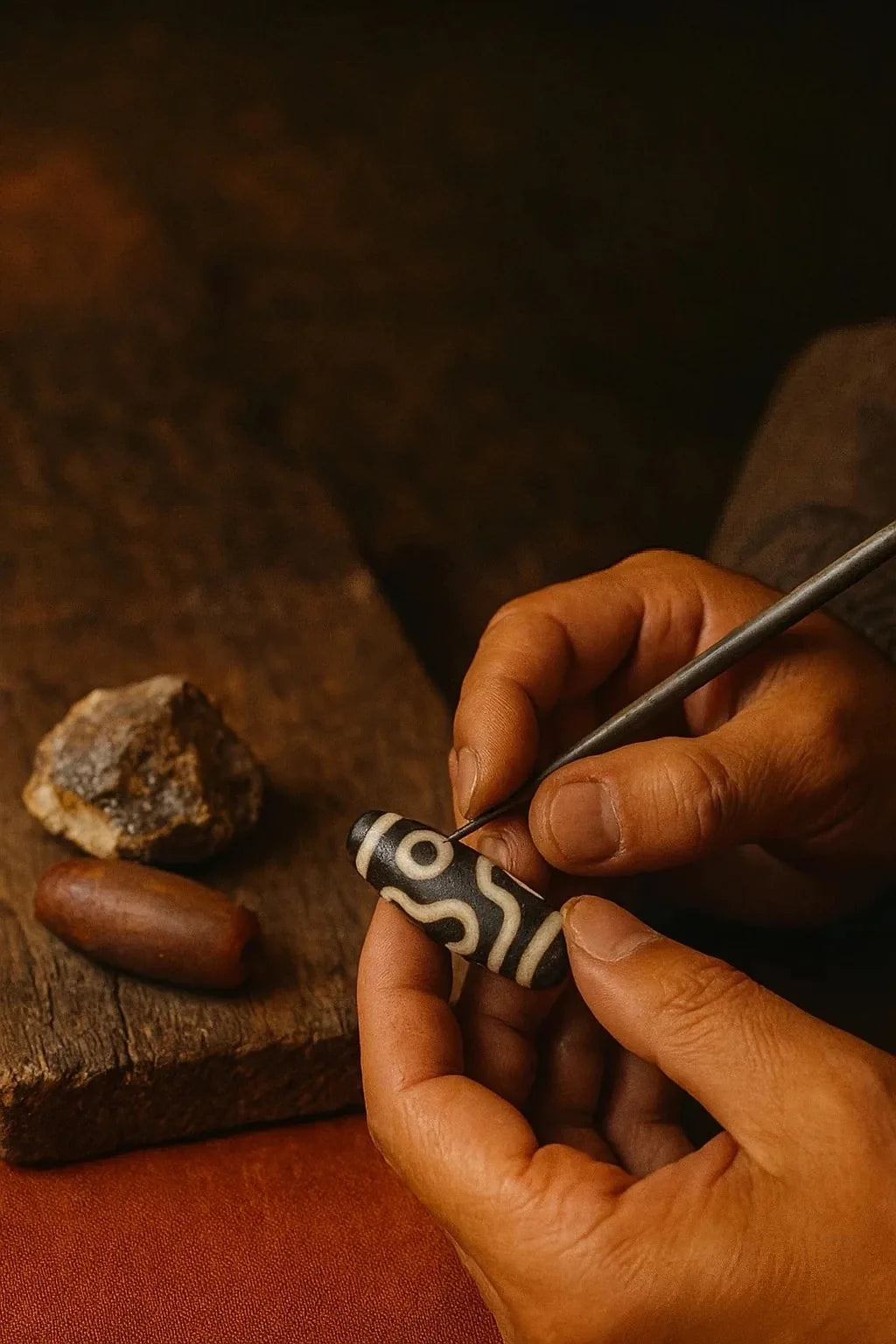










Dzi beads and agate are closely connected, but they are not interchangeable terms. The simplest distinction is this: agate describes a gem material; Dzi describes a culturally meaningful patterned bead category.
Many Dzi beads are made from agate, which is why the two terms often appear together in jewelry descriptions. But an ordinary agate bead does not become a Dzi bead simply because it is made of the same stone. Pattern, object type, cultural context, craftsmanship, age claims, and provenance are separate questions.
Quick answer: If a seller says “agate,” they are making a material claim. If they say “Dzi,” they are making a bead-category or cultural-design claim. A piece may truthfully be both—for example, an agate bead with a Dzi pattern—but one label does not automatically prove the other.
Dzi vs agate in one sentence
Agate tells you what the bead is made of; Dzi tells you what kind of patterned bead it is understood or presented to be.
This distinction sounds simple, but it resolves several common buying questions: Is every Dzi bead agate? Is every patterned agate a Dzi? Does natural agate prove that a Dzi bead is antique? Is an eye pattern naturally formed or intentionally crafted? Those questions require different kinds of evidence.
What is agate?
Agate is a gem material in the chalcedony and quartz family. It is valued for the visual structures that can appear in the stone, including bands, zones, contrasting colors, and sometimes concentric eye-like formations.
In jewelry, “agate” should primarily function as a material description. It does not, by itself, tell you the bead’s cultural identity, age, symbolic interpretation, geographic provenance, or whether visible color has been treated.
For the full material guide, see Agate: Gemology, Meaning, Treatments & Dzi Bead Context.
What is a Dzi bead?
The Getty Art & Architecture Thesaurus classifies Dzi beads as patterned jewelry components that can be cylindrical, tubular, or round and are generally made of agate. It also identifies Dzi beads with Tibetan cultural origins and describes characteristic motifs including eye-like circles, ovals, waves, stripes, rectangles, and other symbolic patterns.
That definition is useful because it keeps material and object category together without collapsing them into the same thing. Getty says Dzi beads are generally made of agate; it does not define “Dzi” as a mineral species.
For the symbolic and cultural side of the subject, see What Does a Dzi Bead Symbolize?.
Dzi beads vs ordinary agate beads: the key differences
- Category: Agate is a gem material. Dzi is a patterned bead category with Tibetan cultural associations.
- Material: An agate bead is identified by stone material. A Dzi bead may also be agate, but “Dzi” alone is not a laboratory material identification.
- Pattern: Agate can display natural banding and eye-like zones. Dzi beads are recognized for a patterned vocabulary that can include eyes, lines, waves, stripes, and geometric forms.
- Cultural context: An ordinary agate bead can belong to many jewelry traditions. Dzi belongs to a specific Tibetan and Himalayan cultural history and to later Dzi collecting and jewelry traditions.
- Age: Neither “agate” nor “Dzi” automatically proves age. A newly made agate Dzi-style bead and an old documented Dzi object may share material while having very different historical value.
- Provenance: Material identification cannot establish where a bead was made, who used it, or its ownership history.
- Treatment: Agate or chalcedony can be dyed or otherwise treated. Treatment status is a separate disclosure from Dzi classification.
Can natural agate patterns look like Dzi patterns?
Yes. Natural agate can show bands, circles, zones, and eye-like structures. This is one reason visual identification can become confusing.
A natural eye-like formation in agate and a Dzi eye motif may resemble each other, but they should not automatically be treated as the same phenomenon. One is a feature of the stone’s natural structure; the other belongs to a cultural and decorative pattern vocabulary.
Cutting and polishing also influence what natural agate structures become visible. A concentric feature may become more prominent when rough material is oriented and cut in a particular direction.
So if a bead has a circular “eye,” the responsible question is not simply “Is this Dzi?” but rather: Is the eye a natural feature of the agate, an intentionally produced motif, or a combination of natural stone structure and craftsmanship?
What does scientific analysis tell us about Dzi patterning?
A 2020 study in the journal Heritage examined one three-eye Dzi bead using X-ray diffraction, X-ray fluorescence, XANES, microscopy, and related techniques. The researchers found that the studied specimen was composed of agate and that its visible ring patterns had been crafted.
This is important evidence because it demonstrates that, in an actual analyzed specimen, natural agate material and intentionally produced Dzi patterning can coexist in the same bead.
It is equally important not to overgeneralize the result. The paper studied one specimen. It does not establish a single manufacturing method for every Dzi bead in every period.
Does being made of agate make a bead a Dzi?
No. Agate is widely used for beads and ornaments beyond Dzi traditions.
The British Museum, for example, holds an ancient agate bicone bead from Afghanistan and notes that it is allied in shape, form, and material to Tibetan Dzi beads. Yet the museum still catalogs the object as an agate bead from Afghanistan rather than reclassifying it as a Tibetan Dzi bead.
This is a useful comparison principle: similarity of material and form can be historically interesting without proving cultural identity.
Does the word Dzi prove a bead is ancient or antique?
No. Dzi describes a bead category; it is not an age certificate.
The market contains historical Dzi beads, modern Dzi beads, Dzi-inspired designs, reproductions, and objects described with Dzi-related terminology. A seller who makes a specific claim such as “ancient,” “antique,” or gives a precise historical date should be able to support that claim independently.
Material identification is not enough. A newly made agate bead can be genuine agate while having no antique provenance at all. This is why material authenticity and historical authenticity are two different questions.
For a buyer-focused framework on age claims, documentation, and what provenance can actually establish, read Modern vs Antique Dzi Beads: Age, Provenance & What Buyers Should Know.
What historical museum evidence shows
The Rubin Museum of Himalayan Art holds a set of Tibetan coral prayer beads dated to the 19th century whose listed materials include coral, turquoise, jade, dzi, clay, and silk. This provides direct museum documentation that Dzi formed part of Tibetan prayer-bead material culture.
The record is valuable precisely because it does not try to answer every gemological question at once. It documents the object, date, origin, and listed materials. That is different from laboratory testing of the mineral composition of every individual component.
For the wider historical evidence, Tibetan and Himalayan context, and what museums and material research can—and cannot—show about origin, see Dzi Bead History & Origin: Tibet, Evidence & What We Know.
What about dyed or treated agate?
Color treatment is another reason buyers should keep terminology separate. The Gemological Institute of America documents dyeing as a long-established treatment used on chalcedony and other gem materials.
A bead can therefore be real chalcedony or agate while still having treated color. Conversely, a vivid color does not automatically prove treatment. Appearance alone is not a universal treatment test.
If natural color or untreated material affects your purchasing decision, look for explicit disclosure. For higher-value claims, qualified gemological testing is more dependable than destructive home tests such as scratching, heating, soaking, or applying chemicals.
Dzi, modern Dzi, and Dzi-inspired jewelry
Modern jewelry descriptions often use several related labels, and they should not be treated as equivalent.
- Dzi bead: a bead presented within the Dzi category or tradition.
- Agate Dzi bead: a description that separately identifies agate as material and Dzi as bead context.
- Modern Dzi bead: a contemporary bead using Dzi pattern vocabulary, without implying antique age.
- Dzi-inspired: a design influenced by Dzi forms or symbolism without claiming the object is an old or historically proven Dzi bead.
Clear labeling is preferable to using “Dzi” as a shortcut for material, age, origin, and spiritual effect all at once.
How Kailora labels Dzi and agate jewelry
Kailora separates the material layer from the symbolic layer wherever possible. A product described as Natural Agate Dzi identifies agate as the material used in that specific piece while using Dzi to describe the bead or design context.
Examples include the Three-Eye Dzi Agate Bracelet, the Dzi Agate Cord Necklace, and the Natural Agate Dzi Bead Earrings.
Symbolic terms such as intuition, awakening, grounding, protection, or abundance belong to cultural interpretation and Kailora’s contemporary intention framework. They are not mineralogical properties and are not guarantees of a spiritual, medical, financial, or protective outcome.
How to choose between agate jewelry and Dzi jewelry
If your main interest is the stone itself—its banding, color, polish, bead quality, and material character—start with Agate jewelry.
If your main interest is Dzi pattern vocabulary, Tibetan cultural associations, eye motifs, or Dzi-related symbolism, explore the Tibetan Dzi Beads collection.
When evaluating an individual piece, use a simple sequence: identify the material first, identify the bead/design category second, ask about treatment third, and evaluate any age or provenance claim separately.
Frequently asked questions
Is Dzi the same thing as agate?
No. Agate is a gem material. Dzi is a patterned bead category associated with Tibetan culture. Many Dzi beads are made from agate, so a bead can be both Dzi and agate.
Is every agate bead a Dzi bead?
No. Agate has been used for beads across many regions and traditions. Material alone does not make an object Dzi.
Can a Dzi bead be real agate but still be modern?
Yes. “Real agate” describes material authenticity. It does not establish antique age. A contemporary Dzi-pattern bead can be made from genuine agate.
Are Dzi eye patterns naturally formed in agate?
Agate can naturally form eye-like structures, but Dzi eye motifs can also involve intentional craftsmanship. The appearance of an eye alone does not prove which process created it.
Does a Dzi pattern prove Tibetan origin?
No. A pattern can reference a Tibetan Dzi vocabulary without proving the geographic origin or historical provenance of a specific bead.
Which is more valuable: Dzi or agate?
There is no single answer because the terms describe different dimensions. Agate value depends on material quality and other gem factors, while Dzi pricing can also reflect age claims, provenance, rarity, craftsmanship, pattern, condition, and collector demand. Strong historical claims require stronger evidence.
Related Kailora guides
- Dzi Bead History & Origin: Tibet, Evidence & What We Know
- Modern vs Antique Dzi Beads: Age, Provenance & What Buyers Should Know
- Are Dzi Beads Made of Agate? Materials, Patterns & What to Know
- Agate: Gemology, Meaning, Treatments & Dzi Bead Context
- What Does a Dzi Bead Symbolize?
- What Are Dzi Bead Bracelets? Meaning, Eye Symbols & How to Choose
Editorial note: This guide separates material identity, bead classification, cultural interpretation, treatment, age, and provenance. Kailora’s contemporary intention language is symbolic and reflective; it is not a medical, scientific, protective, financial, or spiritual guarantee.