









One of the most confusing parts of buying Dzi jewelry is the word real. A seller may use “real Dzi” to mean genuine agate. A collector may use it to mean an old bead with documented history. Another buyer may simply mean a bead with a recognizable Dzi-style pattern.
Quick answer: does “Dzi” mean antique?
No. A modern Dzi bead can be genuine agate, culturally meaningful, and spiritually significant without being antique. “Antique” is a separate claim about age and provenance. Photographs, wear marks, color, pits, or an old-looking surface alone do not establish that age.
This guide focuses specifically on age and provenance. If your main question is “How can I tell whether a Dzi bead is real?” or whether Dzi is the same as agate, use Dzi Beads vs Agate as the primary authenticity guide. For the broader historical question, see Dzi Bead History & Origin.
The four questions buyers often mix together
When evaluating a Dzi bead, four separate questions are often collapsed into one:
1. What is the bead made from?
This is the material question. Many Dzi beads are associated with agate or chalcedony. Gemological testing can help identify mineral composition and, in some cases, treatments.
Material identification does not establish age. A bead can be genuine agate and newly made.
2. How was the pattern produced?
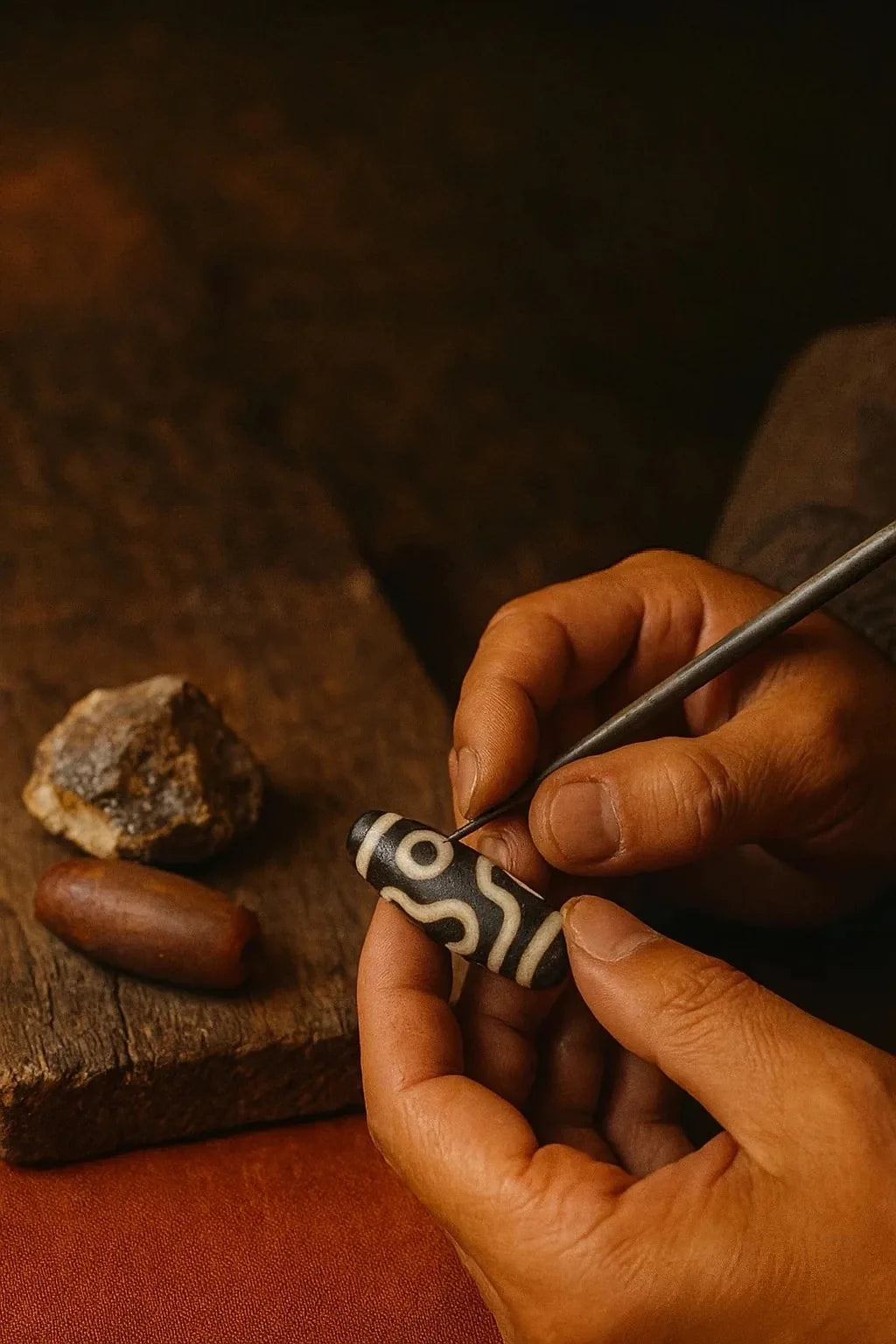
This is the construction question. Dzi-style patterns may be created by controlled surface treatments rather than being natural banding alone. Scientific study of a three-eye specimen published in 2020 found an agate body with a deliberately produced pattern.
That tells us how one studied object was constructed. It does not automatically date it.
3. How old is the bead?
This is the age question. Age cannot normally be established just because a bead looks worn, dark, pitted, faded, smooth, or irregular.
Surface appearance may reflect genuine use and time, but similar visual effects can also result from treatment, handling, abrasion, intentional distressing, or natural variation in the stone.
4. What documented history supports the object?
This is the provenance question. Provenance is the documented history of an object—who owned it, where it was recorded, when it entered a collection, and what evidence connects those stages.
For a serious antique claim, provenance is often more meaningful than a dramatic sales description.
What counts as a modern Dzi bead?
“Modern Dzi” generally describes a contemporary patterned bead made for present-day jewelry, collecting, or spiritual use. The bead may use agate or another disclosed material and may draw on established eye, stripe, wave, geometric, or auspicious visual language.
Modern does not mean meaningless. A recently made Dzi-centered bracelet can still connect a wearer with Tibetan-associated symbolism, contemporary spiritual practice, or a personal intention such as protection, balance, abundance, or awareness.
What modern does not mean is antique. A contemporary bead should not be turned into a centuries-old artifact through copywriting alone.
What does “antique Dzi” imply?
In ordinary collecting language, “antique” is an age claim. With Dzi, it can also imply a history of circulation, inheritance, collection, ritual use, or regional movement.
Because older Dzi can carry cultural and monetary value, the label deserves caution. Depending on the object, stronger evidence might include:
- documented collection or ownership history;
- dated museum, archival, auction, or dealer records;
- credible specialist examination;
- comparison with securely documented objects;
- appropriate material or technical analysis where it can answer a specific question.
No single form of evidence automatically answers everything. A mineral test can identify stone; it may not establish when the bead was made. A family story can be meaningful provenance; it may still be difficult to independently verify.
Can you identify an antique Dzi from photos?
Not reliably.
Photography can reveal pattern, shape, drilling, surface texture, color, chips, abrasions, and proportions. Those details are useful for comparison, but photographs alone usually cannot establish a defensible age.

This is especially important online, where lighting, sharpening, filters, dirt, wax, polish, intentional aging, and image compression can change how a surface appears.
Claims such as “ancient because it has weathering,” “old because the holes are worn,” or “authentic because the surface has cinnabar spots” need more support when they are being used to establish historical age.
What the 2020 synchrotron study can—and cannot—tell us
A 2020 Heritage study used X-ray diffraction, fluorescence imaging, absorption spectroscopy, and related methods to investigate one three-eye Dzi specimen. The researchers identified an agate body and found that the patterned areas resulted from deliberate treatment.
This is valuable because it shows how modern analytical tools can examine Dzi construction without relying only on visual judgment.
But the study examined a single object. It did not establish the age, geographic origin, or manufacturing history of all Dzi beads. Science can answer specific material questions when the right specimen is tested; it does not automatically provide a universal age certificate.
Material identification is not age verification
This distinction resolves much of the confusion:
- Genuine agate tells you something about material.
- A deliberately made Dzi-style pattern tells you something about construction.
- An old or antique date tells you something about age.
- Documented provenance tells you something about an object’s recorded history.

One layer does not automatically prove the next.
For a deeper material explanation, read Are Dzi Beads Made of Agate?. For the broader “real Dzi” question, return to Dzi Beads vs Agate.
Wording that gives buyers more useful information
When evaluating an online listing, specific language is more useful than mystical certainty. Examples include:
- “modern Dzi-style patterned agate bead”;
- “agate bead with a contemporary eye pattern”;
- “age not independently verified”;
- “antique attribution based on documented collection history”;
- “material identified as agate; age not determined.”
By contrast, a claim such as “guaranteed thousand-year-old Tibetan Dzi” deserves evidence proportionate to the claim.
Does a modern Dzi still have spiritual meaning?
For many wearers, yes. Symbolic meaning does not depend on pretending an object is older than it is.
Eye counts and patterns are interpreted today through overlapping Tibetan, Himalayan, Chinese, collector, and global spiritual-jewelry traditions. A wearer may choose a three-eye pattern around prosperity and wellbeing, a nine-eye pattern around protection and abundance, or another motif because of a personal relationship with its visual language.
Kailora treats these meanings as cultural and contemporary symbolic interpretations rather than as proof of an object’s historical age. You can explore the 3-Eye Dzi and 9-Eye Dzi guides for more detail.
How Kailora describes the Dzi beads used in our jewelry
Kailora’s current Dzi-centered jewelry is presented as contemporary jewelry rather than as an antique-object business. Our role is in selection, pairing, composition, stringing, cordwork, spacing, and hand assembly around the focal bead.
We do not need to claim that Kailora manufactures, paints, or etches the Dzi beads themselves in order to explain the craftsmanship of the finished piece. Product-specific material, construction, and origin information remains the source of truth for each design.
When a piece uses a modern Dzi-style bead, we would rather say so clearly than create artificial value through unsupported antiquity claims.

A practical antique-Dzi buying checklist
- Identify the material. Is the stone described specifically?
- Find the age claim. Is the bead called modern, antique, vintage, ancient, or left undated?
- Ask what supports the age claim. Appearance alone is weak evidence.
- Look for provenance. Is there documented collection, ownership, archival, or specialist evidence?
- Separate symbolism from age. A meaningful pattern is not an age certificate.
- Check the finished jewelry. Cord, supporting beads, metal, sizing, finish, and construction matter in a wearable piece.
- Choose meaning intentionally. If you are buying to wear rather than collect, pattern, fit, craftsmanship, and personal resonance may matter more than speculative age.
Research basis
This guide draws on museum collection records, material analysis published in the journal Heritage, and the distinction used in gemology and object studies between identifying material and establishing historical provenance.
The goal is not to reduce Dzi to laboratory data. It is to keep cultural and spiritual meaning strong without weakening it through historical claims that the available evidence cannot support.
Explore Dzi with context
Start with the Kailora Tibetan Dzi Beads collection, then move between symbolism, history, material authenticity, and materials.
The clearest principle is simple: a Dzi bead can be materially genuine, culturally meaningful, and completely modern at the same time. “Antique” is a separate historical claim, and provenance is what gives that claim weight.