
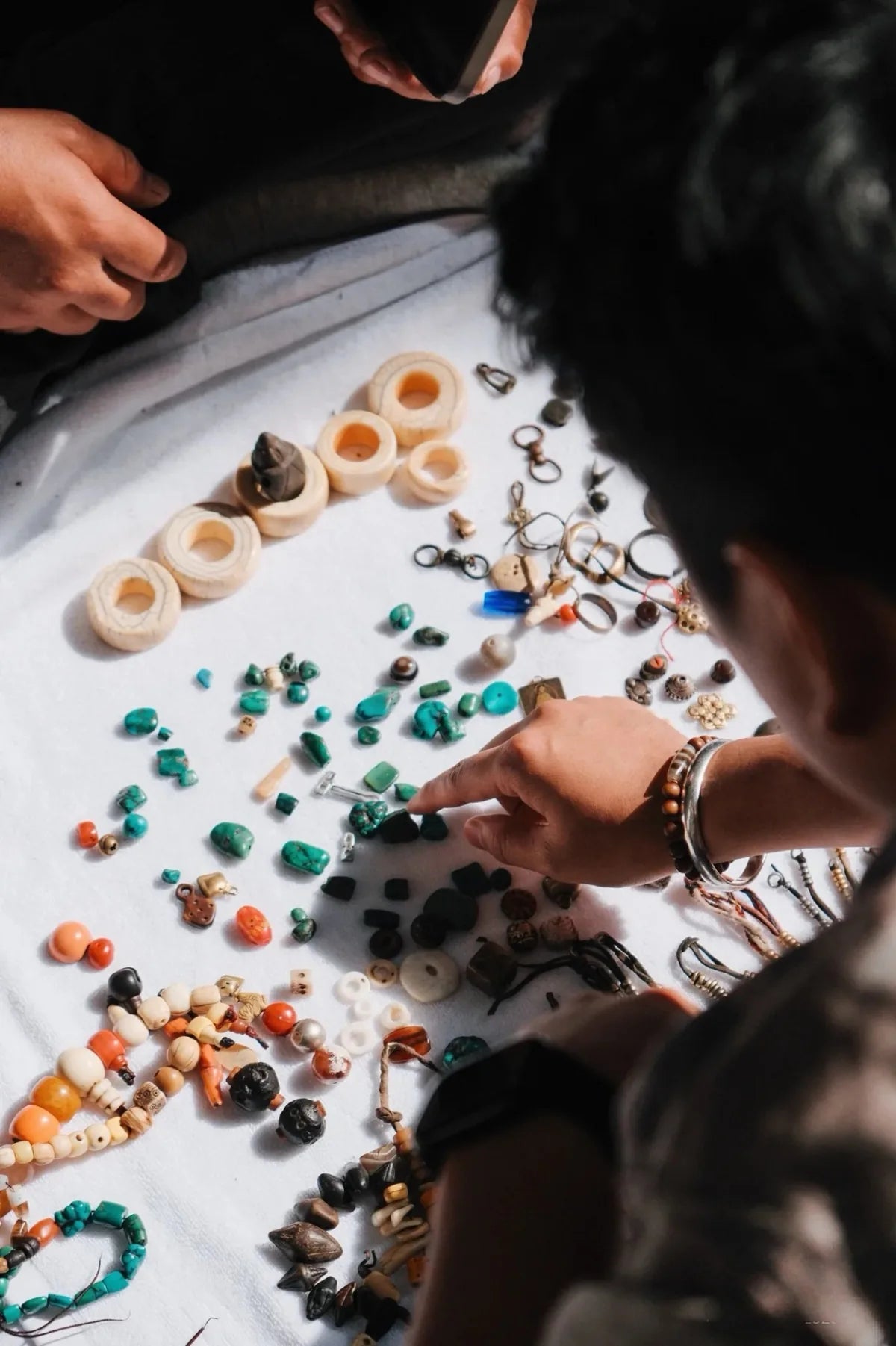
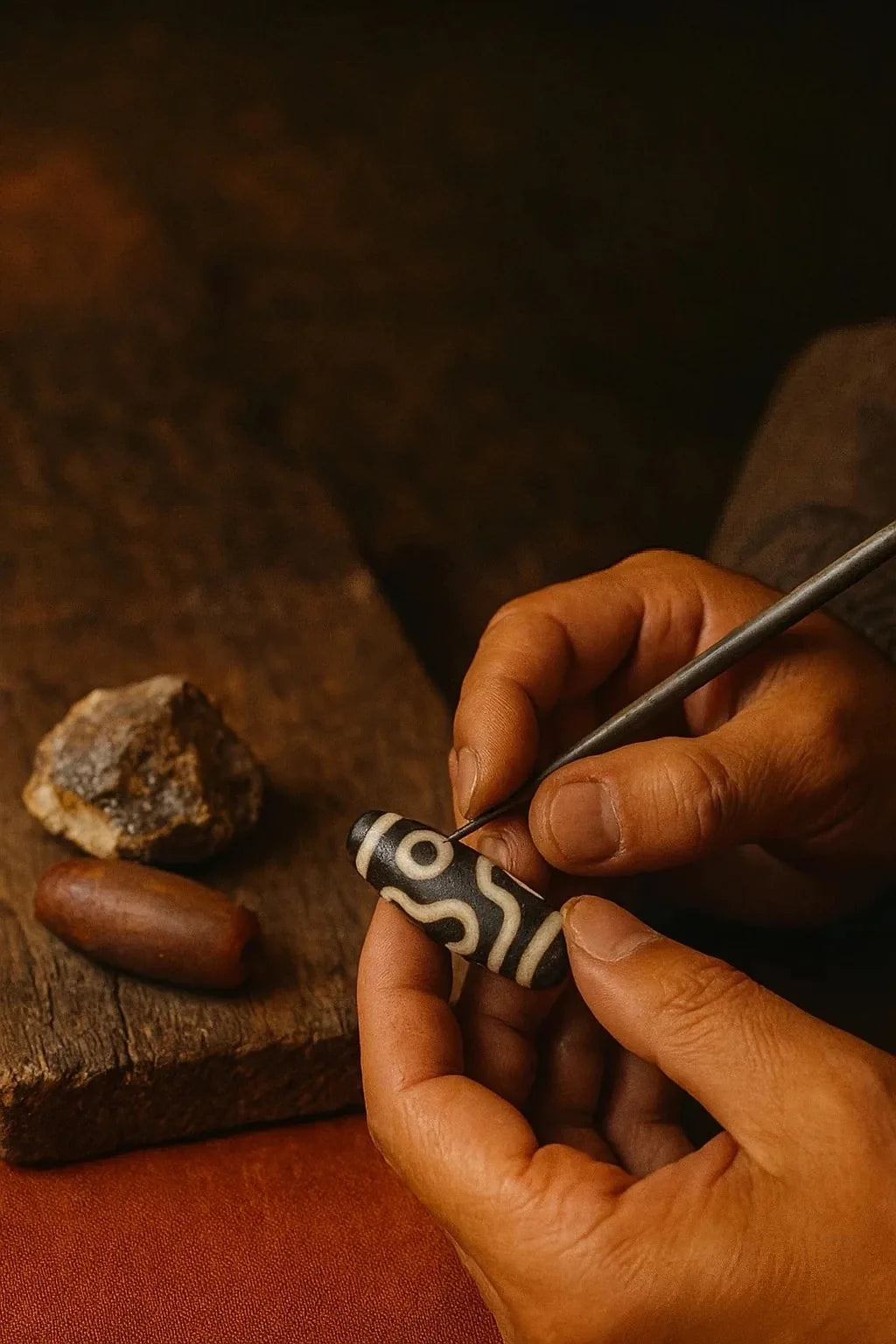









Dzi beads occupy an unusual place in Tibetan and Himalayan material culture. They are worn as jewelry, incorporated into prayer-bead strands, collected as valued objects, and interpreted through layers of protection, fortune, auspiciousness, and personal intention.
Quick answer: where do Dzi beads come from?
Dzi beads are deeply associated with Tibet and the wider Himalayan cultural world, but their earliest origin is not settled by one archaeological discovery or scientific test. Museum records document Dzi within Tibetan material culture, while older patterned-agate traditions elsewhere in Asia provide useful comparison without proving a simple direct ancestry.
This guide focuses on the history and origin question: what can be documented, what remains uncertain, and how that differs from symbolic meaning. For material authenticity and the question of what makes a Dzi bead “real,” read Dzi Beads vs Agate. For age claims and antique provenance, see Modern vs Antique Dzi Beads.
What does the word “Dzi” refer to?
In jewelry and collecting contexts, Dzi is best understood as a culturally recognized category of patterned bead rather than the name of a mineral. Many Dzi beads are associated with agate or chalcedony, while the term itself points to the bead’s patterned identity, cultural use, and symbolic reading.
This distinction matters. A bead can be made of genuine agate without being ancient. It can carry a Dzi-style eye pattern without having documented Tibetan provenance. And a modern patterned bead can still participate meaningfully in contemporary Tibetan-inspired jewelry without needing an invented archaeological story.
For the material side of the subject, see Are Dzi Beads Made of Agate?.

What can museum evidence tell us?
Museum collections give us fixed reference points. They are especially useful because they attach an object to a documented collection record rather than relying only on marketplace language.
A 19th-century Tibetan prayer-bead example
A Tibetan prayer-bead strand in the Rubin Museum collection, dated to the nineteenth century, lists Dzi among its materials together with coral, turquoise, jade, clay, and silk. This gives us a dated museum example of Dzi appearing within Tibetan prayer-bead material culture.
It does not tell us when the first Dzi bead was made. It does show that Dzi had an established place within documented Tibetan objects by the nineteenth century.
An earlier patterned-agate comparison from Afghanistan
The British Museum holds a polished brown-and-white banded agate bead from Afghanistan, dated to around the first century, that the museum describes as allied in shape, form, and material to Tibetan Dzi beads.
That wording should be read carefully. The object is useful comparative evidence for a much wider history of patterned and banded stone beads across Asia. It is not proof that the Afghan bead was itself a Tibetan Dzi bead, nor does it establish a simple direct line from that object to later Tibetan Dzi traditions.
What does material science show?
Scientific analysis can answer questions that visual inspection cannot. In a 2020 Heritage study, researchers used synchrotron-based methods to examine a single three-eye Dzi specimen. Their analysis identified the material as agate and found evidence that the light-colored pattern was deliberately produced rather than simply being a natural band in the stone.
That is useful evidence for how one studied Dzi specimen was constructed. It also demonstrates why material analysis should be separated from broader historical claims.
The study examined one bead. A laboratory result for material and pattern construction is not automatically a dating certificate and cannot establish the geographic origin or manufacturing history of all Dzi beads.
So where did Dzi beads originate?
The most responsible answer is layered:
- Cultural association: Dzi beads are deeply associated with Tibetan and Himalayan jewelry, amulets, personal adornment, and bead traditions.
- Material context: Many Dzi are patterned agate or chalcedony, placing them within a broader Asian history of worked stone beads.
- Historical evidence: Museums document Dzi within Tibetan objects, while earlier patterned-agate traditions elsewhere in Asia provide comparative context.
- Unresolved question: the exact earliest point at which the recognizable Dzi tradition emerged, and the route by which particular patterning techniques entered or developed within the Tibetan cultural sphere, remains more complex than a single origin story.
This is why blanket phrases such as “every Dzi bead is thousands of years old” should not be treated as established history.
Why are Dzi beads so strongly connected with Tibet?
Historical origin is only one kind of truth. Cultural continuity is another.
Within Tibetan and Himalayan contexts, Dzi beads have been valued not merely as decorative stones but as objects with social, personal, and symbolic weight. They may be incorporated into jewelry and prayer beads, passed between people, collected, worn close to the body, and interpreted through auspicious or protective meanings.
Contemporary interpretations also continue to use protective “eye” symbolism around Dzi. That living meaning matters, even when it should not be confused with proof that every modern eye-count interpretation comes from one fixed ancient doctrine.

For the symbolic layer, see What Does a Dzi Bead Symbolize?. For specific contemporary interpretations, explore the 3-Eye Dzi guide and 9-Eye Dzi guide.
Historical fact and spiritual meaning can coexist
Kailora does not treat careful history as a reason to strip Dzi beads of spiritual meaning. The two layers answer different questions.
Historical research asks what can be dated, documented, compared, or materially tested. Cultural and spiritual interpretation asks how communities and wearers understand a bead, what an eye motif may represent, and what intention a person chooses to carry with it.
A Dzi bead can therefore be discussed as an object of Tibetan-associated material culture and, separately, as a contemporary symbol of protection, abundance, balance, awareness, or personal intention. The key is to identify which layer is being discussed.
What does “ancient Dzi” actually require?
Age is a historical claim, not a visual mood. Darkened surfaces, pits, wear marks, softened edges, color variation, or an “old” appearance can be interesting features, but none of them alone proves an ancient date.
A serious age claim becomes stronger when it is supported by documented ownership history, credible collection records, archaeological context, specialist examination, or appropriate scientific analysis. Even then, material identification and age determination are not the same task.
Our companion guide, Modern vs Antique Dzi Beads, explains provenance and age claims in more detail.
How Kailora approaches Dzi history
Kailora keeps four layers visible:
- Material fact: what the bead or supporting jewelry materials are actually made from when known.
- Historical evidence: what museums, documented objects, and research can support.
- Cultural context: how Dzi beads function within Tibetan and Himalayan material and symbolic traditions.
- Contemporary interpretation: how modern wearers understand patterns such as eyes, protection, prosperity, and intention.
This gives us room to discuss spirituality without turning uncertain historical claims into facts.
What this means when choosing Dzi jewelry
You do not need an “ancient” label for a Dzi-centered piece to feel meaningful. For everyday jewelry, it is often more useful to ask:
- Is the material description specific?
- Is the bead presented as modern, antique, or simply Dzi-style—and is that wording supported?
- Are symbolic meanings clearly presented as cultural or spiritual interpretations?
- Are construction, supporting stones, metal, cord, size, and origin described clearly?
- Does the design fit the intention or visual language you want to carry?
You can explore Kailora’s current Dzi-centered pieces in the Tibetan Dzi Beads collection.

Research basis
This article was developed from museum collection records and material research including the British Museum, the Rubin Museum of Himalayan Art, contemporary Tibetan cultural documentation, and the 2020 Heritage synchrotron study of a three-eye Dzi specimen.
These sources do not produce one simple origin story. That is precisely why Kailora treats uncertainty as part of the history rather than filling the gaps with marketing mythology.
In one sentence
Dzi beads are deeply embedded in Tibetan and Himalayan cultural life, but their earliest origin is a layered historical question—so meaning, material, age, and provenance should be discussed separately rather than collapsed into one “ancient Tibetan bead” claim.