
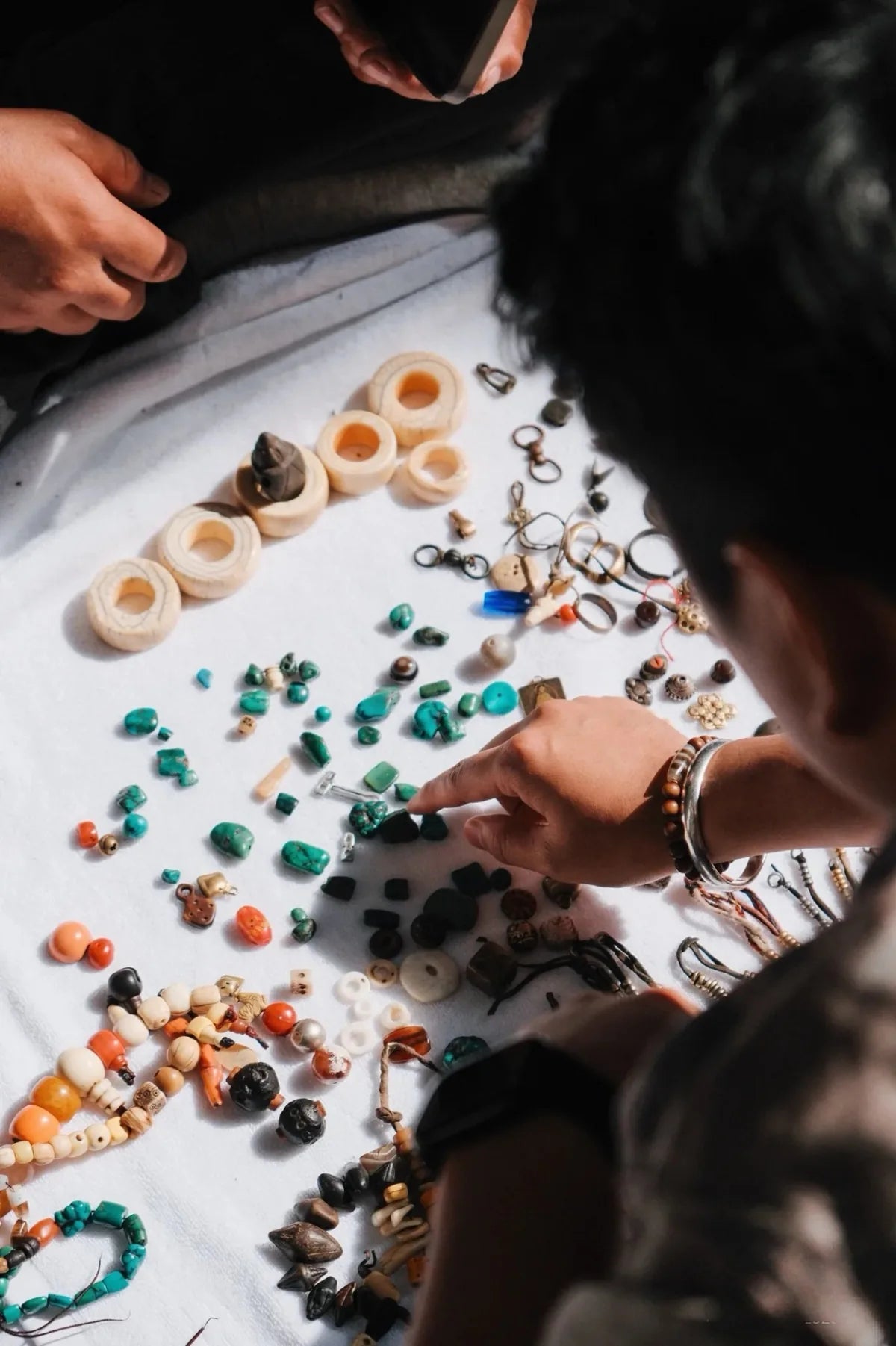










Shopping for gemstone beads can be confusing because the word natural is often used as if it answered every question about a stone. It does not. A bead can be natural-origin and still be dyed, heated, impregnated, coated, or otherwise treated. A laboratory-grown gemstone can be a true synthetic counterpart rather than an imitation. And a material that looks convincing in a photograph can still be a simulant.
Quick answer: there is no single visual clue or universal home test that can prove every gemstone bead is natural. You can screen a piece by checking the seller’s terminology, material disclosure, photographs, price logic, visible variation, and treatment information. But definitive identification may require gemological instruments, microscopy, spectroscopy, or laboratory analysis.
If you first need the terminology, read Natural vs Treated vs Synthetic Gemstones. This guide focuses on the practical next question: what can a buyer realistically check before purchasing gemstone beads?
First, define what “natural” means
When someone asks whether gemstone beads are natural, they may actually be asking four different questions:
- Natural-origin or laboratory-grown? Did the material form in nature, or was it grown as gem material in a laboratory?
- Genuine gem material or imitation? Is the bead actually the material being named, or is another substance being used because it looks similar?
- Untreated or treated? Has the natural-origin material been deliberately altered after mining?
- Naturally colored or color-enhanced? Is the visible color inherent to the material, or has dye, coating, irradiation, heat, or another process contributed to it?
These questions should not be collapsed into “real versus fake.” A natural-origin gemstone can be treated. A synthetic gemstone can share the essential gemological properties of its natural counterpart. An imitation can be a completely different material.
What you can check before buying gemstone beads
1. Look for a specific material name
A useful product description should identify the material as specifically as the seller can reasonably support. Terms such as “natural stone,” “energy stone,” “crystal bead,” or “turquoise color” are broader than a gem name and do not by themselves establish material identity.
If the listing says agate, clear quartz, turquoise, Tiger’s Eye, or smoky quartz, check whether the rest of the description uses the same terminology consistently. A product title, materials section, care information, and FAQ should not contradict one another.
2. Separate the word “natural” from treatment status
One of the most important buyer checks is whether the seller uses natural to mean natural-origin, or uses it as an implied promise of “untreated.” Those are not the same statement.
Gemological references document treatments across many materials, including dyeing, impregnation, coating, bleaching, heating, irradiation, and filling where applicable. A natural-origin bead can therefore still have an altered color, clarity, surface, or stability.
This is especially relevant with materials such as turquoise and chalcedony. See Kailora’s Tibetan Turquoise guide and Agate guide for stone-specific treatment context.
3. Use close-up photographs as a screening tool, not proof
Macro photographs can help you inspect polish, surface texture, color distribution, inclusions, banding, chatoyancy, drill holes, chips, fractures, and bead-to-bead variation. These observations can tell you whether the seller’s description appears plausible enough to investigate further.
They cannot prove natural origin on their own. Natural materials can be highly uniform after sorting and cutting. Synthetic materials can contain growth features. Imitations can be manufactured with convincing variation. Photographs also change with lighting, white balance, editing, compression, and display settings.
4. Treat variation as context, not an authenticity certificate
Natural stone beads often show differences in color, transparency, pattern, inclusions, or internal texture because the starting material is not perfectly uniform. That variation can be consistent with natural material.
But variation is not proof. Manufacturers can intentionally create irregular-looking glass, resin, ceramic, composite material, or treated stone. Conversely, a well-sorted strand of natural beads can look unusually consistent. The correct conclusion is therefore limited: visible variation may support a material description, but it does not verify it.
5. Inspect unusual color carefully
Very intense, unusually even, or unexpectedly bright color can justify asking more questions about treatment, but it should not automatically be labeled fake. Some gems naturally occur in vivid colors, while others are commonly dyed or otherwise enhanced.
Under magnification, color concentrations in surface-reaching features or around drill areas can sometimes be a clue to dyeing in suitable materials. Coatings can sometimes show surface-related clues as well. These observations are material-specific, however, and should be treated as screening signs rather than universal diagnostic rules.
6. Check whether the price and story require stronger evidence
Price alone cannot authenticate a gemstone. Expensive material can be misrepresented, and genuine natural material can be inexpensive when it is abundant, small, lower grade, heavily included, or commercially cut.
What price can do is tell you how much verification may be reasonable. If a seller makes a high-value claim involving rare material, untreated status, unusual geographic origin, antique age, or historic provenance, the evidence standard should rise with the claim.
What visual clues cannot prove
Online advice often turns individual clues into absolute rules. That creates false confidence. None of the following should be treated as a universal standalone conclusion:
- “Natural stones are always imperfect.” Natural material can be selected and matched for consistency.
- “Perfectly clear beads must be synthetic.” Clarity alone does not determine natural or synthetic origin.
- “Bubbles always mean fake.” Gas bubbles can be relevant in identifying some glass materials, but one visual feature is not a complete identification method.
- “If the bead feels cold, it is real.” Thermal sensation depends on material, temperature, bead size, surface, and environment and is not a universal authenticity test.
- “If it scratches glass, it is genuine.” Hardness can help narrow possibilities in controlled gemological work, but many different materials overlap in hardness and scratch testing can damage jewelry.
The safest way to use visual inspection is to identify questions to ask next, not to manufacture certainty that the observation cannot support.
Why common home tests are unreliable
Scratch tests, flame tests, hot-needle tests, acid tests, solvent soaking, intentional chipping, and other destructive methods circulate widely online. They are poor general-purpose tests for finished gemstone jewelry.
First, they can damage the bead, polish, dye, coating, metal components, elastic cord, thread, adhesive, or finish. Second, many of them test only one property while multiple materials can share that property. Third, a treatment may be difficult or impossible to detect with a simple household method.
For example, gemological treatment references note that some bleaching can be extremely difficult to detect, while other treatment and growth-origin questions can require spectroscopy or chemical analysis. A household test cannot substitute for a complete identification workflow.
What professional gemologists actually use
Professional identification works differently from viral “one trick” tests. Gemologists combine multiple observations and instruments, then interpret the results for a specific material.
Standard colored-stone examination can include microscopy together with instruments such as a refractometer, polariscope, dichroscope, and spectroscope. Ultraviolet fluorescence or phosphorescence can provide additional clues in some materials. When routine testing is not enough, laboratories may use techniques such as UV-Vis-NIR spectroscopy, FTIR spectroscopy, and chemical analysis.
Microscopy is particularly important because inclusions, growth structures, surface features, fillings, coatings, dye concentrations, assembled construction, and other characteristics can provide evidence about identity, treatment, or natural versus laboratory-grown origin. But interpretation still depends on the gem species and the full set of observations.
When is a laboratory report worth it?
Not every bead bracelet or mala needs an individual laboratory report. Testing can cost more than low-value beads justify. A report becomes more useful when one or more of the following materially affects the purchase:
- the piece has a high purchase value;
- the material is rare or unusually valuable;
- untreated status is central to the price;
- natural versus laboratory-grown origin matters;
- a geographic-origin claim meaningfully changes value;
- the seller makes an important antique or provenance claim that needs separate documentation.
Major gemological laboratories can identify many colored stones, determine natural or synthetic origin, and report detectable treatments. Geographic-origin opinions are available only for certain gem materials and when the evidence supports a conclusion.
Remember that a gemological report identifies gemological characteristics. It does not automatically prove that a bead is antique, that it belonged to a particular historical community, or that a symbolic or spiritual story attached to it is historically documented.
A seven-question buyer checklist
- What exact material is being sold? Ask for a gem or material name, not just a color or spiritual label.
- Is the material natural-origin or laboratory-grown?
- Are any treatments known or disclosed?
- Does “natural” explicitly mean untreated, or only natural-origin?
- What evidence supports geographic origin, age, or provenance if those claims are part of the price?
- Are close-up photographs of the actual piece available?
- What is the return policy if the material description is materially inaccurate?
A seller who cannot answer every advanced gemological question is not automatically unreliable. What matters is whether the description stays within the evidence available and whether uncertainty is communicated rather than hidden behind absolute marketing language.
Examples from common Kailora gemstone topics
Turquoise
With turquoise, natural origin and untreated status must be considered separately. Porous turquoise can be impregnated or otherwise treated, and imitation materials can also resemble turquoise. Color and matrix alone should not be treated as proof of authenticity.
Agate and Dzi beads
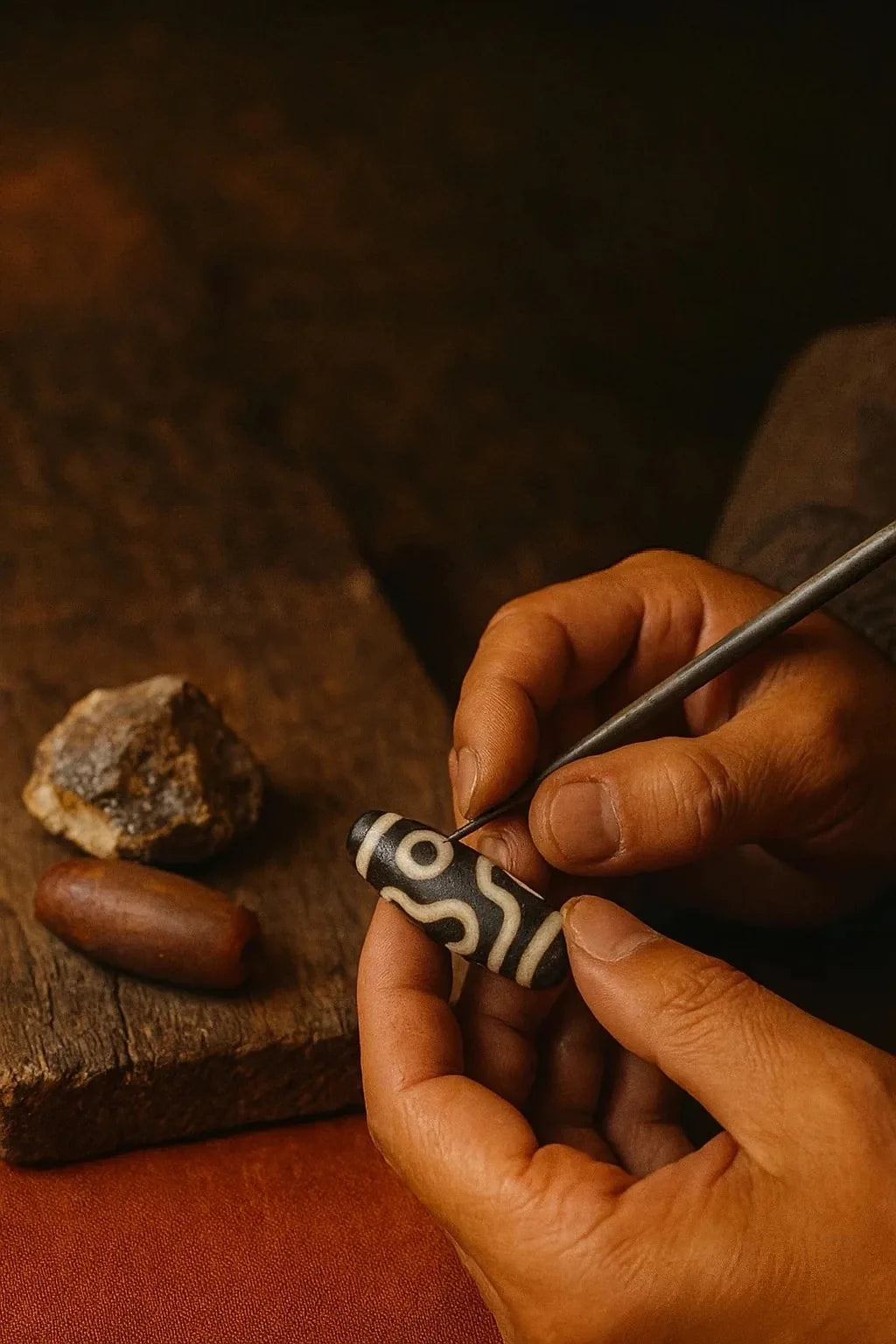
Agate can show natural banding and eye-like structures, but agate can also be dyed. In Dzi-related jewelry, the bead category, pattern, material, age, and provenance are separate questions. Read Are Dzi Beads Made of Agate? and Dzi Beads vs Agate.
Clear quartz
Natural rock crystal exists alongside synthetic quartz produced by laboratory growth methods. A clear appearance by itself does not prove either category. See Clear Quartz (Rock Crystal): Gemology, Meaning & Jewelry.
Tiger’s Eye and smoky quartz
For quartz-family materials, visible appearance, color origin, treatment status, and material identity should remain separate questions. Read the Tiger’s Eye guide and Smoky Quartz guide.
Kailora’s material-transparency approach
Kailora’s editorial framework separates four things that are often mixed together in spiritual-jewelry marketing: material identity, treatment status, cultural or historical context, and contemporary symbolic intention.
A gemological statement should describe the material. A historical statement should be supported by historical evidence. A symbolic meaning should be identified as traditional belief, contemporary interpretation, or Kailora’s intention language rather than presented as a laboratory property of the stone.
This approach also means that “natural” should never be used as shorthand for guaranteed healing, protection, luck, purity, spiritual power, antique age, or geographic provenance.
Frequently asked questions
Can I tell whether gemstone beads are natural just by looking at them?
Sometimes appearance provides useful clues, but visual inspection alone cannot universally determine natural versus synthetic origin, identify every imitation, or detect every treatment.
Do inclusions prove a bead is natural?
No. Some inclusions and growth features can be diagnostically useful to trained gemologists, but “it has inclusions” is not a universal proof of natural origin. The type and context of the inclusion matter.
Are perfectly matched beads fake?
No. Natural material can be sorted by color, transparency, size, and pattern to create a consistent strand. High uniformity can justify closer examination but does not prove synthetic or imitation material.
Does “natural stone” mean untreated?
No. Natural origin and treatment status are separate. A natural gemstone can later be dyed, heated, impregnated, coated, irradiated, filled, bleached, or otherwise treated where those processes apply.
Should I use a scratch or fire test?
Not on finished jewelry. Destructive household tests can damage beads and components while still failing to provide a reliable identification. For important purchases, professional gemological testing is a better evidence standard.
Can a laboratory prove where every gemstone came from?
No. Geographic-origin determination is available only for certain materials and only when diagnostic evidence supports an opinion. Material identity should not be confused with mine origin, cultural provenance, or historical ownership.
Related Kailora guides
- Natural vs Treated vs Synthetic Gemstones
- Tibetan Turquoise: History, Gemology, Symbolism & Jewelry
- Agate: Gemology, Meaning, Treatments & Dzi Bead Context
- Clear Quartz (Rock Crystal): Gemology, Meaning & Jewelry
- Tiger’s Eye: Gemology, Meaning, Symbolism & How to Wear It
- Explore Kailora Crystal Jewelry
Research basis
This guide was developed from gemological identification and treatment guidance published by the Gemological Institute of America, including its colored-stone laboratory methods, gem-treatment guidance, synthetic-material guidance, simulant terminology, and colored-stone reporting framework. U.S. seller-disclosure context was cross-checked against the Federal Trade Commission’s Jewelry Guides. External reference links are intentionally not embedded in the article.
Editorial note: This guide is educational and does not authenticate a specific gemstone from photographs alone. Kailora’s symbolic intention language is reflective and cultural; it is not a medical, scientific, protective, financial, or spiritual guarantee.