

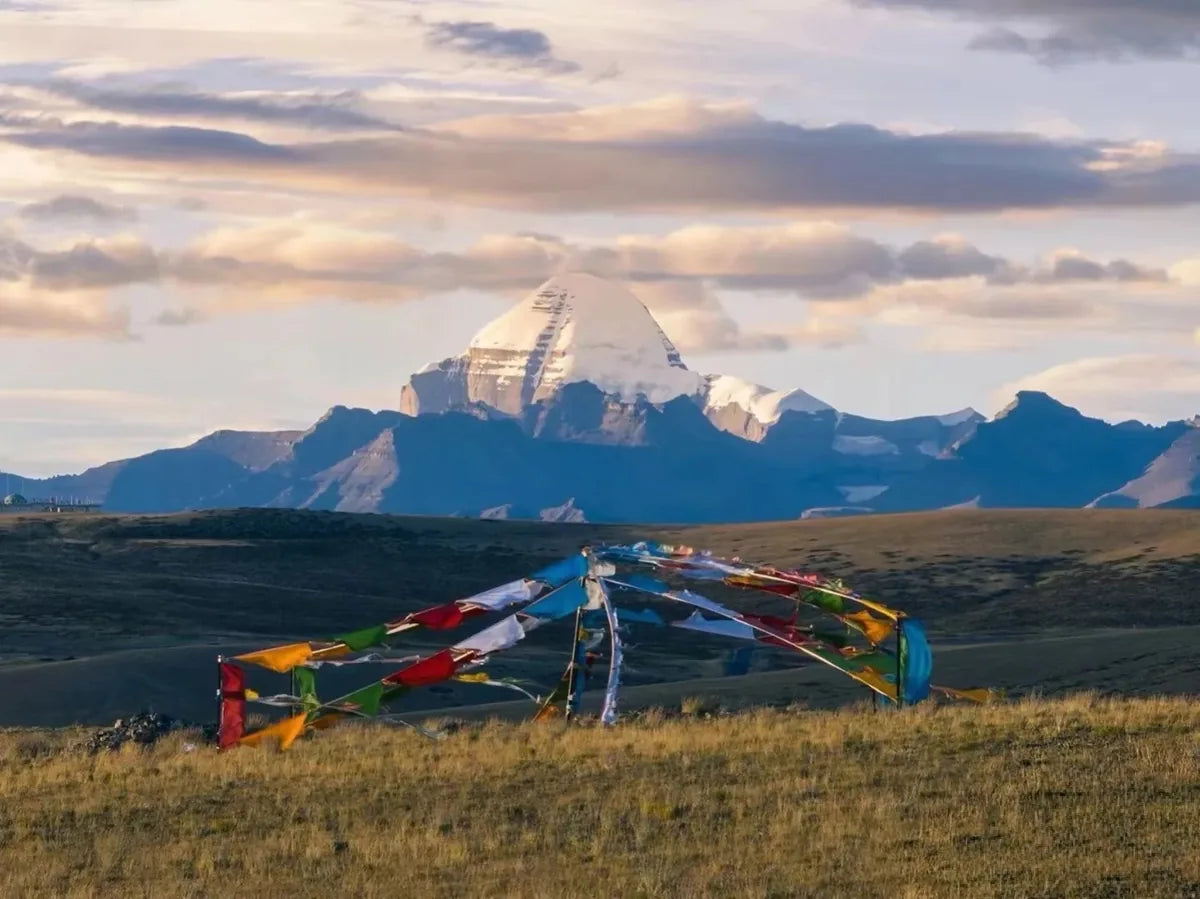
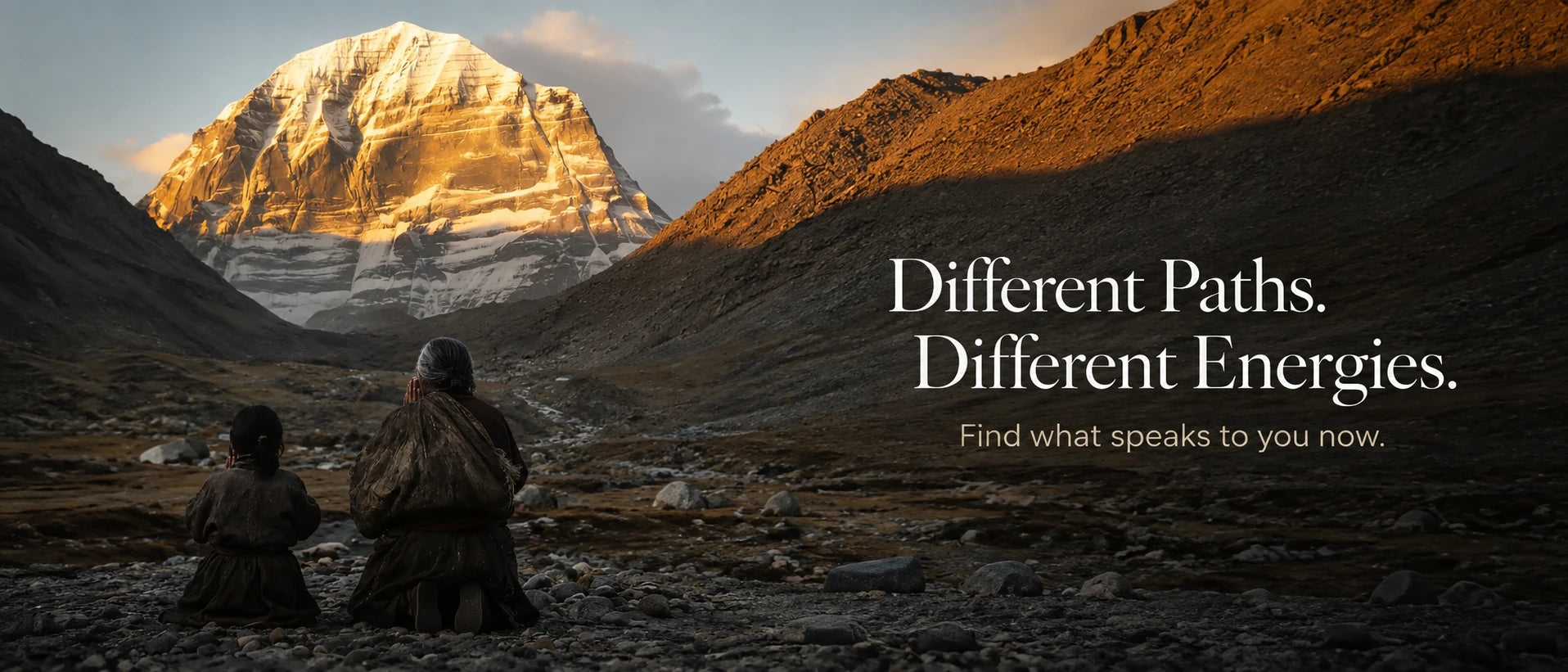


Mount Kailash rises in far western Tibet, but its importance cannot be explained by height or geology alone. For centuries, communities across the Himalayas and South Asia have approached the mountain as sacred geography: a landscape understood through cosmology, pilgrimage, story, ritual, and memory.
Tibetans commonly call the mountain Kang Rinpoche. Mount Kailash is revered in Tibetan Buddhism and Bön, and it is also sacred in Hindu and Jain traditions. These traditions do not assign the mountain one shared meaning. Its significance changes depending on the religious world through which a pilgrim understands it.
Quick Answer
Mount Kailash is a sacred mountain in western Tibet revered in Tibetan Buddhism, Bön, Hindu traditions, and Jainism. Its meanings differ among those traditions. Pilgrims encounter the mountain through sacred geography, circumambulation, prayer, narrative, and ritual rather than through a single universal explanation.
Where Is Mount Kailash?
Mount Kailash lies in the Ngari region of western Tibet, within a high-altitude landscape associated with major river systems and nearby Lake Manasarovar.
For pilgrims, the mountain is not simply a scenic destination. Paths, passes, monasteries, prostration sites, Mani stones, lakes, and remembered events transform the wider landscape into a network of meaningful places.
For the wider concept, see What Is Sacred Geography in Tibetan Buddhism?.
Why Is Mount Kailash Sacred in Tibetan Buddhism?
In Tibetan Buddhist cosmology and pilgrimage traditions, Mount Kailash belongs to an extraordinary sacred landscape and is associated with important narratives and tantric traditions. It is often connected with Mount Meru, the cosmic mountain described in Buddhist cosmology.
Tibetan stories also associate the region with teachers and religious encounters, including narratives concerning the yogi Milarepa and the Bön master Naro Bönchung. Such stories show that sacred landscape is shaped through communities, memory, and religious narrative—not simply the mountain's physical form.
Why Is Kailash Important in Bön?
Bön, a distinct Tibetan religious tradition with its own scriptures, rituals, teachers, and history, also regards Mount Kailash as a major sacred site. Bön pilgrimage traditions preserve their own narratives and ritual relationships with the mountain.
This is why describing Kailash only as “a Buddhist holy mountain” is incomplete.
Why Is Mount Kailash Sacred in Hindu Traditions?
For many Hindus, Mount Kailash is revered as the abode of Shiva and Parvati. The mountain is therefore connected with Hindu sacred geography and with religious narratives distinct from Tibetan Buddhist or Bön interpretations.
Hindu pilgrims may combine the journey to Kailash with visits to Lake Manasarovar and other sacred places in the region.
What Does Kailash Mean in Jain Traditions?
Jain sacred geography also connects the Kailash region with narratives concerning the first Tirthankara, Rishabhanatha, and the sacred mountain Ashtapada. Modern geographic identifications are discussed in different ways, so these traditions should not be collapsed into one oversimplified claim.

What Is Kora Around Mount Kailash?
Kora is the Tibetan term commonly used for circumambulation—moving around a sacred object, temple, monastery, mountain, or other revered place. The pilgrimage circuit around Mount Kailash is among the best-known examples.
Walking the route is physically demanding because of distance, altitude, and weather. Some pilgrims also perform full-body prostrations, extending the journey significantly. Religious traditions can differ in the direction and ritual details of circumambulation, another reminder that a shared path does not erase distinct beliefs.
Our dedicated guide What Is Kora? explores circumambulation, clockwise movement in Tibetan Buddhist practice, pilgrimage, and the relationship between body and sacred place.
Saga Dawa and Pilgrimage to Kailash
Mount Kailash pilgrimage becomes especially visible during Saga Dawa, an important period of Tibetan Buddhist commemoration and practice. Pilgrimage, kora, prostrations, generosity, prayer, scripture reading, and offerings can intensify during the sacred month.
Not every photograph or account of a Kailash pilgrim should automatically be labeled “Saga Dawa.” Sacred pilgrimage takes place in broader contexts throughout the year.
Why Walk Around a Mountain Instead of Climbing It?
Modern mountain culture often treats a summit as the goal. Sacred pilgrimage can organize movement differently. At Kailash, the mountain is approached through circumambulation rather than through a conventional summit narrative.
A pilgrim does not need to “conquer” a sacred mountain to form a relationship with it. Walking around it can express reverence, fulfill a vow, participate in religious merit, or create space for prayer and reflection depending on the tradition and practitioner.
Sacred Geography Is More Than Scenery
A photograph of Kailash can be visually extraordinary, but sacred geography includes layers that a photograph cannot show. A pass may be associated with transition. A rock may be remembered through a religious story. A monastery may connect a lineage to the landscape. A circuit becomes meaningful through countless repeated journeys.
This is why cultural interpretation should distinguish “beautiful Himalayan landscape” from “sacred place.” Beauty may attract a visitor; sacredness is produced and maintained through communities, narratives, practices, and inherited relationships.
Mani Stones and Sacred Routes
Along Tibetan pilgrimage landscapes, carved prayer stones can make religious practice visible within the terrain itself. Read What Are Mani Stones? for the relationship among carved mantra, pilgrimage, and sacred landscape.
Pilgrims and Modern Visitors
People reach the Kailash region for different reasons. Some travel as Buddhist, Bön, Hindu, or Jain pilgrims. Others come for cultural interest, photography, trekking, or personal reflection. These motivations can overlap, but they are not interchangeable.
A respectful visitor recognizes that the landscape is not an empty backdrop for adventure content. Prayer flags, prostrations, Mani stones, shrines, and pilgrim behavior belong to living traditions rather than to a cinematic set.
Mount Kailash in Kailora’s Cultural World
Mount Kailash is an important visual and cultural reference for Kailora because it brings together Himalayan landscape, pilgrimage, memory, and the idea of intention carried through movement. That is a contemporary brand interpretation—not a claim that Kailora jewelry reproduces the religious authority of the mountain.
For a concrete example of how Kailora keeps those layers separate, read the design story behind the Mount Kailash Stud Earrings, where the mountain’s visual form inspires contemporary jewelry without redefining its religious meaning.
Why Kailash Cannot Be Reduced to One Meaning
Asking “Why is Mount Kailash sacred?” has no single-answer solution because sacredness is tradition-specific. A Tibetan Buddhist pilgrim, a Bön practitioner, a Hindu devotee, and a Jain pilgrim can look at the same mountain through different cosmologies.
What they share is not one doctrine but a recognition that this landscape is more than ordinary terrain. The mountain becomes sacred through relationships between place, story, practice, and generations of people who continue to travel around it.
Cultural note: Mount Kailash is sacred to multiple religious traditions whose interpretations are related through geography but not interchangeable. This article provides a comparative cultural introduction rather than religious instruction.
Continue with the Kailora Tibetan Culture Guide for the wider cultural map.